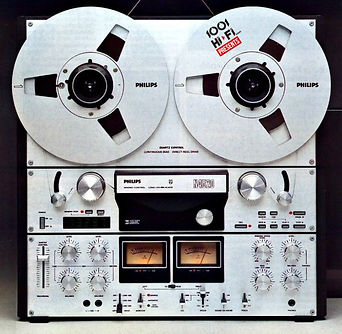
Brief History

Philips, a Dutch company, produced reel-to-reel tape recorders from 1950 to 1983, primarily manufactured in the Netherlands. During this period, Philips developed and marketed various models, catering to both professional and consumer markets.
In the early years, Philips focused on producing high-quality reel-to-reel recorders for professional use, such as broadcasting and music recording studios. These machines were designed to meet the demands of audiophiles and professionals, offering features like high-fidelity sound reproduction and advanced tape handling systems.
In the 1960s, Philips introduced consumer-oriented reel-to-reel tape recorders, making them more accessible to the general public. These models, like the EL-3400 (1964), used 1-inch tape and were larger and heavier due to their size. However, they still maintained high sound quality and were popular among home users and schools.
As the compact cassette (introduced by Philips in 1963) gained popularity, reel-to-reel tape recorders gradually lost ground in the consumer market. By the 1970s and 1980s, Philips focused primarily on producing professional-grade reel-to-reel recorders, such as the Nagra, which was renowned for its high-quality analog recordings.


Throughout its production run, Philips reel-to-reel tape decks were known for their durability, reliability, and excellent sound quality. Although they eventually gave way to newer formats like compact cassettes and digital recording technologies, Philips reel-to-reel tape decks remain a testament to the company’s commitment to innovation and audio excellence.
Philips’ early professional reel-to-reel recorders exhibited several key design innovations and technical advancements. Notably:
-
Solid-state circuits: The replacement of vacuum tubes with solid-state electronics improved reliability and reduced maintenance requirements.
-
Direct drive motors: This technology upgrade enhanced the stability and consistency of tape transport, resulting in better sound quality and reduced wear on the tape.
-
Frequency response improvements: Advancements in reel-to-reel design and manufacturing led to improved frequency response, making these recorders suitable for professional applications.
Philips’ early professional reel-to-reel recorders likely incorporated these technical advancements, positioning them as reliable and high-quality options for professional recording applications.