
AEG/Telefunken Tonschreiber B
AEG/Telefunken
Germany
Tape Deck Details
Number of Motors
3
Number of Heads
8
Head Configuration
Wow & Flutter
Signal-to-Noise [dB]
38
Dimensions [mm]
Weight [kg]
Year built
1939–1945
Head Composition
Equalization
Frequency Response
60 Hz – 5,000 Hz
Speed
Max Reel [inch]
Tracks
Price
User
Pro
Additional Information
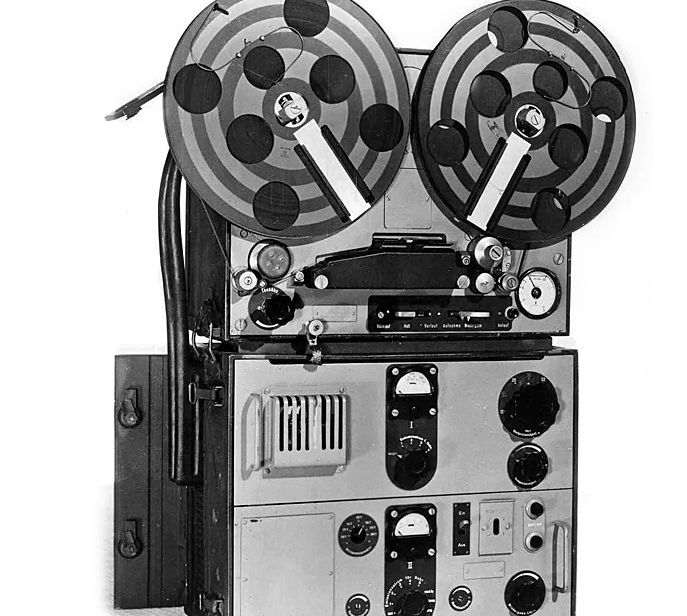
The AEG Tonschreiber B (also known as Tonschreiber b, Ton.S b, or Tonschreiber Berta / B1/B2 variants) is a World War II-era German military portable magnetic tape recorder, produced approximately 1939–1945 (manufactured by AEG, Allgemeine Elektricitäts-Gesellschaft, in Berlin, with some units associated with Telefunken due to wartime collaboration). It was a rugged, field-deployable "sound writer" (Tonschreiber = sound writer) derived from the pre-war civilian Magnetophon K-series (particularly the K4), adapted for Wehrmacht (German armed forces) use in intelligence, propaganda, interrogation, and field recording. The Tonschreiber B is one of the earliest production portable tape recorders, notable for its variable speed capability (including high-speed modes for compression/expansion of speech or Morse code) and modular design.
This was a full-track mono (Vollspur) recorder in standard configuration (single wide track for maximum signal strength), with some units featuring multi-head setups for special applications (e.g., rotating heads for pitch-preserving speed change). It used paper-based magnetic tape (BASF Type C or L, 6.5 mm wide) and DC bias/erase (no AC bias in most units—AC bias came later in civilian models).
Key Technical Specifications
Recording/Playback System — Full-track mono (Vollspur standard); records/plays in one direction (tape flip for reverse); mono compatible; basic overdub possible; variable speed head assembly in some units for pitch-preserving playback (compression/expansion).
Tape Speeds — Variable from 9 cm/s to 120 cm/s (3.54 ips to 47.24 ips); standard operational speeds often 19 cm/s (7.5 ips) or higher; high-speed mode up to 120 cm/s for compressing long messages (playback slowed down for decoding).
Tape Width — 6.5 mm (early standard; later 6.35 mm).
Tape Type — Paper carrier coated with iron oxide powder (BASF Type C early; Type L later—oxide facing outward; fragile paper base prone to tearing).
Reel Size — Special military reels or hubs (typically 10–15 cm diameter; designed for portability; some units used 2-hole bobbins).
Frequency Response — Approximately 60 Hz – 5,000 Hz (limited by wartime tape and DC bias; voice-intelligible range for military use; some sources cite 50–6000 Hz).
Dynamic Range / Signal-to-Noise Ratio — Around 38–45 dB (typical for DC-bias wartime machines; high noise and distortion).
Wow & Flutter — Moderate to high (mechanical variations in portable design; improved in later units).
Heads — Up to 8 heads in advanced variants (erase / record / replay + 4 replay heads for variable speed); standard: erase/record/replay; rotating multi-gap head assembly in Berta for pitch-preserving speed change.
Drive System — Three motors (capstan + two reels); capstan-driven with pinch roller; mechanical transport; modular suitcase design (transport unit separate from amps/speakers).
Electronics — Tube-based (typically 9 tubes, e.g., 7× RV12P2000 pentodes + 2× LS50 power tubes); DC bias/erase; basic amplification.
Amplification & Speakers — Separate amplifier unit; external headphones or speakers required (no built-in in transport unit).
Inputs — Microphone/line level (military connectors).
Outputs — Line level to amplifier; monitor via headphones or speakers.
Features —Variable speed recording/playback (9–120 cm/s).
Rotating head assembly (in Berta variant) for pitch-preserving speed change (compression for transmission, expansion for decoding).
Modular suitcase/portable design (transport + amplifier units).
Built-in testing features (common in German military gear).
Power — AC mains (110/125/145/165/190/220/250 V switchable) or field generator; consumption moderate.
Build & Dimensions — Rugged metal suitcase/portable design (transport unit large suitcase size); total weight very high (~30–40 kg+ for full system).
Manufacturing — Germany (AEG, Berlin); limited wartime production (mostly 1942–1945; serial numbers often below 1000 for b1 variants).
Performance & Legacy Context
The Tonschreiber B was a rugged military tool—optimized for field reliability, variable speed for intelligence (e.g., compressing long Morse or speech for transmission, expanding on reception without pitch change via rotating heads), and voice intelligibility (60–5000 Hz range sufficient for military use). It suffered from high noise, distortion (DC bias), and fragile paper tape, but proved the concept of portable magnetic recording in wartime.
Surviving examples are ultra-rare (mostly collector/museum pieces; some restored). They are prized for historical importance as one of the earliest portable tape recorders and military adaptations of the Magnetophon technology. Restorations are highly specialized (tube checks, DC bias circuit, fragile tape compatibility).
Common issues (historical/modern): Fragile paper tape (breaking/tearing), tube reliability, mechanical wow/flutter, high distortion/noise (DC bias), and head wear. Modern use requires careful tape selection (original paper tape fragile; plastic base better).
Compared to siblings:
Magnetophon K1–K6 — Pre-war civilian prototypes (DC bias).
Tonschreiber B — WWII military adaptation (variable speed, rotating heads in Berta).
K7 — 1941 AC-bias breakthrough (civilian).
Tonschreiber B — 1939–1945 military "sound writer" (DC bias, portable, variable speed).