
AEG/Telefunken Magnetophon 105
AEG/Telefunken
Germany
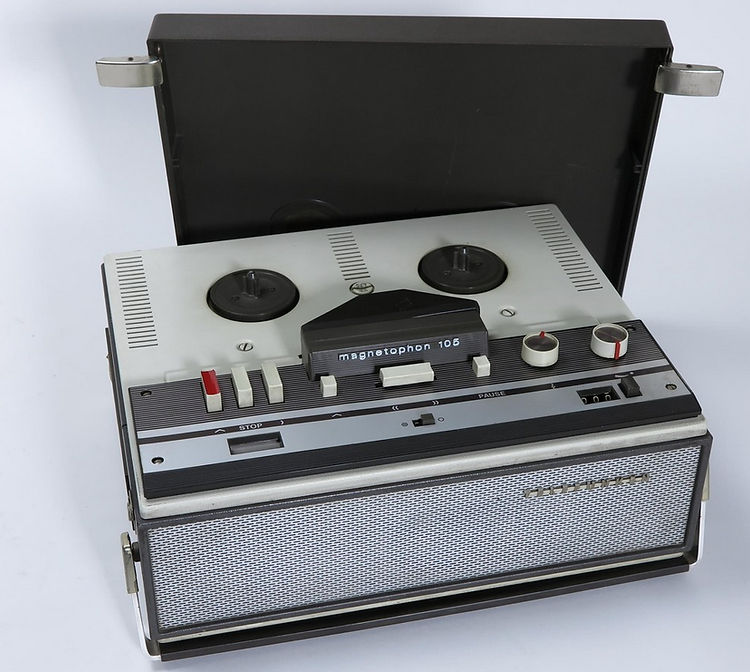
Tape Deck Details
Number of Motors
1
Number of Heads
2
Head Configuration
Stacked/Inline
Wow & Flutter
0.25–0.35%
Signal-to-Noise [dB]
45
Dimensions [mm]
380 × 165 × 300
Weight [kg]
10.6
Year built
1964–1967
Head Composition
Permalloy
Equalization
IEC
Frequency Response
60 Hz – 12,000
Speed
1⅞, 3¾
Max Reel [inch]
7
Tracks
1/2 Rec/PB
Price
User
Consumer
Additional Information
The AEG-Telefunken Magnetophon M105 (also marketed as Telefunken Magnetophon 105 or Magnetophon 105) is a mid-1960s consumer mono reel-to-reel tape recorder, produced approximately 1964–1967 (manufactured in Germany by Telefunken, with AEG branding on identical units due to shared distribution). It was a popular entry-to-mid-range portable/tabletop model in the Magnetophon KL-series (Koffer-Lautsprecher = suitcase with loudspeaker), designed for home recording (radio dubbing, microphone, phono/line) and playback. The M105 was fully tube-based, offering simple mono operation with integrated amplification and speaker for standalone convenience.
This was a 2-track (half-track) mono recorder (Zweispur), focused on ease of use and reliability rather than hi-fi stereo or advanced features.
Key Technical Specifications
Recording/Playback System — 2-track (half-track) mono; records/plays in one direction (tape flip for reverse); mono compatible; basic overdub possible.
Tape Speeds — Two speeds:1⅞ ips (4.75 cm/s)
3¾ ips (9.5 cm/s)
Reel Size — Up to 7 inches (15 cm or 18 cm max diameter in some listings; Spulen-Ø 15 cm standard).
Frequency Response (approximate):At 9.5 cm/s (3¾ ips): 60 Hz – 12,000–14,000 Hz (±3 dB)
At 4.75 cm/s (1⅞ ips): 60 Hz – 8,000–10,000 Hz Adequate for voice, speech, and basic music on small reels.
Wow & Flutter — Approximately 0.25–0.35% weighted (typical for single-motor tube consumer design).
Signal-to-Noise Ratio — Around 45–48 dB (standard for mid-1960s tube mono).
Heads — 2 heads: combined record/playback (permalloy) + erase head.
Drive System — Single motor (synchronous or induction type); belt/idler mechanism; mechanical brakes; fast wind/rewind.
Electronics — Tube-based (4 tubes: EF86 preamp, ECC83 phase inverter/driver, EL95 output, EM84 magic eye level indicator).
Amplification & Speakers — Built-in mono amplifier; internal elliptical loudspeaker (typically 5 × 3 inches); output power 2.5 W (unknown quality rating).
Inputs —Microphone (low-level).
Radio/line/phono (higher level).
DIN-style connectors.
Outputs —Line out.
Internal speaker.
Headphones possible.
Features —Magic eye level indicator (EM84).
Basic transport controls.
Portable/tabletop design with lid/handle.
Power — AC mains (multi-voltage switchable: 110/127/200/220/240 V); consumption moderate.
Build & Dimensions — Tabletop metal case; 380 × 165 × 300 mm (15 × 6.5 × 11.8 inches); weight 10.6 kg (23 lb 5.6 oz).
Manufacturing — Germany (Telefunken/AEG-Telefunken); original price ~499 DM (mid-1960s).
Performance & Legacy Context
The Magnetophon M105 was a practical mid-1960s mono consumer deck—offering two speeds, tube warmth, and integrated amp/speaker for convenience. It delivered decent clarity for radio dubbing, voice recording, or basic music at 3¾ ips, with acceptable dynamics for its price point. The tube electronics (including magic eye) provided a classic sound signature, though limited by mono and lower speeds compared to later stereo models.
Common issues today: Tube aging (preamp/output stages weak/noisy), electrolytic capacitor drying/leakage, belt/idler hardening, dirty heads, mechanical wear, and magic eye failure. Restorations are common (tube replacement, recap, alignment); service info available (Radiomuseum, collector sites; German schematics common).
Compared to siblings:
Magnetophon M105/M106 — Hybrid tube/transistor mono models (M105 half-track, M106 quarter-track variant).
M55/M23/M302 — Similar mid-1960s mono portables (battery/AC focus).
Higher models (M207/M230) — Stereo, three-head, three-speed.
M105 — Mid-range mono tabletop with tube electronics and magic eye.