
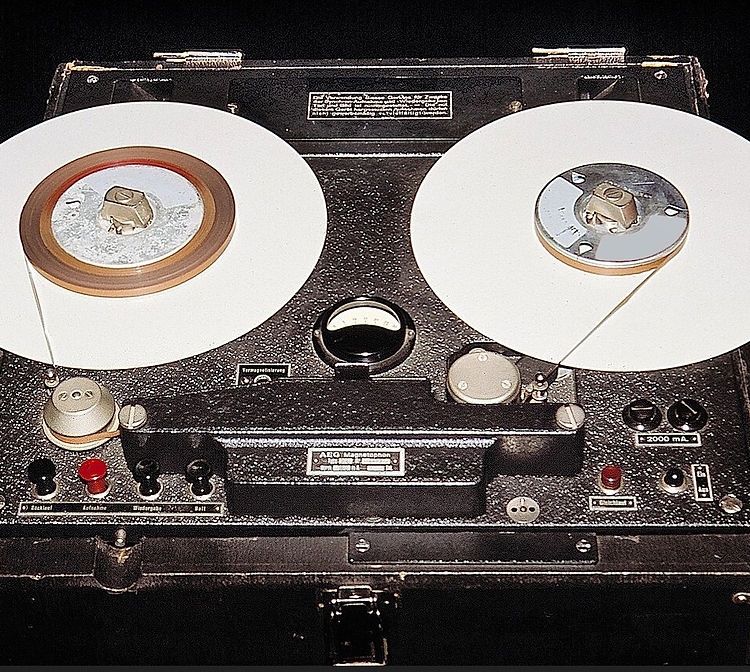
AEG/Telefunken Magnetophon K4
AEG/Telefunken
Germany
Tape Deck Details
Number of Motors
3
Number of Heads
3
Head Configuration
Wow & Flutter
Signal-to-Noise [dB]
38
Dimensions [mm]
Weight [kg]
40
Year built
1938
Head Composition
Equalization
Frequency Response
50 Hz – 6,500 Hz
Speed
30
Max Reel [inch]
Tracks
Price
User
Pro
Additional Information
The AEG Magnetophon K4 (often labeled Magnetophon K4 or K 4) is a late 1930s pre-WWII portable magnetic tape recorder, introduced in 1938 (manufactured in Germany by AEG, Allgemeine Elektricitäts-Gesellschaft, in Berlin). It was an improved successor in the Magnetophon "K" series (Koffer = suitcase/portable), building on the K1 (1935 prototype) and K2/K3 (1936–1937). The K4 was AEG's first commercially successful tape recorder, designed for portability and broadcast/field use, with a rugged suitcase-style enclosure. It used paper-based magnetic tape coated with iron oxide (Type C or early Type L from BASF) and DC bias/erase (no AC bias yet—AC bias was introduced later in 1941 with the K7).
The K4 marked a significant step toward practical tape recording, offering better reliability and portability than earlier prototypes. Surviving originals are extremely rare (mostly museum pieces or reconstructions); many were used during WWII and post-war (some modified or rebuilt in the 1940s–1950s).
Key Technical Specifications
Recording/Playback System — Mono (single-track); direct magnetic recording on coated paper tape; no stereo (early mono only); basic erase/record/play functions.
Tape Speed — 77 cm/s (30 ips or approximately 76–77 cm/s standard for European broadcast studios; some sources cite 100 cm/s in earlier K-series, reduced for practicality).
Tape Width — 6.5 mm (early standard; later 6.35 mm).
Tape Type — Paper carrier coated with iron oxide powder (BASF Type C early; Type L later—homogeneous or cast oxide); oxide facing outward.
Reel Size — Large reels (up to ~30 cm diameter in early demos); recording time ~20–22 minutes per reel at 77 cm/s.
Frequency Response — Approximately 50 Hz – 6,500 Hz (or up to 6,000–7,000 Hz; limited by tape and DC bias).
Dynamic Range — ~38 dB (early estimates; limited headroom and high distortion without AC bias).
Wow & Flutter — Prone to variations (early K4 models suffered from mechanical wow/flutter; improved in later refinements).
Signal-to-Noise Ratio — Poor by modern standards (~ -35 dB estimated; high hiss and background noise).
Heads — Ring-shaped magnetic heads (miniature electromagnetic armatures with laminated cores); gaps: erase ~0.5 mm, record ~40 microns (front) / 0.3 mm (rear), playback ~20 microns.
Drive System — Three motors (capstan + two reels); capstan-driven with pinch roller; mechanical transport; modular suitcase design (transport unit separate from amps/speakers).
Electronics — Tube-based (typically 6 tubes: EF12 ×2, AH1, AF7, AL4, AZ1); audio amplification; DC bias/erase current.
Amplification & Speakers — Separate amplifier suitcase required; external speakers needed (no built-in in transport unit).
Inputs — Microphone/line level (basic connectors for broadcast/radio use).
Outputs — Line level to amplifier; monitor via headphones or speakers.
Features — Basic transport controls; modular three-suitcase system (transport, amplifiers, speakers); no VU meters in earliest versions.
Power — AC mains (220 V standard; multi-voltage in some units); consumption moderate.
Build & Dimensions — Portable suitcase/portable design (transport unit large suitcase size); total weight very high (professional/portable broadcast prototype, ~40 kg or more for full system).
Manufacturing — Germany (AEG, Berlin); early production (limited units; first commercially successful model).
Performance & Legacy Context
The Magnetophon K4 was a breakthrough as AEG's first commercially viable tape recorder—offering portability, lower cost than steel-tape systems, and sufficient fidelity for radio broadcast and archiving. It achieved ~50–6500 Hz response and ~38 dB dynamic range with DC bias/erase, though early recordings had noticeable distortion, hiss, and limited bandwidth. The K4's rugged suitcase design made it suitable for field use, and it influenced wartime Tonschreiber models.
Surviving examples are ultra-rare (mostly reconstructions or post-war rebuilds); originals were used extensively pre- and during WWII. It directly led to AC bias improvements in the K7 (1941) and post-war Magnetophon models. The technology was captured by Allies and influenced Ampex, 3M, and others.
Common issues (historical): Fragile paper tape (breaking), mechanical wow/flutter, tube reliability, high distortion/noise (DC bias), and tape wear. No widespread modern restorations due to rarity.
Compared to siblings:
Magnetophon K1 — 1935 prototype (similar speed, fewer refinements).
K2/K3 — 1936–1937 early commercial variants.
K7 — 1941 model (introduced AC bias for major quality jump).
K4 — 1938 first commercially successful (77 cm/s, DC bias, paper tape).