
AEG/Telefunken Magnetophon K8
AEG/Telefunken
Germany
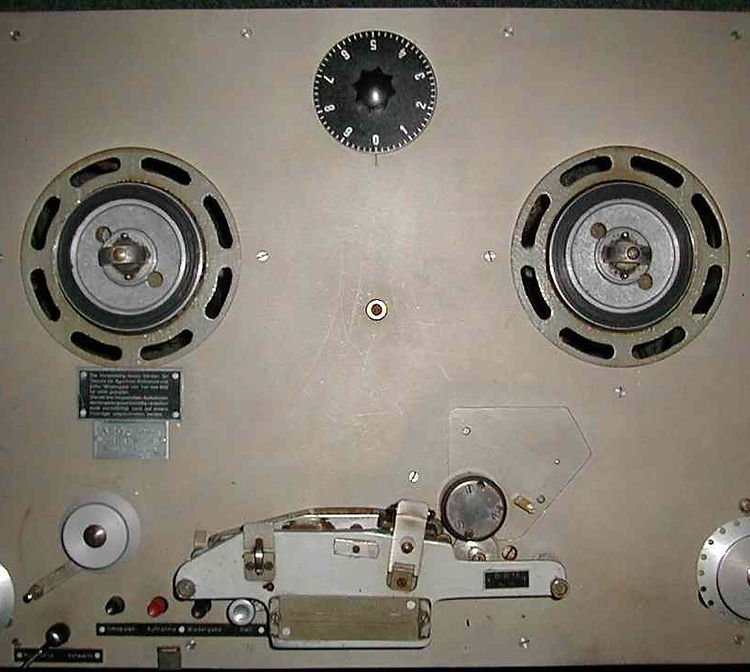
Tape Deck Details
Number of Motors
3
Number of Heads
3
Head Configuration
Wow & Flutter
Signal-to-Noise [dB]
50
Dimensions [mm]
Weight [kg]
Year built
1947–1950
Head Composition
Permalloy
Equalization
Frequency Response
40–50 Hz – 10,000–15,000 Hz
Speed
30
Max Reel [inch]
Tracks
Price
User
Pro
Additional Information
The AEG Magnetophon K8 (often labeled Magnetophon K8 or K 8) is a post-WWII professional/studio reel-to-reel tape recorder, produced approximately 1947–1950 (manufactured in Germany by AEG, Allgemeine Elektricitäts-Gesellschaft, with some units under Telefunken branding). It was a direct successor to wartime models (e.g., Tonschreiber) and one of the first post-war Magnetophon production machines, incorporating refinements from the pre-war K-series and wartime experience. The K8 was a full-track (Vollspur) mono recorder optimized for broadcast and professional use, with interchangeable head carriers (Kopfträger) for flexibility, open 30 cm reels, and high tape speed.
This was a full-track mono (Vollspur) machine (single wide track for maximum signal strength), designed for studio/broadcast applications with robust construction and modular components.
Key Technical Specifications
Recording/Playback System — Full-track mono (Vollspur); records/plays in one direction (tape flip for reverse); mono compatible; basic overdub possible; interchangeable head carrier (Kopfträger) for different configurations.
Tape Speed — 76 cm/s (30 ips) — standard high-speed broadcast/professional speed for maximum fidelity.
Tape Width — 6.35 mm (standard post-war).
Tape Type — Paper-based with iron oxide coating (BASF Type L or improved wartime types; later plastic base in post-war use).
Reel Size — Open reels up to 30 cm (12 inches) diameter.
Frequency Response — Approximately 40–50 Hz – 10,000–15,000 Hz (typical for 76 cm/s with AC bias; improved over pre-war models due to better tape and electronics).
Dynamic Range / Signal-to-Noise Ratio — Around 50–60 dB (strong for the era with AC bias and full-track configuration).
Wow & Flutter — Low for the time (synchronous motor and mechanical improvements reduced variations compared to wartime models).
Heads — Interchangeable head carrier; typically 3 heads (record, playback, erase); permalloy or similar.
Drive System — Three motors (capstan + two reels); capstan-driven with pinch roller; mechanical transport; modular suitcase design (transport, amps, speakers).
Electronics — Tube-based (13 tubes reported in some units, e.g., EF12 ×2, EF14, EL11, AZ11); audio amplification; AC bias/erase circuit (key post-war improvement).
Amplification & Speakers — Separate amplifier unit required; external speakers needed (no built-in in transport unit).
Inputs — Microphone/line level (broadcast connectors).
Outputs — Line level to amplifier; monitor via headphones or speakers.
Features — Basic transport controls; interchangeable head carrier; modular system (transport, amplifiers, speakers); no VU meters in earliest versions (later added).
Power — AC mains (220 V standard; multi-voltage in some units); consumption moderate.
Build & Dimensions — Portable/semi-fixed suitcase design (transport unit large suitcase size); total weight very high (~40 kg+ for full system).
Manufacturing — Germany (AEG, Berlin); limited production (post-war broadcast/military focus).
Performance & Legacy Context
The Magnetophon K8 was a major step forward in post-WWII tape recording—retaining the high-speed 76 cm/s format for broadcast fidelity, with AC bias providing much lower distortion and noise than pre-war DC-bias models. It offered excellent dynamic range and clarity for radio archiving and professional use, with full-track configuration maximizing signal strength. The interchangeable head carrier allowed flexibility (e.g., different gaps or configurations).
Surviving examples are rare (mostly collector or museum pieces; some restored and demonstrated in videos). They are prized for historical importance as one of the first post-war production Magnetophons, influencing the transition to plastic-tape models and transistor designs. Restorations are specialized (tube checks, bias circuit, tape compatibility with modern tape).
Common issues (historical/modern): Fragile early tape (paper base), tube reliability, mechanical wow/flutter (improved over wartime), and head wear. Modern use requires careful tape selection (original paper tape fragile; plastic base better).
Compared to siblings:
Magnetophon K1–K6 — Pre-war prototypes (DC bias, higher distortion).
K7 — 1941 AC-bias breakthrough (K8 as post-war evolution).
K8 — 1947–1950 post-war production model (76 cm/s, AC bias, full-track mono).
Later models — Transistorized consumer decks (M-series).