
AEG/Telefunken Magnetophon M2000
AEG/Telefunken
Germany
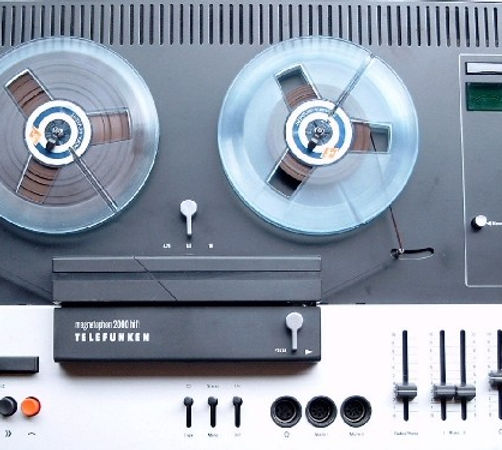
Tape Deck Details
Number of Motors
1
Number of Heads
2
Head Configuration
Stereo
Wow & Flutter
0.15%
Signal-to-Noise [dB]
50
Dimensions [mm]
530 × 155 × 350
Weight [kg]
15
Year built
1974–1977
Head Composition
Permalloy
Equalization
IEC
Frequency Response
40 Hz – 16,000–18,000 Hz
Speed
3¾, 7½
Max Reel [inch]
7
Tracks
1/4 Rec/PB
Price
User
Consumer
Additional Information
The AEG-Telefunken Magnetophon M2000 (also known as Magnetophon 2000 HiFi or M 2000 HiFi) is a mid-1970s consumer stereo reel-to-reel tape recorder, produced approximately 1974–1977 (manufactured in Germany by Telefunken under the AEG-Telefunken brand). It was a mid-range hi-fi model in the Magnetophon line, positioned as an economy version of the more sophisticated M3000 HiFi, with cost-saving measures such as a single motor (instead of two or three) and two heads (instead of three). The M2000 emphasized affordability, stereo capability, and integrated amplification for home use, making it accessible to enthusiasts during the declining years of consumer open-reel production.
This was a 4-track (quarter-track) stereo recorder with mono compatibility, designed for domestic recording (radio, microphone, phono/line inputs) and playback, with push-button controls and basic stereo monitoring.
Key Technical Specifications
Recording/Playback System — 4-track (quarter-track), 2-channel stereo/mono compatible; records and plays stereo on tracks 1-4 forward and 3-2 reverse (manual tape flip required); mono compatible; basic overdub/sound-on-sound possible.
Tape Speeds — Three speeds:1⅞ ips (4.75 cm/s)
3¾ ips (9.5 cm/s)
7½ ips (19 cm/s)
Reel Size — Up to 7 inches (18 cm) maximum diameter.
Frequency Response (approximate, typical tolerances; varies by tape/condition):At 7½ ips: 40 Hz – 16,000–18,000 Hz
At 3¾ ips: 40 Hz – 12,000–14,000 Hz
At 1⅞ ips: 40 Hz – 8,000–10,000 Hz Respectable hi-fi performance at higher speeds for a mid-1970s consumer deck.
Wow & Flutter — Approximately 0.15–0.25% at 7½ ips (good for single-motor design; typical consumer level).
Signal-to-Noise Ratio — >50 dB at 7½ ips (standard for transistor era with low-noise tape).
Heads — 2 heads: combined record/playback (permalloy) + erase head (no separate playback head for off-tape monitoring).
Drive System — Single motor (synchronous type); belt/idler drive; mechanical brakes; fast wind/rewind.
Electronics — Fully transistorized (19 transistors); printed circuit board amplifier.
Amplification & Speakers — Built-in stereo amplifiers; output for headphones or external amp (no internal speakers in most configs; line out for hi-fi integration).
Inputs —Microphone (low-level).
Radio/line/phono (higher level).
DIN-style connectors standard.
Outputs —Line out (~1 V).
Headphones (monitor).
External amp/speakers.
DIN-style.
Features —Twin VU meters or level indicators (active for record/playback).
Push-button controls (relay-driven in some units).
Portable/tabletop design with lid/handle.
Power — AC mains (multi-voltage switchable: 110/127/220/240 V); consumption moderate (~50–80 W).
Build & Dimensions — Tabletop case (often silver/black with plastic/metal finish); 530 × 155 × 350 mm (20.9 × 6.1 × 13.8 inches); weight 15 kg (33 lb).
Manufacturing — Germany (Telefunken/AEG-Telefunken).
Performance & Legacy Context
The Magnetophon M2000 was a practical mid-1970s consumer deck—offering three speeds, transistor reliability, and stereo capability at a lower price point than three-head/three-motor siblings like the M3000. It delivered decent stereo imaging and clarity at 7½ ips for radio dubbing or home music recording, with acceptable dynamics for its era and cost-saving design. The single-motor and two-head setup limited wow/flutter and monitoring compared to pro or higher-end models, but it provided good value for entry-to-mid-level hi-fi users.
Common issues today: Belt/idler degradation (goo/melting—kits needed), dried electrolytic capacitors, transistor aging, dirty heads (alignment critical), worn idler tires/clutches, and mechanical wear. Restorations are straightforward—many units revive well for vintage consumer use. Service manuals scarce (mostly German originals via Radiomuseum or collector sites; some shared online).
Compared to siblings:
Magnetophon M3000 — Higher-end sibling (three-head, three-motor, more refined).
M2000 — Economy version (single motor, two heads, cost-reduced).
Earlier models (M207/M230/M250) — Similar mid-range stereo but often three-head.
M2000 — Mid-range consumer tabletop with three-speed stereo focus and single-motor simplicity.