
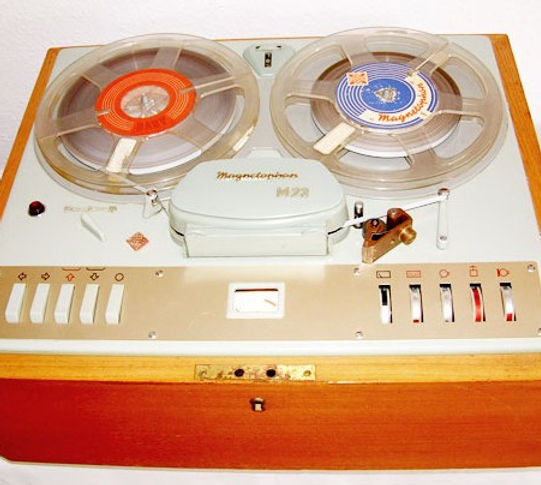
AEG/Telefunken Magnetophon M23
AEG/Telefunken
Germany
Tape Deck Details
Number of Motors
Number of Heads
Head Configuration
Wow & Flutter
Signal-to-Noise [dB]
Dimensions [mm]
530 x 270 x 530
Weight [kg]
30
Year built
1957-1958
Head Composition
Equalization
Frequency Response
Speed
7½, 15
Max Reel [inch]
Tracks
1/4 Rec/PB
Price
User
Pro
Additional Information
The AEG-Telefunken Magnetophon M23 is a legendary piece of German engineering from the mid-1960s. Positioned as a "semi-professional" or high-end studio machine, it sits comfortably between the consumer-grade Magnetophons and the massive M10/M15 broadcast consoles.
It is best known for its robust mechanical build and its role as a bridge between the tube (valve) era and the transistor era. It was designed as a high-end studio recorder without a built-in power amplifier (the "ohne Endstufe" variant). The M23 was designed for reliability and ease of maintenance, featuring a modular internal layout.
Key Specifications
Dimensions and Weight: Measures 530 x 270 x 530 mm (WHD) and weighs 30 kg, built as a chassis for integration into larger systems.
Drive and Tracks: Supports dual speeds of 9.5 cm/s (3¾ ips) and 19 cm/s (7½ ips), with interchangeable head blocks for full-track mono, 2-track, or 4-track operation; handles up to 22 cm (8.7-inch) reels.
Power: AC 110-237V operation, using 9 tubes for audio amplification in preamp stages.
Design: Intended for headphones or external amp connection, emphasizing precise tape handling for broadcast or studio use.
Performance Notes
It was priced at 1,390 DM upon release around 1957-1958, reflecting its robust build for demanding environments.
The M23 belongs to Telefunken's early Magnetophon series, evolving from WWII-era innovations into consumer-pro audio gear with switchable track formats for versatility.
Like the related M205, it prioritizes tape stability over consumer frills, appealing to audiophiles restoring vintage hi-fi setups.