
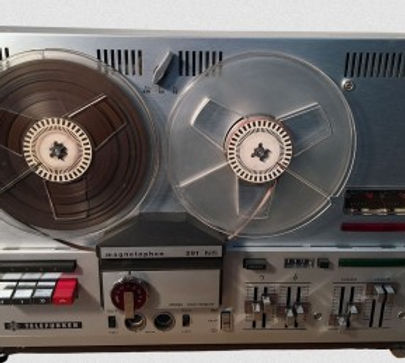
AEG/Telefunken Magnetophon M291
AEG/Telefunken
Germany
Tape Deck Details
Number of Motors
3
Number of Heads
3
Head Configuration
Stereo
Wow & Flutter
0.1%
Signal-to-Noise [dB]
55
Dimensions [mm]
460 × 360 × 200
Weight [kg]
14
Year built
1973–1977
Head Composition
Permalloy
Equalization
IEC
Frequency Response
30–40 Hz – 18,000–20,000 Hz
Speed
1⅞, 3¾, 7½
Max Reel [inch]
7
Tracks
1/4 Rec/PB
Price
User
Consumer
Additional Information
The AEG-Telefunken Magnetophon M291 (also known as Magnetophon 291 or M 291) is a mid-1970s consumer stereo reel-to-reel tape recorder, produced approximately 1973–1977 (manufactured in Germany by Telefunken under the AEG-Telefunken brand). It was one of the higher-end models in the final generation of Magnetophon consumer open-reel decks before the format was largely discontinued in favor of cassettes. The M291 was positioned as a premium domestic hi-fi machine with full stereo capability, three-head monitoring, three-motor drive, and integrated stereo amplification—making it one of the most capable consumer open-reel recorders AEG-Telefunken ever produced for the home market.
This was a 4-track (quarter-track) stereo recorder with mono compatibility, designed for serious home recording (radio, microphone, phono/line inputs) and high-quality playback, featuring off-tape monitoring, sound-on-sound overdubbing, and built-in speakers for immediate stereo listening.
Key Technical Specifications
Recording/Playback System — 4-track (quarter-track), 2-channel stereo/mono compatible; records and plays stereo on tracks 1-4 forward and 3-2 reverse (manual tape flip required); mono compatible; sound-on-sound/multiplay overdub facilities.
Tape Speeds — Three speeds:1⅞ ips (4.75 cm/s)
3¾ ips (9.5 cm/s)
7½ ips (19 cm/s)
Reel Size — Up to 7 inches (18 cm) maximum diameter.
Frequency Response (approximate, typical tolerances; varies by tape/condition):At 7½ ips: 30–40 Hz – 18,000–20,000 Hz
At 3¾ ips: 40 Hz – 15,000 Hz
At 1⅞ ips: 40 Hz – 10,000 Hz Very good hi-fi extension at higher speeds for a late consumer deck.
Wow & Flutter — ≤0.10% at 7½ ips; ≤0.15% at 3¾ ips; ≤0.30% at 1⅞ ips (excellent stability from three-motor design).
Signal-to-Noise Ratio — >55 dB at 7½ ips (strong for transistor era with low-noise tape).
Heads — 3 heads: separate record, playback, and erase (permalloy; enables real-time off-tape monitoring/A-B comparison).
Drive System — Three motors (1 × synchronous capstan motor + 2 × reel motors); belt/idler drive to capstan; mechanical or electronic tension control; fast wind/rewind; precise braking.
Electronics — Fully transistorized; printed circuit board amplifier.
Amplification & Speakers — Built-in stereo amplifiers; dual internal loudspeakers; output power sufficient for monitoring/room filling (typically 3–6 W per channel).
Inputs —Microphone: low-level (~0.2 mV).
Radio/line/phono: higher level (~100–200 mV).
DIN-style connectors standard.
Outputs —Line out: ~1 V / 20–50 kΩ.
Headphones (monitor).
External speakers or amp.
DIN-style.
Features —Twin illuminated VU meters (needle type; active for record/playback).
Off-tape monitoring (source/tape switch).
Pause function.
Portable/tabletop design with lid/handle; vertical/horizontal orientation possible.
Power — AC mains (multi-voltage switchable, e.g., 110–240 V); consumption ~70–100 W.
Build & Dimensions — Tabletop case (often silver/grey with wood accents); approx. 460 × 360 × 200 mm (18.1 × 14.2 × 7.9 inches); weight ~12–14 kg.
Manufacturing — Germany (Telefunken/AEG-Telefunken).
Performance & Legacy Context
The Magnetophon M291 was one of AEG-Telefunken's most refined consumer open-reel decks in the mid-1970s—offering three-head monitoring, three-motor stability, three speeds (including usable 7½ ips for music), and integrated stereo amp/speakers for convenience. It delivered clear stereo imaging, good dynamics, low noise, and respectable extension at higher speeds when aligned and used with quality tape. The transistorized design provided excellent reliability and low background noise.
Common issues today: Belt/idler degradation (goo/melting—multiple belts need replacement kits), dried electrolytic capacitors, transistor aging, dirty heads (3-head alignment critical), worn idler tires/clutches, and mechanical adjustments. Restorations are common and highly effective—many examples perform exceptionally well post-service. Service/user manuals available (HiFi Engine, Elektrotanya—includes schematics and alignment; German/English versions).
Compared to siblings:
Magnetophon M207/M230 — Very similar (often considered close predecessors; M291 may have minor refinements in electronics or cosmetics).
Magnetophon M203/M205/M212 — Lower-range models (often 2-head or fewer speeds).
M291 — Mid-to-high-range consumer portable with 3-head, three-motor, three-speed stereo focus.