
AEG/Telefunken Magnetophon M300
AEG/Telefunken
Germany
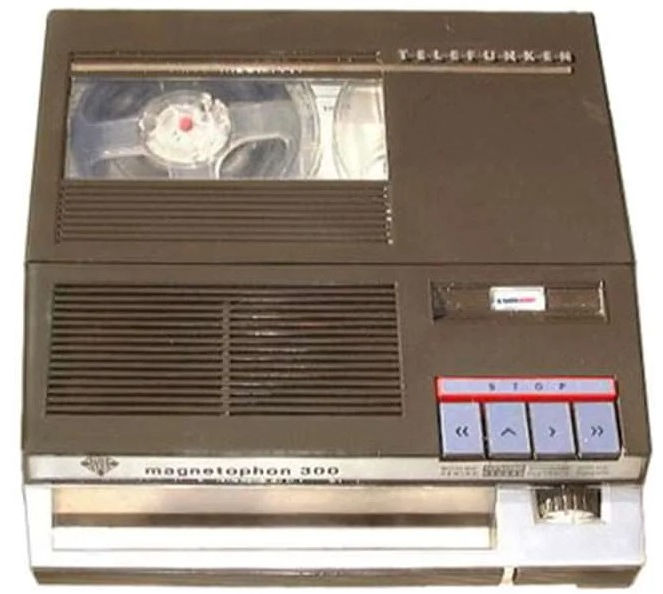
Tape Deck Details
Number of Motors
1
Number of Heads
2
Head Configuration
Half-track-mono
Wow & Flutter
0.3%
Signal-to-Noise [dB]
46
Dimensions [mm]
273 × 77 × 277
Weight [kg]
3.6
Year built
1965–1968
Head Composition
Permalloy
Equalization
IEC
Frequency Response
40 Hz – 14,000 Hz
Speed
3¾
Max Reel [inch]
5
Tracks
1/2 Rec/PB
Price
User
Consumer
Additional Information
The AEG-Telefunken Magnetophon M300 (also known as Magnetophon 300 or M 300) is a mid-1960s portable mono reel-to-reel tape recorder, produced approximately 1965–1968 (manufactured in Germany by Telefunken under the AEG-Telefunken brand following the 1967 merger). It was a compact, lightweight consumer/battery-operated model in the Magnetophon line, designed for portable recording (e.g., field use, dictation, or home applications) with a sturdy metal frame protecting internal components.
The M300 emphasized portability, battery/AC operation, and simple mono recording/playback—typical of mid-1960s entry-level open-reel machines before the widespread shift to stereo and higher-end models.
This was a half-track (2-track) mono recorder (some sources confirm quarter-track variants or mono compatibility), focused on convenience and reliability in a small form factor.
Key Technical Specifications
Recording/Playback System — Half-track (2-track) mono; records/plays in one direction (tape flip for reverse); mono compatible; basic overdub possible.
Tape Speeds — Single speed:3¾ ips (9.5 cm/s)
Reel Size — Maximum 5 inches (13 cm) diameter (compact for portability).
Frequency Response (approximate):At 9.5 cm/s: 40 Hz – 14,000 Hz (±3 dB) Adequate for voice and basic music on small reels.
Wow & Flutter — Better than 0.3% weighted (respectable for portable single-motor design).
Signal-to-Noise Ratio — Better than 46 dB (typical for mid-1960s transistor mono portable).
Heads — 2 heads: combined record/playback (permalloy) + erase head.
Drive System — Single motor (capstan drive); belt or idler mechanism; mechanical brakes; fast wind/rewind (~3 minutes for full 5" reel with 885 ft tape).
Electronics — Fully transistorized (10 transistors + 1 diode); printed circuit board amplifier.
Amplification & Speakers — Built-in mono amplifier; internal permanent magnet dynamic loudspeaker (elliptical); output power ~1 W (push-pull).
Inputs —Microphone.
Radio/line/pick-up.
DIN-style connectors.
Outputs —Line out.
Internal speaker.
Headphones possible.
Power — Batteries (5 × 1.5 V = 7.5 V) or external AC adapter/charger; also compatible with 12 V car adapter in some configs.
Build & Dimensions — Portable metal-framed case; 273 × 77 × 277 mm (10.7 × 3 × 10.9 inches); weight 3.1–3.6 kg (lightweight for portability).
Manufacturing — Germany (Telefunken/AEG-Telefunken).
Performance & Legacy Context
The Magnetophon M300 was a practical mid-1960s portable mono deck—offering single-speed operation, transistor reliability, and battery/AC flexibility for field or home use. It delivered decent clarity for voice/journalism or basic music dubbing at 3¾ ips on small reels, with acceptable dynamics for the price point. As a mono portable, it prioritized convenience over hi-fi stereo performance.
Common issues today: Belt/idler hardening, dried electrolytic capacitors, transistor aging, dirty heads, mechanical wear (especially on portable transport), and battery compartment corrosion (if stored with old cells). Restorations are straightforward—many units revive well for vintage portable charm. Service manuals available (Radiomuseum, Elektrotanya—German originals with schematics and alignment).
Compared to siblings:
Magnetophon 300 series — Compact mono portables (M300 as entry-level model).
Higher models (e.g., M207/M230) — Stereo, three-head, three-speed.
M300 — Battery-powered mono portable with single-speed focus.