
AEG/Telefunken Magnetophon M77
AEG/Telefunken
Germany
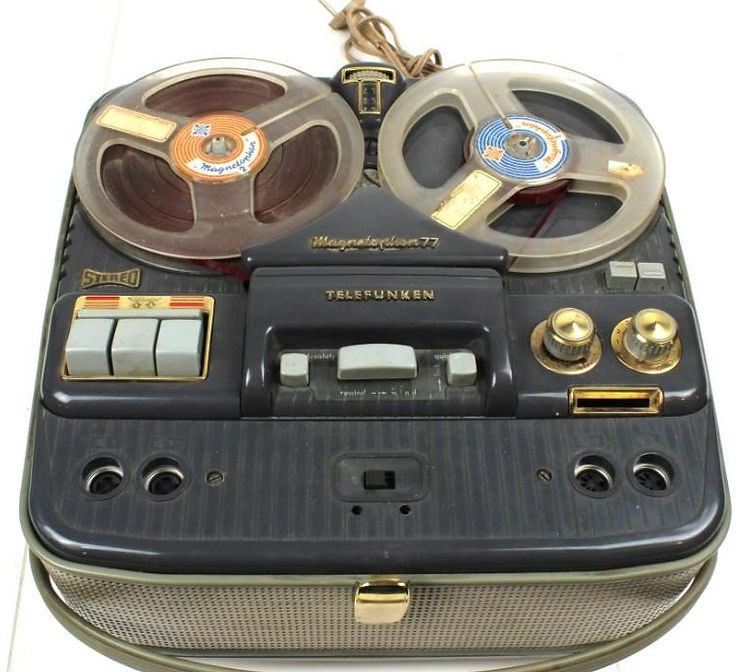
Tape Deck Details
Number of Motors
1
Number of Heads
3
Head Configuration
Stacked/Inline
Wow & Flutter
0.2%
Signal-to-Noise [dB]
45
Dimensions [mm]
400 × 300 × 150
Weight [kg]
10
Year built
1959–1963
Head Composition
Permalloy
Equalization
IEC
Frequency Response
40–50 Hz – 15,000–18,000 Hz
Speed
3¾, 7½
Max Reel [inch]
5
Tracks
1/4 Rec/PB
Price
User
Consumer
Additional Information
The AEG-Telefunken Magnetophon M77 (also known as Magnetophon 77 or M77) is a late 1950s to early 1960s consumer stereo reel-to-reel tape recorder, produced approximately 1959–1963 (manufactured in Germany by Telefunken, with AEG-Telefunken branding appearing on later or export units after the 1967 merger). It holds historical significance as Telefunken's first full stereo tape recorder, introducing quarter-track stereo recording to their consumer line while retaining tube-based electronics for warmth and dynamics. The M77 was a compact, high-end portable/tabletop model for its time, expensive (around 699 DM new), and relatively rare due to limited sales compared to its mono siblings (M74/M75/M76).
This was a 4-track (quarter-track) stereo recorder (vierspur-stereo), with hybrid tube/transistor electronics in some channels, aimed at audiophiles seeking stereo capability in a domestic format.
Key Technical Specifications
Recording/Playback System — 4-track (quarter-track), 2-channel stereo/mono compatible; records and plays stereo on tracks 1-4 forward and 3-2 reverse (manual tape flip required); mono compatible; sound-on-sound/multiplay overdub facilities.
Tape Speeds — Two speeds:3¾ ips (9.5 cm/s)
7½ ips (19 cm/s)
Reel Size — Up to 7 inches (18 cm) maximum diameter.
Frequency Response (approximate, typical tolerances):At 7½ ips: 40–50 Hz – 15,000–18,000 Hz
At 3¾ ips: 50 Hz – 12,000–14,000 Hz Respectable stereo extension for late 1950s/early 1960s consumer deck.
Wow & Flutter — Approximately 0.2–0.3% at 7½ ips (good for era's design).
Signal-to-Noise Ratio — Around 45–50 dB (typical for tube/transistor hybrid stereo).
Heads — 3 heads: separate record, playback, and erase (permalloy; enables off-tape monitoring).
Drive System — Likely three-motor or robust single-motor with capstan drive; belt/idler mechanism; mechanical brakes; fast wind/rewind.
Electronics — Hybrid tube/transistor (each channel used 2 × OC63 transistors, a twin triode, and an output tube; special shielding, DC tube heating, and mu-metal head surrounds reduced hum & noise).
Amplification & Speakers — Built-in stereo amplifiers; internal loudspeakers (or external amp required for full stereo); output power modest for monitoring.
Inputs —Microphone (low-level).
Radio/line/phono (higher level).
DIN-style connectors.
Outputs —Line out.
Headphones possible.
Internal/external speakers.
Features —Twin level meters (one per channel).
Off-tape monitoring.
Portable/tabletop design with lid/handle.
Power — AC mains (multi-voltage switchable, e.g., 110–240 V); consumption typical for tube hybrid (~60–100 W).
Build & Dimensions — Compact tabletop case (often grey/silver with wood accents); approx. ~400 × 300 × 150 mm (estimated); weight ~8–10 kg — notably small and expensive for its era.
Manufacturing — Germany (Telefunken/AEG-Telefunken).
Performance & Legacy Context
The Magnetophon M77 was groundbreaking as Telefunken's first full stereo consumer recorder—offering quarter-track stereo, hybrid tube/transistor electronics for warmth and low noise, and three-head monitoring in a compact package. It delivered good stereo imaging and dynamics at 7½ ips for late 1950s/early 1960s standards, suitable for home hi-fi or small-studio use. Special shielding and mu-metal reduced hum, making it quieter than many contemporaries.
Surviving examples are rare and collectible due to high original cost and limited production—prized for historical value and tube-hybrid sound. Common issues today: Tube aging (preamp/output stages weak/noisy), capacitor drying/leakage, belt/idler hardening, dirty heads (3-head alignment critical), worn idler tires/clutches, and mechanical wear. Restorations are specialized (tube checks, recap, alignment); service info scarce (mostly German schematics via collector sites).
Compared to siblings:
Magnetophon 76/77 series — Early stereo introduction (M77 as first full stereo model).
M74/M75/M76 — Mono predecessors (more common).
Later models (M207/M230/M250) — Transistorized stereo with refinements.
M77 — Hybrid tube/transistor compact stereo pioneer (1959–1963).