
AEG/Telefunken Magnetophon K1
AEG/Telefunken
Germany
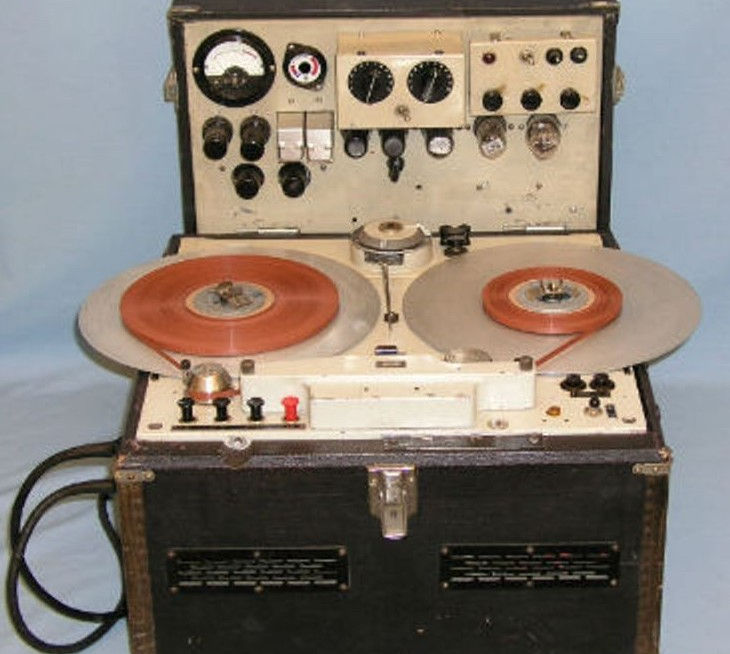
Tape Deck Details
Number of Motors
3
Number of Heads
3
Head Configuration
Wow & Flutter
Signal-to-Noise [dB]
35
Dimensions [mm]
Weight [kg]
Year built
1935
Head Composition
Equalization
Frequency Response
50 Hz – 6,000 Hz
Speed
Max Reel [inch]
Tracks
Price
User
Pro
Additional Information
The AEG Magnetophon K1 (often simply called Magnetophon K1) is the world's first practical magnetic tape recorder, developed by engineers at AEG (Allgemeine Elektricitäts-Gesellschaft) in Berlin and publicly demonstrated at the Berlin Radio Show (Internationale Funkausstellung) in August 1935. It was a groundbreaking prototype machine that marked the birth of modern magnetic tape recording technology, based on Fritz Pfleumer's 1928 patent for magnetic tape (using paper coated with iron oxide particles) and further developed by Eduard Schüller and the AEG team in collaboration with BASF (who supplied the improved tape).
The K1 was not a mass-produced commercial product—only a few prototypes were built (estimates range from 1–3), and all original units were reportedly destroyed by fire during World War II. One reconstructed example exists today (from surviving parts). It was a large, modular system consisting of three heavy suitcases: one for the tape transport, one for amplifiers, and one for speakers. It used paper-based magnetic tape (initially 6.5 mm wide, coated with Fe₃O₄ iron oxide; later upgraded to Fe₂O₃ by 1939 in successors).
The K1 laid the foundation for all subsequent reel-to-reel recorders, introducing concepts like capstan-driven tape transport and erase/record/play heads. However, early performance was limited compared to later models (especially before AC bias was added in 1941 with the K7).
Key Technical Specifications
Recording/Playback System — Mono (single-track); direct magnetic recording on coated paper tape; no stereo (early mono only); basic erase/record/play functions.
Tape Speed — 1 m/s (100 cm/s or approximately 39.37 ips) — much faster than modern standards (e.g., 30 ips/76 cm/s became common later).
Tape Width — 6.5 mm (early standard; later models used 6.35 mm).
Tape Type — Paper-based with iron oxide coating (initially Fe₃O₄; BASF Type C tape debuted with K1).
Reel Size — Large reels (up to ~30 cm diameter in early demos); recording time ~20 minutes per reel at 1 m/s.
Frequency Response — Approximately 50 Hz – 6,000 Hz (early estimates; limited by tape and no AC bias yet).
Wow & Flutter — Not precisely documented for K1 prototypes (early machines suffered from mechanical variations; later K-series improved this significantly).
Signal-to-Noise Ratio — Poor by modern standards (~ -35 dB estimated; high hiss and distortion without bias).
Heads — Basic magnetic heads (record, playback, erase); no separate playback head in earliest configs.
Drive System — Three motors (one for capstan, two for reels); capstan-driven with pinch roller; mechanical transport; modular suitcase design.
Electronics — Tube-based (3 tubes reported: AF7, AL4, AZ1 in some reconstructions; preamp, output, rectifier).
Amplification & Speakers — Separate amplifier suitcase; external speakers required (no built-in in transport unit).
Inputs — Microphone/line level (basic connectors for radio/broadcast use).
Outputs — Line level to amplifier; monitor via headphones or speakers.
Features — Basic transport controls; no VU meters (early prototypes); modular suitcase system (transport, amps, speakers).
Power — AC mains (220 V standard for Europe).
Build & Dimensions — Three heavy suitcases (transport unit ~large suitcase size); total weight very high (professional/portable broadcast prototype).
Manufacturing — Germany (AEG, Berlin); prototypes only (few units built; not mass-produced).
Performance & Legacy Context
The Magnetophon K1 was revolutionary as the first practical tape recorder using affordable magnetic tape instead of expensive steel wire or steel tape systems. It offered better sound quality and lower cost than competitors, with sufficient fidelity for broadcast and music archiving (though limited by no AC bias—introduced later in 1941). Early recordings suffered from distortion, noise, and limited bandwidth (50–6000 Hz), but it proved the concept viable. The K1's 1 m/s speed was chosen for high fidelity, but later models standardized around 76–77 cm/s (30 ips).
Surviving examples are museum pieces (e.g., reconstructions in Germany); no original K1 survives intact. It directly led to the K2 (1936), K3–K9 series (pre-WWII improvements), and post-war Magnetophon models. The technology was captured by Allies after WWII and influenced Ampex and other manufacturers.
Common issues (historical): Fragile paper tape (prone to breaking), mechanical wow/flutter, tube reliability, and no bias (high distortion). No modern restorations exist due to rarity.
Compared to siblings:
Magnetophon K2 — First commercial variant (1936).
K7 — Introduced AC bias (1941, major quality jump).
Later models — Transistorized consumer decks (M-series).
K1 — 1935 prototype pioneer (1 m/s, no bias, paper tape).