
Aiwa TP-1012
Aiwa
Japan
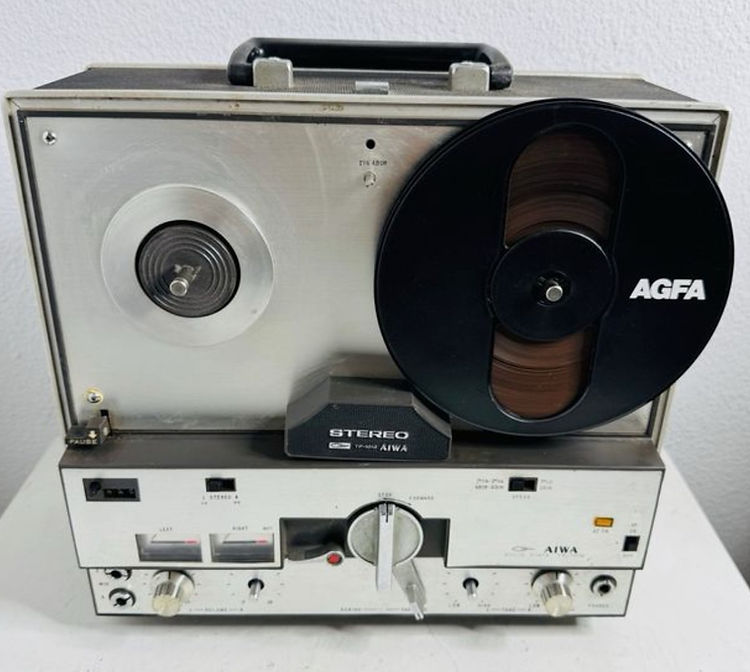
Tape Deck Details
Number of Motors
1
Number of Heads
3
Head Configuration
Stereo
Wow & Flutter
0.3%
Signal-to-Noise [dB]
42
Dimensions [mm]
343 x 318 x 184
Weight [kg]
7.5
Year built
Head Composition
Permalloy
Equalization
IEC
Frequency Response
60 Hz – 10,000–12,000 Hz
Speed
3¾
Max Reel [inch]
7
Tracks
1/4 Rec/PB
Price
User
Consumer
Additional Information
The AIWA TP-1012 is a late 1960s to early 1970s portable stereo open-reel tape recorder, produced in Japan approximately 1969–1972. It was one of AIWA's more advanced consumer reel-to-reel models in the TP series, offering true stereo recording and playback in a compact, battery/AC-powered portable format. The TP-1012 improved upon earlier mono rim-drive portables (e.g., TP-30R, TP-1003) by including a capstan drive (rather than pure rim-drive), better electronics, and integrated stereo speakers—making it one of AIWA's few capstan-driven stereo open-reel machines before the company shifted heavily to cassette decks.
This was a 4-track (quarter-track) stereo recorder (vierspur-stereo), allowing two stereo sides per reel (manual tape flip required), with mono compatibility and basic sound-on-sound overdub capability.
Key Technical Specifications
Recording/Playback System — 4-track (quarter-track), 2-channel stereo/mono compatible; records/plays stereo on tracks 1-4 forward and 3-2 reverse (manual tape flip); mono compatible; sound-on-sound/multiplay overdub possible.
Tape Speeds — Single fixed speed:3¾ ips (9.5 cm/s) nominal (capstan-controlled; more stable than rim-drive models).
Reel Size — Maximum 7 inches (127 mm) reels (compact for portability; typical tape length ~300–600 feet).
Recording Time — Approximately 30–45 minutes per side (both stereo tracks) with 600-foot tape; ~1–1.5 hours total per reel.
Frequency Response (approximate):At 9.5 cm/s: ~60 Hz – 10,000–12,000 Hz (±3–6 dB) Respectable stereo performance for a late-1960s/early-1970s portable capstan recorder.
Wow & Flutter — Approximately 0.3–0.5% (improved over rim-drive thanks to capstan; still higher than desktop hi-fi decks).
Signal-to-Noise Ratio — ~42–48 dB (typical for transistor stereo portable of the era; noticeable hiss but better than pure rim-drive models).
Heads — 3 heads: separate record, playback, and erase (stereo pair; enables basic off-tape monitoring in some modes).
Drive System — Capstan drive with pinch roller (significant upgrade over earlier rim-drive TP models); single motor for capstan + reel spooling; mechanical brakes; push-button controls.
Electronics — Fully transistorized (likely 10–14 transistors); printed circuit board amplifier.
Amplification & Speakers — Built-in stereo amplifiers (~300–500 mW per channel); two small dynamic speakers (internal, often 2–3 inches); stereo headphone jack for private monitoring.
Inputs —Stereo microphone (low-level).
Stereo line/phono (higher level).
DIN-style or mini-jack connectors.
Outputs —Stereo line out.
Stereo headphone jack.
Internal speakers.
Power — Batteries: 6 × 1.5 V "C" cells (9 V total) or optional AC adapter; some units include rechargeable battery pack.
Build & Dimensions — Compact plastic/metal case with carrying handle; approx. 343 x 318 x 184 mm weight ~7.5 kg (with batteries).
Manufacturing — Japan (AIWA Co. Ltd.); original price ~$120–180 (late 1960s/early 1970s budget-to-midrange stereo portable).
Performance & Legacy Context
The AIWA TP-1012 was a capable early stereo portable reel-to-reel recorder—offering true stereo recording/playback with capstan drive (better speed stability than rim-drive siblings) in a compact, battery-powered package. It delivered acceptable stereo imaging, clarity, and dynamics for voice, radio dubbing, field recording, or casual music at 3¾ ips, with built-in stereo speakers for immediate playback. The capstan drive and three-head configuration made it noticeably better than pure rim-drive portables like the TP-1003, though still limited in fidelity compared to desktop hi-fi decks.
Surviving examples are collectible curiosities (often missing batteries, belts, or pinch rollers). They are valued for late-1960s Japanese miniaturization and early portable stereo reel-to-reel design but rarely used today due to small reel capacity, mechanical wear, and the decline of open-reel in favor of cassette.
Common issues today: Rubber pinch roller/idler wear (speed instability), motor failure (old batteries corrode), transistor aging, dirty heads (alignment critical), mechanical binding, case cracking, and speaker cone degradation. Restorations are moderately complex but feasible—parts (pinch rollers, belts, small reels) are scarce but available from vintage specialists.
Compared to siblings:
AIWA TP-1003 — Earlier rim-drive stereo portable (similar era).
TP-1012 — Late 1960s/early 1970s capstan-drive stereo portable (3¾ ips, 5" reels, 3-head, built-in stereo speakers).
Later models — Shift to cassette decks (TP-1009, TP-1010 series).