
Aiwa TP-40
Aiwa
Japan
Tape Deck Details
Number of Motors
1
Number of Heads
2
Head Configuration
Wow & Flutter
Signal-to-Noise [dB]
Dimensions [mm]
Weight [kg]
Year built
1960s
Head Composition
Permalloy
Equalization
Frequency Response
Speed
1⅞, 3¾
Max Reel [inch]
3
Tracks
1/4 Rec/PB
Price
User
Consumer
Additional Information
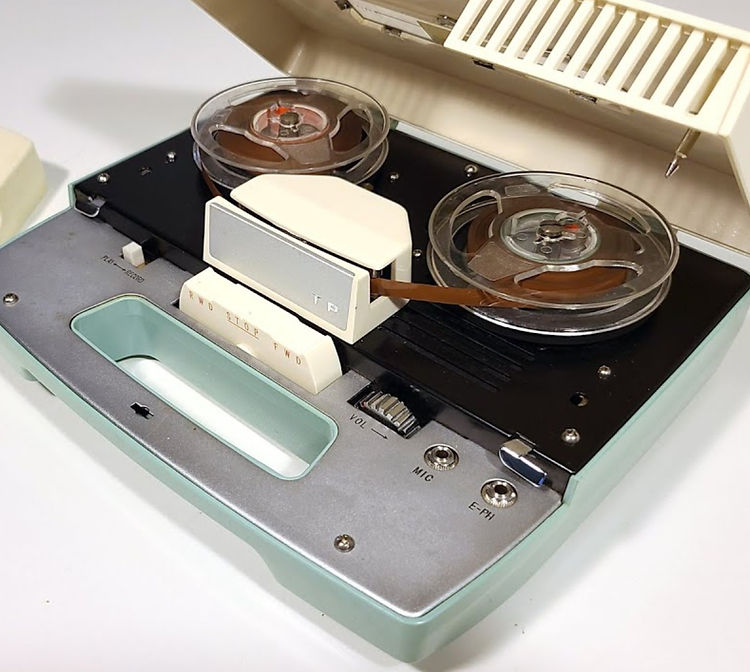
The TP-40 is an early portable open-reel tape recorder developed during Aiwa’s transitional period from vacuum-tube to solid-state consumer recording platforms. Engineered for domestic and semi-portable use, the unit integrates a compact single-motor transport with onboard amplification and monitoring facilities.
Tape Transport
Tape format: ¼-inch magnetic tape
Track system: 4-track (2-channel stereo / mono compatible)
Tape speeds:
3¾ ips (9.5 cm/s)
1⅞ ips (4.75 cm/s)Maximum reel capacity: 5-inch
Drive system: Belt-driven single-motor transport
Head configuration:
Combined record / playback head
Erase head
The 4-track recording format allows stereo program material to be recorded in both tape directions, effectively doubling available recording time.
Electronic Architecture
Amplifier topology: Discrete transistorized circuitry
Recording equalization: NAB consumer standard
Level monitoring: Analog VU metering
Inputs:
Microphone input
Auxiliary line inputOutputs:
Line output
Headphone monitoring output
Solid-state amplification improves operational stability and reduces power consumption relative to earlier tube-based portable designs.
Integrated Audio System
Internal loudspeaker: Full-range driver for playback monitoring
Built-in power amplifier enabling fully self-contained recording and playback without external hi-fi equipment
Power System
AC operation: Mains supply
DC operation: Internal battery compartment (D-cell configuration)
AC/DC power capability supports both stationary and mobile recording applications.
Application Profile
Typical deployment scenarios included:
Home stereo recording
Educational voice logging
Field interviews
Entry-level music archiving
The TP-40 reflects a conventional consumer portable reel-to-reel design approach of the mid-1960s, combining basic stereo recording capability with integrated monitoring in a transportable format.