
Aiwa TP-50R
Aiwa
Japan
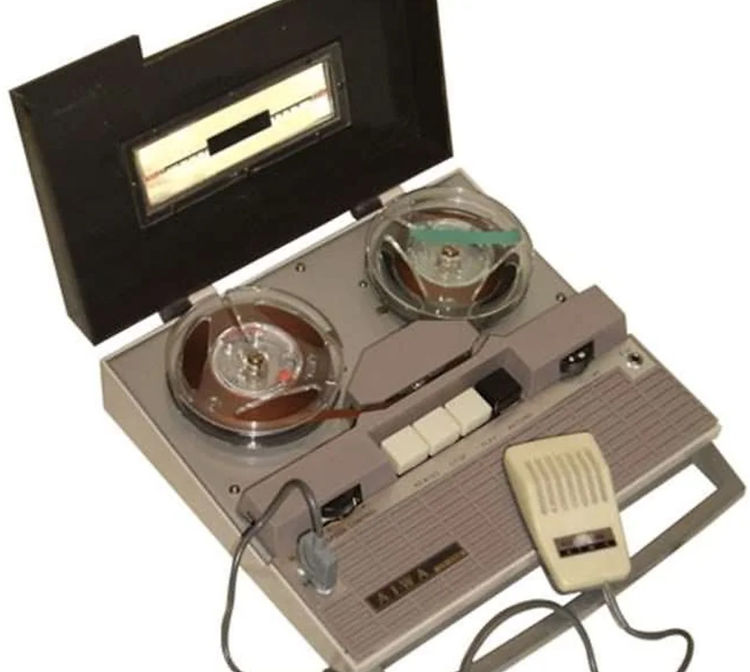
Tape Deck Details
Number of Motors
1
Number of Heads
2
Head Configuration
Full-track-mono
Wow & Flutter
Signal-to-Noise [dB]
Dimensions [mm]
Weight [kg]
Year built
1960s
Head Composition
Permalloy
Equalization
Frequency Response
Speed
1⅞
Max Reel [inch]
5
Tracks
1/2 Rec/PB
Price
User
Consumer
Additional Information
The Aiwa TP‑50R is a mid‑1960s portable, battery‑powered open‑reel tape recorder aimed at the consumer/dictation end of the market rather than hi‑fi listening. It was part of Aiwa’s small rim‑drive series of mono machines, designed for voice notes, radio off‑air recording, and casual music capture.
Transport and tape format
Reel format: small open reels (typically 3–5 inch; designed primarily around compact 3" reels).
Drive system: rim‑drive; the motor drives the outer rim of the take‑up hub directly, without a capstan and pinch roller. This makes for very simple mechanics but relatively high wow & flutter and speed variation compared with capstan‑driven decks.
Tape speed: single nominal speed of 1⅞ ips, with a small range of adjustment to compensate for battery voltage drop.
Track format: 2‑track mono (half‑track record/playback on ¼" tape), allowing use of both directions of the tape for extended recording time.
Heads: 2‑head configuration (erase and combined record/playback head), using a basic permalloy core typical of portable machines of the period.
Because the TP‑50R is rim‑drive and lacks a true capstan, it consumes tape relatively quickly for a given programme length and is more sensitive to reel size, tape tension, and any eccentricity in the hubs.
Electronics and power
Electronics: fully transistorised solid‑state amplifier, modest output power intended to drive a small built‑in loudspeaker and an earphone.
Power supply:
Motor: two 1.5 V cells (C‑size), in series, dedicated to transport.
Amplifier: one 9 V battery for the audio electronics.Inputs:
Combination mic/radio input (mini‑jack), switchable or auto‑sensing depending on version.
Remote start jack for use with an external microphone switch.Outputs:
Earphone jack (also suitable as an aux/line‑level feed into an external amplifier at modest level).
The separation of motor and amplifier supplies reduces motor noise modulation on the audio rail and allows recording even as motor batteries droop, within limits.
Acoustic section and monitoring
Built‑in speaker: single round driver around 6 cm (≈2¼") diameter, mounted behind a front or top grille, providing nearfield monitoring.
No separate tweeter; the voicing is optimised for speech intelligibility rather than full‑range music.
A simple level control and basic tone shaping via the amplifier’s natural roll‑off; no separate tone controls.
Typical frequency response for this type of rim‑drive 1⅞ ips portable is roughly 150/200 Hz–6/7 kHz at best, suitable for voice but clearly below hi‑fi standards.
Mechanical controls and features
Transport controls: mechanical keys or levers for Record, Play, Stop, Rewind (no true fast‑forward in many examples), often interlocked so only one mode can be engaged.
Speed trim: small “remote speed” or fine‑speed adjustment range around nominal 1⅞ ips, used to correct pitch as batteries discharge.
No tape counter and no cue/review facilities.
Simple hinged or removable reel cover and carrying handle, often all‑metal, emphasizing portability and durability.
Use, limitations, and restoration notes
Intended usage: dictation, meeting notes, language practice, off‑air recording; not a studio machine.
Main limitations:
Rim‑drive without capstan gives higher wow/flutter and speed drift.
Single slow speed limits top‑end frequency response and increases print‑through susceptibility.Typical age‑related issues:
Hardened or glazed rubber on the driven rim and idlers, causing slippage and poor speed stability.
Oxidised switch contacts and ageing electrolytic capacitors in the audio path.
Worn pressure pads or foam acting on the tape against the head, leading to weak or distorted recordings if not renewed.
In restored condition, a TP‑50R is a charming, mechanically simple example of early solid‑state portable open‑reel design—historically interesting and fun for voice recording, but not a candidate for serious hi‑fi work.