
Aiwa TP-61R
Aiwa
Japan
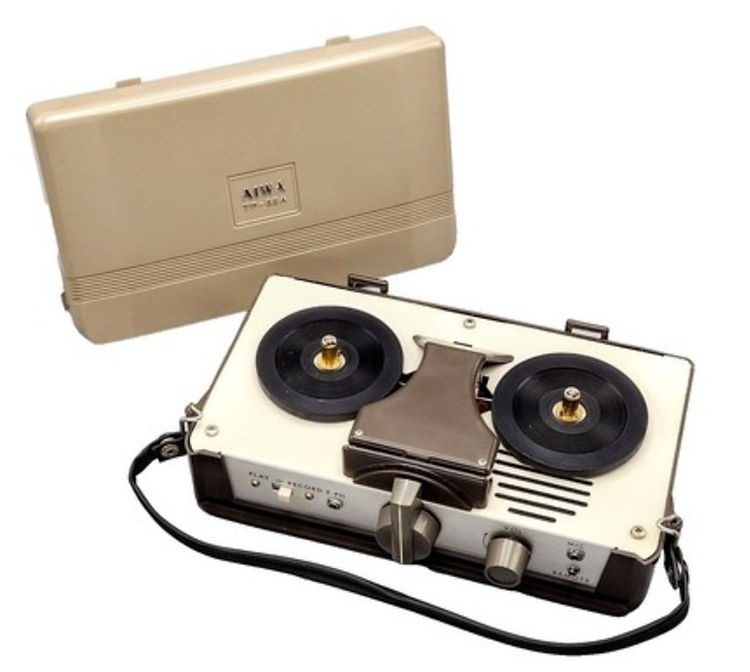
Tape Deck Details
Number of Motors
1
Number of Heads
2
Head Configuration
Full-track-mono
Wow & Flutter
Signal-to-Noise [dB]
Dimensions [mm]
147 × 97 × 54
Weight [kg]
0.5
Year built
Head Composition
Permalloy
Equalization
Frequency Response
Speed
3¾
Max Reel [inch]
3
Tracks
1/2 Rec/PB
Price
User
Consumer
Additional Information
The Aiwa TP‑61R is a very small mid‑1960s pocket open‑reel recorder, essentially a cost‑reduced successor to the TP‑60/TP‑60R, aimed at memo and voice recording rather than hi‑fi use.
Positioning and era
Introduced around 1965 as a miniature, battery‑powered reel‑to‑reel machine from Aiwa Co. Ltd., Tokyo.
Marketed as an ultra‑compact monaural “memo” recorder, not a music deck.
Transport and tape format
Uses tiny open reels (commonly 2.5–3 inch) with mono recording. Aiwa and collectors describe it as a pocket reel‑to‑reel with single‑speed rim drive.
Rim‑drive transport: the motor drives the reel hub directly; there is no separate capstan/pinch‑roller system, so speed varies slightly as tape packs on the take‑up reel.
Mono tape recorder with dual‑direction use of the tape (one track each direction), typical of memo machines of this size.
Electronics and power
Fully transistorised audio amplifier (solid‑state), designed for speech intelligibility at modest output levels.
Powered by four 1.5 V dry cells (4 × AA), giving a 6 V supply shared between motor and amplifier.
Circuit revision compared with the TP‑60R allowed somewhat higher playback volume, at the expense of more audible distortion at high levels—optimized for clarity over fidelity.
Acoustic section and monitoring
Built‑in permanent‑magnet dynamic loudspeaker (small round driver) for direct monitoring.
Intended frequency range is essentially voice band; in practice it is tailored so recorded speech remains easy to understand even in less‑than‑ideal conditions.
Earphone jack allows private listening and slightly clearer monitoring than the tiny speaker.
Controls, I/O and features
Monophonic pocket recorder with:
Play, Record, and Stop controls; Rewind is typically via a mechanical lever or by manually turning the reel, depending on version.
Microphone input jack.
Remote jack for a microphone with start/stop switch.
Earphone jack for monitoring.No tape counter, no separate tone controls, and no advanced transport features like cue/review; simplicity and size are the priorities.
Construction, size, and differences from TP‑60R
Very small handheld form factor (under 8" overall), classed as a “pocket‑set.”
Plastic case instead of the earlier metal body of the TP‑60/TP‑60R, making it lighter and cheaper; even the hand strap went from leather to synthetic, reflecting its budget positioning.
Internally, the mechanism is largely carried over from the TP‑60 series, with the same basic rim‑drive layout.
Use and restoration notes
Designed for note‑taking, interviews, and off‑air speech snippets, not music archiving.
Age‑related issues typically include hardened rim‑drive rubber, noisy or oxidised switches, and tired electrolytic capacitors in the amplifier—common restoration tasks for collectors today, especially given many examples now approach 60 years old.
In short, the TP‑61R is a historically interesting miniature memo recorder: technically modest but an appealing artifact of Aiwa’s push into ultra‑portable open‑reel in the mid‑1960s.