
Aiwa TP-703
Aiwa
Japan
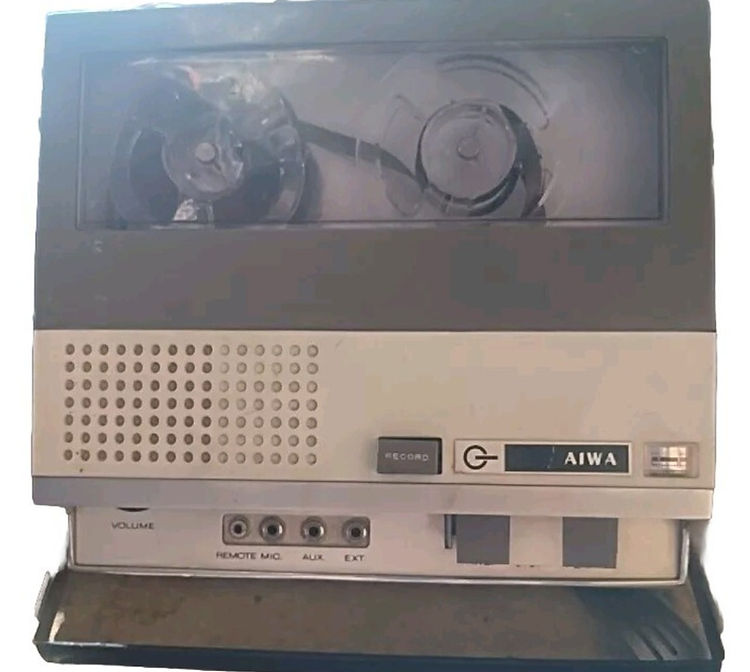
Tape Deck Details
Number of Motors
1
Number of Heads
2
Head Configuration
Wow & Flutter
Signal-to-Noise [dB]
Dimensions [mm]
240 × 65 × 210
Weight [kg]
Year built
1960s
Head Composition
Permalloy
Equalization
NAB
Frequency Response
Speed
1⅞, 3¾
Max Reel [inch]
7
Tracks
1/2 Rec/PB
Price
User
Consumer
Additional Information
Portable, suitcase‑style open‑reel tape recorder from mid‑1960s Japan (around 1965).
Aimed at home and educational recording rather than studio use: speech, off‑air radio, and casual music.
Transport and tape format
Reel size: Accepts up to 7‑inch reels, unusually large for a compact portable of this type.
Drive system: True capstan drive with pinch roller. Two speeds selected by fitting/removing a capstan sleeve:
1⅞ ips
3¾ ipsEqualization: NAB standard.
Track format: ½‑track (2‑track) mono record/playback on ¼‑inch tape.
Heads: 2 heads (erase + combined record/playback), permalloy composition.
No auto‑reverse and no fast‑forward mode; rewind only, to keep the mechanism simple and light.
Electronics and performance
Fully transistorised solid‑state design (6 semiconductors noted in period listings).
Power:
Four C‑size 1.5 V cells for portable use.
External DC input and separate AC adapter option; nominal mains version 110–120 V.Performance class: User ratings put sound quality and long‑term reliability around 5/10—mid‑fi for its era, respectable at 3¾ ips, clearly more limited at 1⅞ ips.
AC bias with manual recording level; recordings at 3¾ ips are described as “not bad at all” for voice and light music if the machine is in good mechanical condition.
Controls, I/O, and features
Front‑panel controls:
Push‑button transport: Play, Stop, Rewind, Record (no separate fast‑forward).
Recording level control and basic monitor volume.Connections (all mini‑jacks):
Mic input.
Remote start jack.
DC supply input.
Outputs: earphone and auxiliary (line‑level) out for external amplifier/speaker.No tape counter, no tone controls, and no auto‑level circuit—operation is simple and manual.
Acoustic section and monitoring
Built‑in loudspeaker: 6 cm (≈2½‑inch) circular driver mounted in the case for nearfield monitoring.
Intended response is adequate for speech and modest music; for best results the aux output should feed an external amp and larger speakers.
Construction, size, and form factor
Case material: mainly plastic (no Bakelite), with metal chassis inside.
Dimensions: approximately 240 × 65 × 210 mm (W × H × D) according to Radiomuseum; another listing gives 340 × 210 × 65 mm including handle and protrusions.
Table‑top / portable “lunchbox” style with push buttons and top‑mounted reel field, handle for carrying.
Use and restoration notes
Well suited for collectors who want a mechanically simple, 2‑speed, capstan‑drive portable that can handle full 7‑inch reels.
Common service items:
Capstan/pinch‑roller rubber wear,
Aged electrolytic capacitors in the amplifier and power supply,
Dirty switches and speed‑change sleeve needing cleaning and lubrication.
In working order at 3¾ ips, the TP‑703 offers charming mid‑1960s portable open‑reel performance with better stability than Aiwa’s tiny rim‑drive memo machines, while remaining far from modern hi‑fi standards.