
Ampex 1455
Ampex
USA
Tape Deck Details
Number of Motors
1
Number of Heads
3
Head Configuration
Stereo
Wow & Flutter
Signal-to-Noise [dB]
Dimensions [mm]
Weight [kg]
Year built
1968 - 1969
Head Composition
Permalloy
Equalization
NAB
Frequency Response
Speed
1⅞, 3¾, 7½
Max Reel [inch]
7
Tracks
1/4 Rec/PB
Price
User
Consumer
Additional Information
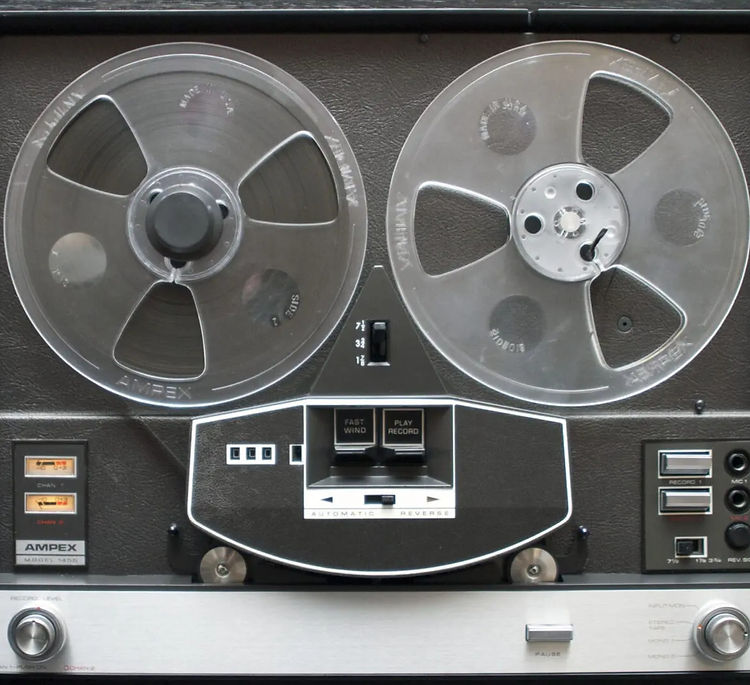
The Ampex 1455 - a vintage stereo reel-to-reel tape recorder aimed at the high-end consumer HiFi market, introduced around 1968-69.
The Ampex 1455 is a stereo consumer-grade reel-to-reel tape deck from Ampex, offered around 1968-69.
According to the Ampex “fact-book” it was described thus: “Model … 1455 … which include pause control. … The 1455 features tape-monitoring, sound-with-sound, automatic reversing and replay, and simplified threading.”
A restoration article emphasises the 1455 as “a marvel of mechanical engineering” and notes it is a “reversible” machine (i.e., auto-reverse feature) for ¼-inch tape.
Service manuals and schematics are available (e.g., at HiFiEngine) for the 1455/1450 series.
Key Features & Transport Mechanism
Tape width & track format: The 1455 uses ¼-inch tape (standard HiFi width) in stereo. The reversible feature means it supports recording/playback on two pairs of tracks (4-track on ¼-inch) so that when one “side” ends it flips and plays the other.
Auto-reverse / simplified threading: The factory spec indicates automatic reversing and simplified tape threading as distinguishing features of the 1455.
Mechanics: The restoration write-up reports that the transport uses a pair of drive belts connecting the main motor to pulleys and the twin capstans, and that the mechanical layout is relatively compact and user-accessible.
It gives an inside view: the drive motor has multiple pulley tracks (for different speeds), and the belt layout goes through idlers etc.
The reversible mechanism and transport require that the head stack supports both forward and reverse playback.Controls & monitoring: The fact-book mentions features such as “tape-monitoring, sound-with-sound” (i.e., you could monitor the source while recording) and “automatic reversing and replay.”
Audio/Electrical Performance & Specs (as known)
While a full spec sheet (frequencies, S/N, wow & flutter, distortion at multiple speeds) is not easily located in public domain for every speed, here are what we know:
The manual library lists the 1455 as a “Stereo Tape Deck (1968-69)”. hifiengine.com
From the restoration article: after alignment and biasing, the machine met “+/- 3 dB from 30 Hz to 13 kHz, down 4 dB at 15 kHz” in record/playback mode on one channel.
The article also mentions the machine’s “no detectable speed variations” in listening tests — effect on wow & flutter appears very small.
Given the era and feature set (auto-reverse, belt drive, consumer HiFi market) one would expect moderate but decent specs for its time — good HiFi, but not studio/professional recorder levels.
Operational / Practical Considerations
Condition & maintenance: As with many machines of that era, typical wear-out risks include belts and idler tyres (rubber components), capstan bearings, heads needing cleaning or replacement, and alignment drift. The restoration article highlights how the original belts had deteriorated into goo in some machines.
Tape speed & performance trade-offs: Being a consumer deck, the 1455 likely supports multiple tape speeds (common HiFi speeds like 7½, 3¾, maybe 1 ⅞ inch per second). The restoration article referenced pulleys for “7-1/2, 3-3/4, or 1-7/8 IPS” when describing motor tracks.
Auto-reverse feature: This is a nice convenience. Users need to ensure the reverse head path is aligned and the tone-sensor (for auto-reverse flag tone) is working. The article notes that some tapes have the 20 Hz tone that triggers the reverse.
Tape threading & reel size: The machine uses standard ¼″ tape. Often these machines use smaller reels (7″) typical of consumer market, but one should verify maximum reel diameter supported and hub sizes.
Voltage / power: If importing from another region, ensure correct mains voltage / frequency or a suitable transformer is used.
Sound quality expectations: For its era, the 1455 offers good HiFi sound. But modern noise-floors, tape formulation, head wear, and transport stability mean that it will likely not match modern digital clarity — but it can provide excellent analogue character.
Summary & Use-Case
In summary: The Ampex 1455 is a fine vintage stereo reel-to-reel deck targeted at serious home audiophiles in the late 1960s. It offers stereo recording/playback, reversible operation, decent mechanical quality, and good performance for its class. It is not a broadcast-studio professional machine, but rather a high-end consumer machine.
If you are considering acquiring or refurbishing one, here’s a checklist:
Verify transport mechanism works smoothly (belts, capstans, reels)
Check heads for wear and alignment; check bias and EQ calibration
Measure tape speeds and stability (wow & flutter) if possible
Confirm audio chain (record & playback amps) are functional — check noise, hum, distortion
Examine condition of rubber/drive parts and availability of spares
Ensure correct mains voltage compatibility
Decide what tape speeds you intend to use (e.g., 7½ IPS vs 3¾ IPS) and corresponding tape stock.