
Ampex 602
Ampex
USA
Tape Deck Details
Number of Motors
1
Number of Heads
3
Head Configuration
Stereo
Wow & Flutter
0.17% at 7½ ips
Signal-to-Noise [dB]
55
Dimensions [mm]
Weight [kg]
Year built
1956
Head Composition
Permalloy
Equalization
Frequency Response
40-15kHz
Speed
7½
Max Reel [inch]
7
Tracks
1/2 Rec/PB
Price
User
Pro
Additional Information
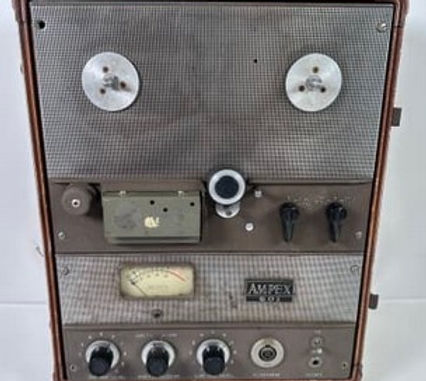
The Ampex 602 reel-to-reel tape deck, introduced in 1956, is recognized as one of the smallest professional stereo tape recorders of its time. It supports 7½ inches per second (ips) tape speed and offers two-track stereo magnetic tape recording with three heads: erase, record, and playback, arranged for superior fidelity and flexibility.
Technical features include:
Tape Speed: 7½ ips with timing accuracy about ±0.2%, resulting in minimal drift (approx. 3.6 seconds over a 30-minute recording).
Tape Length and Rewind Time: Rewinds a full 1200-foot reel in around 90 seconds.
Head Assembly: Three separate permalloy heads for erase, record, and playback, configured to ensure precise signal tracking and monitoring capabilities.
Electronics: Tube-based amplification with built-in low-impedance microphone transformers, enabling balanced input signals and low noise operation; silicon diode rectifiers help maintain cooler operation.
Drive System: Features a hysteresis-synchronous motor that ensures stable tape transport with low wow and flutter (under 0.17% at 7½ ips).
Controls: Includes a record/safe switch on each channel, plus remote control capability via a central master control panel, supporting efficient professional workflows.
Size and Weight: Portable, weighing approximately 25 lbs for the single-channel model and 42 lbs for the stereo version, designed for easy transport and field or studio use.
Power: Operates from 115V AC, with low power consumption and quiet tube-based electronics.
The Ampex 602 was designed for broadcast and professional recording environments requiring a compact, reliable, and high-fidelity tape recording solution. Its combination of rugged portability, precise electronics, and stable transport mechanisms made it favored for both field and studio work.
In summary, the Ampex 602 exemplifies mid-1950s advancements in stereo reel-to-reel technology, delivering impressive audio fidelity and operational flexibility in a small, robust form factor suitable for professional applications. Service manuals and technical documentation remain available for restoration and maintenance purposes.