
Apolec RA-11
Apolec
Japan
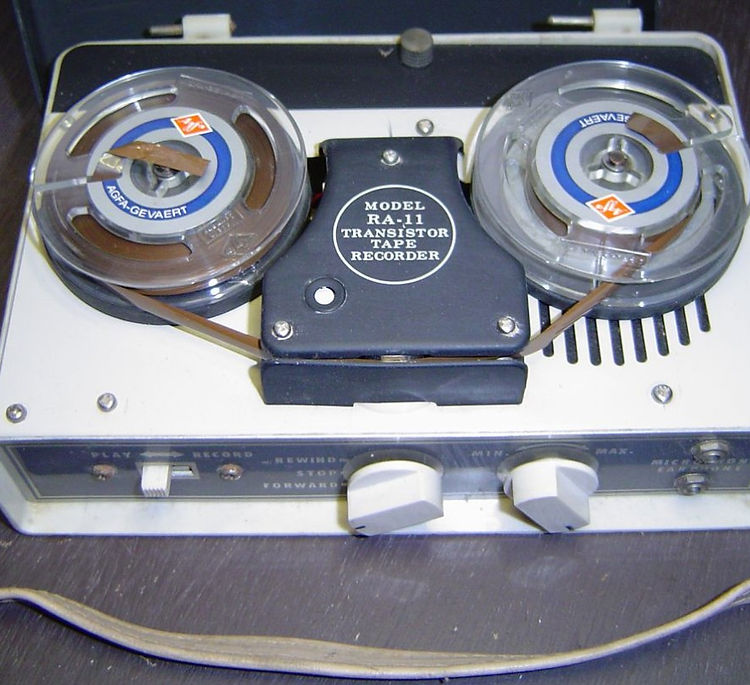
Tape Deck Details
Number of Motors
1
Number of Heads
Head Configuration
Full-track-mono
Wow & Flutter
Signal-to-Noise [dB]
Dimensions [mm]
230 x 65 x 160
Weight [kg]
1.5
Year built
1963
Head Composition
Equalization
Frequency Response
Speed
1⅞
Max Reel [inch]
4
Tracks
Price
User
Consumer
Additional Information
The Apolec RA-11 is a compact, battery-powered portable reel-to-reel tape recorder from the early-to-mid 1960s, manufactured in Japan by Apollo Electric Industries (also referred to as Apollo Industries or Sunwave in some references). It was a low-cost, entry-level consumer device typical of the transistor era, sold under multiple rebranded names including Encor, Star-Lite, Universal, Raleigh, and others.
Key Technical Specifications
Transistors: 4-transistor circuit (all discrete semiconductors, no ICs)
Type: Open-reel (reel-to-reel) tape recorder, monaural (single-channel)
Tape Drive System: Rim-drive mechanism (the motor drives the reel directly via friction on the rim rather than a capstan-pinch roller system in many examples). Some variants or similar models may differ slightly in drive design.
Tape Speed: Single speed, typically 1⅞ ips (inches per second) or around 4.75 cm/s — standard for voice and basic music recording on such portables.
Reels: Supports small reels, usually up to 3-inch or 4-inch diameter reels (exact maximum depends on the unit; the compact chassis limits reel size).
Recording/Playback: Record and playback functions with a basic record/play switch. It includes a built-in microphone or external mic input.
Power Supply
Battery operated for true portability.
Common configuration: One 9V battery for the motor + 2× C cells for the electronics/amplifier (or slight variations like multiple penlight batteries in similar models).
No AC mains power in the base design (no built-in power supply).
Dimensions and Build
Approximate dimensions: 210–230 mm wide × 150–160 mm deep × 65 mm high (roughly 8–9" × 6" × 2.5").
Weight: Around 1–1.5 kg (lightweight plastic housing typical of 1960s Japanese portables).
Ports: Microphone jack (input), earphone/headphone jack (output). Some units mention radio/phono inputs on related models, but the RA-11 is primarily mic-focused.
Features
Simple operation with record, play, fast-forward/rewind (rewind is often manual-assist or slow due to the rim-drive design).
Built-in speaker for playback (small, low-power).
Basic volume control and possibly a record level indicator (limited or none on cheapest 4-transistor designs).
Designed primarily for voice recording, dictation, personal memos, or casual music capture — frequency response and fidelity are modest by modern (or even contemporary hi-fi) standards.
Performance Notes
Audio quality is limited due to the 4-transistor amplifier, rim-drive transport (which can cause speed variations/flutter), and low tape speed.
Signal-to-noise ratio and distortion are not high-end; these units were budget-oriented rather than audiophile.
Reliability issues in surviving examples often include degraded belts (if any), weak batteries causing slow operation, oxidized contacts, or dried-out capacitors.
Context and Market Position
Priced around $29.95 in 1963 advertisements, the RA-11 was an affordable "personal" tape recorder marketed during the boom in battery-operated transistor portables. It competed with similar low-end Japanese imports but lacked the dual-speed capstan drive or better electronics found in slightly higher models (e.g., some 6-transistor versions).
Today, the Apolec RA-11 is a collectible vintage piece prized more for nostalgia and retro aesthetics than serious audio performance. Many surviving units are sold "as-is" or for repair/restoration projects because of age-related issues with the mechanics and electronics.
Note: Detailed service manuals or full frequency response curves are scarce online, as this was a very basic consumer product rather than a professional or semi-pro deck (unlike larger studio machines such as the Ampex ATR-102 you mentioned earlier). YouTube videos exist showing operation and disassembly if you want to see the rim-drive mechanism in action.