
Berlant Concertone 605
Berlant
USA
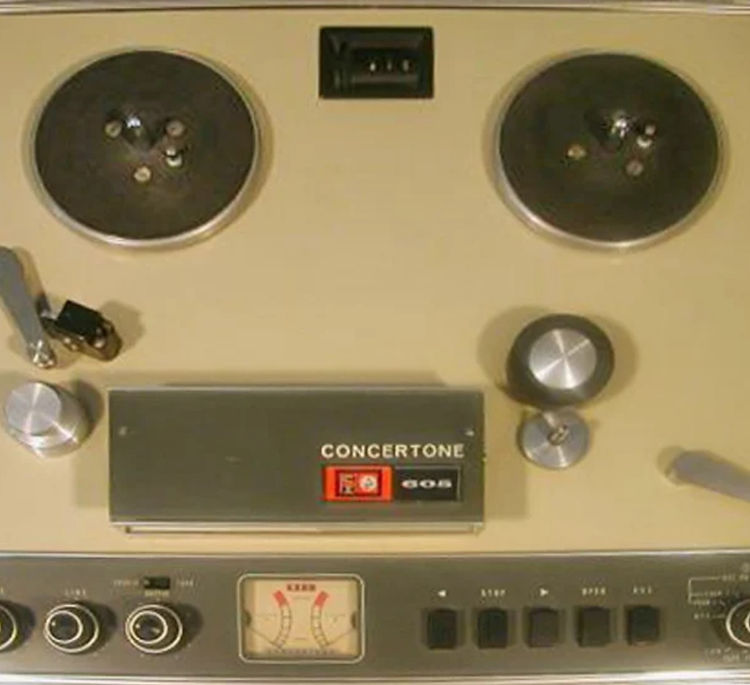
Tape Deck Details
Number of Motors
3
Number of Heads
3
Head Configuration
Dual-track-mono
Wow & Flutter
50
Signal-to-Noise [dB]
50
Dimensions [mm]
Weight [kg]
Year built
1957 - 1960
Head Composition
Permalloy
Equalization
NAB
Frequency Response
40–50 Hz to 15 kHz
Speed
3¾, 7½
Max Reel [inch]
7
Tracks
1/2 Rec/PB
Price
User
Consumer
Additional Information
The Berlant Concertone 605 (also known as American Concertone 605) is a late-1950s to early-1960s vintage open-reel tape recorder from the Concertone line, produced during the transitional period when Berlant Associates (founded by Emmanuel "Bert" Berlant) evolved and eventually licensed or transitioned manufacturing to TEAC in Japan. It was positioned as a high-quality prosumer (professional-consumer) deck, bridging home hi-fi and semi-professional use, with advanced features for its time.
This model is noted for its robust build, innovative head design, and flexibility, often described as a "great prosumer recorder." It shares design lineage with later Concertone models like the 505 and transitional TEAC units (e.g., some Concord R-2000 variants are mechanically very similar or identical with cosmetic differences). Surviving examples are rare collectibles, occasionally appearing in vintage audio markets for restoration or parts.
Key Technical Specifications
Tape Speeds: 3.75 ips and 7.5 ips (standard for late Concertone hi-fi/prosumer decks; some variants or related models included 15 ips options, but 605 focused on these for extended play and quality balance).
Frequency Response: Approximately 40–50 Hz to 15 kHz (typical for Concertone's tube/solid-state hybrid era; improved shielding and head design contributed to clean highs).
Signal-to-Noise Ratio: Around 50–55 dB (solid for the period, aided by front-shielded heads reducing crosstalk and hum).
Track Configuration: Switchable 2-track (quarter-track) and 4-track stereo/mono capability via removable head assembly (easy swap between 2-track and 4-track heads for versatility in recording/playback modes).
Heads: 3-head design standard (erase, record, playback); featured innovative front-shielded heads developed by Concertone chief engineer Al Solfe for better performance and reduced interference. Removable head assembly allowed quick changes between track formats.
Reel Sizes: Up to 7" standard (some prosumer Concertone models handled larger, but 605 aligned with 7" for portability and common use).
Motors: 3-motor transport (separate capstan drive, supply, and take-up for precise tension, low wow/flutter, and reliable operation without belts in critical paths).
Timing Accuracy / Wow & Flutter: Approximately 0.2–0.25% (excellent stability for semi-pro applications).
Other Features:Full remote control capability (uncommon and advanced for consumer/prosumer decks of the era).
Likely NAB equalization, tube or early solid-state electronics (transitional period; some units tube-based, others hybrid).
Stereo/mono switching, monitoring while recording (off-tape via playback head).Auto-Reverse (Reverse-O-Matic): One of the 605’s standout features is its automatic reverse mechanism, allowing for bi-directional playback and recording without manual intervention. This was a significant convenience for users and a hallmark of later Concertone models
Weight: Around 40–50 lbs (sturdy cast chassis for low resonance and durability).
Original Price: In the $400–$700 range (positioned as premium; comparable to the Concertone 505 at ~$644 in 1960).
Design and Build Overview
The 605 emphasized mechanical precision with a 3-motor direct-drive system for smooth, accurate tape handling and minimal maintenance. The standout innovation was the removable tape head assembly, allowing users to easily swap between 2-track and 4-track configurations—ideal for evolving from mono to stereo recording or different track standards. Front-shielded heads (a Concertone/Al Solfe development) improved shielding against stray fields, enhancing signal clarity in home or semi-pro environments.
It was built on a rigid chassis (often aluminum or similar), with integrated electronics, power supply, and transport. As a transitional model near the end of the pure Berlant/Concertone U.S. era, it incorporated early TEAC influences before full licensing/absorption. This made it a bridge to 1960s Japanese decks like TEAC's A-series (e.g., similarities to A-1100 or Concord badged units).
Compared to earlier Berlant models (e.g., 1401 or 20/20 with 10.5" reels and 15 ips focus), the 605 shifted toward more compact, versatile prosumer use with better track flexibility and remote features. It was praised for rivaling professional gear in build quality while being more accessible than full studio decks like Ampex.
Today, these are sought-after by vintage audio enthusiasts for restoration. Common issues include aging capacitors, tubes (if applicable), mechanical wear, or head alignment. Service manuals exist (e.g., for the 605-2 variant), and it's valued for historical significance in the shift from U.S.-made to Japanese-dominated reel-to-reel production.