
Crown GCSX
Crown
USA
Tape Deck Details
Number of Motors
2
Number of Heads
2
Head Configuration
Stereo
Wow & Flutter
0.25%
Signal-to-Noise [dB]
50
Dimensions [mm]
Weight [kg]
Year built
1960–1965
Head Composition
Permalloy
Equalization
NAB
Frequency Response
40–50 Hz
Speed
3¾, 7½, 15
Max Reel [inch]
10.5
Tracks
1/2 Rec/PB
Price
User
Consumer
Additional Information
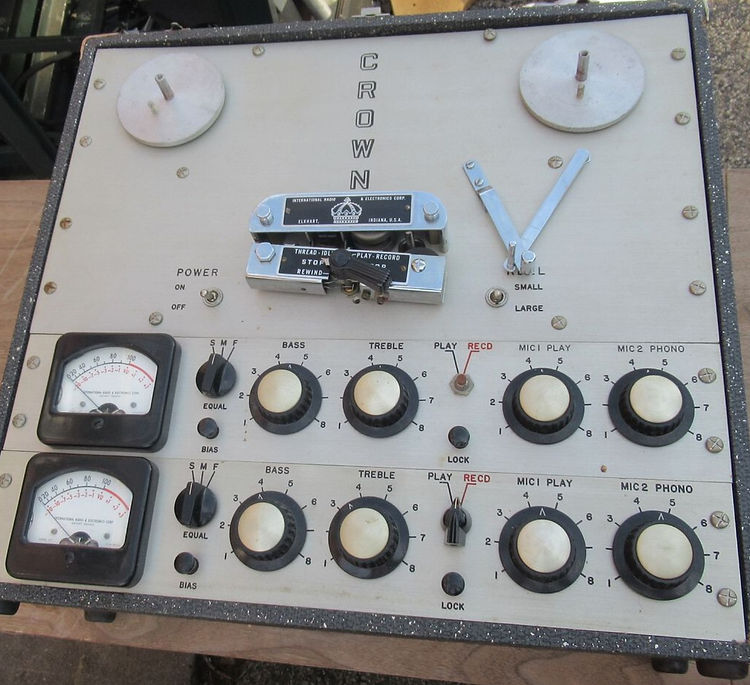
The Crown GCSX (also known as Gold Crown SX or Crown GCSX in vintage listings) is a rare, early tube-based (valve) stereo open-reel tape recorder from Crown International (Elkhart, Indiana, USA), produced in the early-to-mid 1960s (circa 1960–1965, transitional period before the solid-state 700 series). It belongs to Crown's "Gold Crown" lineup (preceding the professional 700/800 series), often described as an "early 700-like" machine but with tube electronics and a simplified 2-head design.
This model was positioned as a high-fidelity stereo recorder for home hi-fi enthusiasts or semi-pro use, emphasizing Crown's signature rugged build (designed for reliability in remote/missionary applications) and warm tube sound. It featured separate stereo preamplifiers (often two matching tube units) for record/playback, making it self-contained or expandable. Surviving examples are extremely scarce—appearing sporadically on eBay/Reverb as "parts" or restoration projects (e.g., $800–$1,000+ for non-working units)—valued for their historical role in Crown's evolution from consumer tube machines to pro solid-state decks.
Key Technical Specifications
Tape Speeds: 3.75 ips, 7.5 ips, and 15 ips (three speeds switchable on the front panel; professional capability for fidelity, timing, or extended play).
Frequency Response: Approximately 40–50 Hz to 15–20 kHz (typical for early 1960s tube stereo; respectable extension with tube warmth and slight high-end contour for "bloom").
Signal-to-Noise Ratio: Around 50–55 dB (solid for tube-era stereo; benefited from careful design but limited by 2-head simplicity).
Track Configuration: Stereo (likely half-track or dual-track stereo; two-channel record/playback, often in-line heads for simultaneous left/right on one direction).
Heads: 2-head design (combination record/playback head + erase head; unlike 3-head models for off-tape monitoring—simplified for cost/reliability in early Gold Crown era).
Reel Sizes: Up to 10.5" NAB professional (standard for extended recordings; adapters supported).
Motors: Likely 3-motor transport (hysteresis synchronous capstan; separate reel motors; electronic/differential-magnetic braking for smooth, gentle stops—hallmark of early Crown ruggedness).
Timing Accuracy / Wow & Flutter: Low for the era (~0.15–0.25% range; good stability from Crown's mechanical focus).
Other Features:All-tube electronics (warm, high-headroom sound; separate matching stereo preamplifiers for record/playback—often two units included).
NAB equalization (basic per-speed or fixed).
Stereo inputs/outputs (mic/line; speaker-level outputs possible via integrated or optional amp).
Controls for level, tone, bias, and transport functions (piano-key or pushbutton style in some).
Built-in or paired amplification (self-contained stereo playback capability).
Weight: Substantial (50+ lbs; heavy, overbuilt chassis for durability).
Original Price: In the $500–$900+ range (premium for early 1960s stereo tube recorder; comparable to Gold Crown series like GCR).
Design and Build Overview
The Crown GCSX used a rugged transport similar to early 700 series precursors—emphasizing reliability, gentle handling (electronic braking), and tube amplification for dynamic, warm performance with signature "Crown bloom" (slight frequency contouring). The 2-head design simplified construction (record head doubles as playback) but omitted off-tape monitoring—common in transitional consumer/prosumer models before 3-head dominance in pro lines.
Separate tube preamps allowed flexible stereo setup (record one channel while monitoring the other in some configs). It bridged Crown's 1950s Gold Crown integrated designs (e.g., GCP/GCR) and the 1966+ solid-state pro series (700/800 with modular boards, lower wow/flutter ~0.05%).
Today, these are ultra-rare collectibles due to scarcity. Common restoration needs: full electrolytic recapping, tube replacement, belt/pinch roller renewal (rubber degrades), head relapping/alignment, motor bearing lube/cleaning, and control deoxiting. Service info is scarce but overlaps with early Gold Crown/700 tube references.