
Denon 700
Denon
Japan
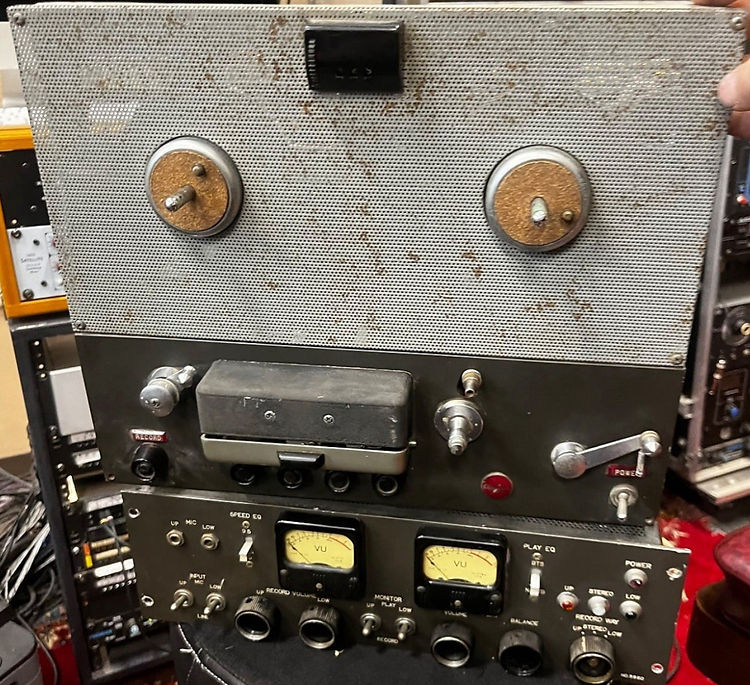
Tape Deck Details
Number of Motors
3
Number of Heads
3
Head Configuration
Stacked/Inline
Wow & Flutter
0.2-0.4%
Signal-to-Noise [dB]
50
Dimensions [mm]
500 × 300 × 200
Weight [kg]
20
Year built
1958–1962
Head Composition
Permalloy
Equalization
NAB
Frequency Response
50 Hz – 15,000 Hz
Speed
3¾, 7½
Max Reel [inch]
7
Tracks
1/4 Rec/PB
Price
User
Consumer
Additional Information
The Denon 700 (also sold or rebranded as Griffin GB-707A or Griffin 707A in some export markets, particularly the U.S.) is a late 1950s tube-based reel-to-reel tape recorder, produced around 1958–1962 by Denon (Nippon Columbia Co., Ltd., Japan). It was an early semi-professional or advanced consumer model, often marketed as a 4-track stereo-capable machine in a two-piece design (separate deck and tube preamp/electronics unit). This setup was common in the late 1950s transition from mono to stereo open-reel recording, and the Griffin branding was used for North American distribution (similar to how Akai used Roberts or other brands rebranded Philips models).
The Denon 700/Griffin 707A is now extremely rare and collectible, valued more for its historical significance and tube-era charm than modern hi-fi performance. It represents Denon's early push into multi-track capable consumer/professional recorders after their pioneering 1951 PT-series broadcast portables.
Key Technical Specifications
Recording/Playback System — 4-track (quarter-track) stereo (some sources confirm 4-track 2-channel stereo capability); records and plays stereo on tracks 1-4 forward and 3-2 reverse (manual tape flip required); mono compatible; sound-on-sound/multiplay overdub possible with separate heads/amplifiers; no auto-reverse.
Tape Speeds — Likely two speeds: 3¾ ips (9.5 cm/s) and 7½ ips (19 cm/s) (typical for late 1950s Denon/Griffin models; exact confirmation scarce but standard for era's stereo-capable decks).
Reel Size — Up to 7 inches (18 cm) maximum diameter (cine-type reels common).
Frequency Response (approximate, typical for late 1950s tube stereo):At 7½ ips: 50 Hz – 15,000 Hz (or ~40–18,000 Hz in optimal conditions).
At 3¾ ips: 50 Hz – 10,000–12,000 Hz. Respectable for early stereo but limited highs compared to 1960s transistor models.
Wow & Flutter — ~0.2–0.4% at 7½ ips (good for tube-era three-motor design when maintained).
Signal-to-Noise Ratio — Approximately 45–50 dB (typical tube performance; separate preamp helps reduce noise).
Heads — 3 heads: separate record, playback, and erase (permalloy; enables off-tape monitoring and multiplay effects).
Drive System — Three motors (capstan + two reel motors); belt drive to capstan/flywheel; idler tires/clutches; mechanical brakes; fast wind/rewind; robust for semi-pro use.
Electronics — Vacuum tube (valve)-based; separate preamp unit (e.g., paired with 8089 preamp in some listings); typical tube complement includes preamp, record/playback, and output stages (e.g., EF86, ECC83, EL95 types in similar era machines).
Amplification & Speakers — Separate tube preamp/amplifier unit (often two-piece design); no built-in speakers (external amp required for full stereo playback); modest output for monitoring.
Inputs —Microphone (low-level).
Line/radio/phono (higher level).
DIN-style or similar connectors.
Outputs —Line out for external amp.
Headphones possible.
DIN-style.
Features —Twin level meters (one per channel).
Before/after tape monitoring.
Echo/multiplay capabilities.
Pause function.
Portable/semi-portable two-piece design (deck + preamp unit) with handle/metal case.
Power — AC mains (110–120 V / 220–240 V switchable; 100 V noted in some U.S. listings); consumption typical for tube deck (~60–100 W).
Build & Dimensions — Metal case (silver/metal finish); two-piece unit (deck + preamp); approx. ~500 × 300 × 200 mm per unit (estimated); weight ~15–20 kg combined (robust semi-pro construction).
Manufacturing — Japan (Denon/Nippon Columbia); exported as Griffin 707A in some markets.
Performance & Legacy Context
The Denon 700/Griffin 707A was an early multi-track capable tube recorder—offering separate heads for monitoring and effects, three-motor stability, and stereo playback at a time when many consumer decks were still mono. It delivered tube warmth and decent fidelity at 7½ ips for late 1950s standards, suitable for semi-pro or advanced home use (e.g., small studios or enthusiasts). The two-piece design (deck + preamp) was practical for upgrades or repairs.
Surviving examples are extremely rare (often "project" or parts units on eBay/Reverb), valued as historical pieces rather than daily drivers. It represents Denon's bridge from 1950s broadcast portables (PT series) to later 1970s consumer hi-fi decks (DH/DN series).
Common issues today: Tube aging (preamp/output tubes weak/noisy), capacitor drying/leakage, belt/idler hardening, dirty heads (3-head alignment critical), worn idler tires/clutches, and mechanical wear on transport. Restorations are specialized (tube checks, recap, alignment); many units are sold "as-is" for parts due to rarity.
Compared to era siblings:
Denon PT-11/PT-12 (1951) — Earlier broadcast portables (mono, tube, field-focused).
Griffin/Denon 707A — Late 1950s semi-pro tube stereo (3-head/3-motor, rare export).
Later Denon (1970s) — Transistor hi-fi like DH-710S (direct-drive, 3-head, higher specs).