
Grundig TK 30
Grundig
Germany
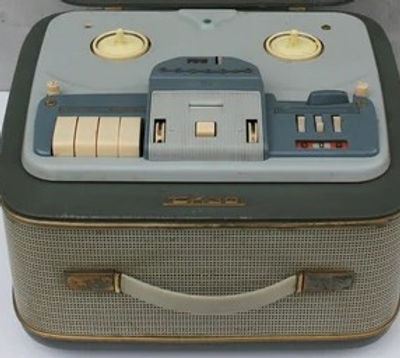
Tape Deck Details
Number of Motors
1
Number of Heads
2
Head Configuration
Full-track-mono
Wow & Flutter
0.2%
Signal-to-Noise [dB]
43
Dimensions [mm]
457 × 457 × 292
Weight [kg]
14
Year built
1958-1962
Head Composition
Permalloy
Equalization
IEC
Frequency Response
50 Hz – 15 kHz
Speed
3¾, 7½
Max Reel [inch]
7
Tracks
1/2 Rec/PB
Price
User
Consumer
Additional Information
The Grundig TK 30 (also known as TK30 or TK 30 in various markets, with related variants like TK 35) is a late-1950s open-reel (reel-to-reel) tape recorder produced by Grundig Radio-Vertrieb in Fürth, Germany. Manufactured primarily from 1958 to around 1962, it was a mid-range mono domestic/portable machine aimed at home users, radio enthusiasts, and semi-serious hobbyists. It was part of Grundig's popular TK series and valued for its dual-speed (or triple-speed in the TK 35 variant), robust valve design, large 7-inch reel capability, and excellent audio quality for its era.
The TK 30 was priced originally around £50–70 in export markets (equivalent to roughly 500–700 DM in Germany), positioning it as a premium consumer model. It gained a reputation for reliable performance, warm tube sound, and versatility for dubbing radio broadcasts, family recordings, or music.
Key Technical Specifications
Track System: 2-track (half-track), single-channel monaural (monaural record/playback; records on upper half of tape in one direction, lower half in reverse)
Tape Speeds: Two speeds — 7½ ips (19 cm/s) and 3¾ ips (9.5 cm/s); switch-selectable (TK 35 variant adds 1⅞ ips / 4.75 cm/s for extended runtime)
Reel Size: Maximum 7 inches / 18 cm (standard for domestic recorders of the era; supports NAB/international hubs)
Heads: 2 heads — combined record/playback head + erase head (permalloy construction; no separate playback head or off-tape monitoring)
Motors: 1 motor (capstan drive; single-motor design with mechanical reel assistance; reliable induction-type motor typical of late-1950s consumer machines)
Drive System: Mechanical transport with push-button or lever controls; constant tape speed; foil-sensing automatic stop at tape end; basic tension regulation suitable for standard and thinner tapes; sound-on-sound (erase cut-out) for overdubbing in some configurations
Frequency Response: 50 Hz – 15 kHz (±3 dB at 7½ ips); 50 Hz – 10 kHz at 3¾ ips (respectable for a dual-speed mono recorder of the era, with good clarity, dynamics, and extension for voice and music)
Signal-to-Noise Ratio: Better than 43 dB (typical; good for mid-century consumer mono, aided by quality tube design)
Wow & Flutter: Less than 0.2% at 7½ ips; less than 0.25% at 3¾ ips (low and excellent for domestic use; single-motor designs had minimal variations)
Equalization: IEC/CCIR/European standard for the period (some export versions note NARTB compatibility)
Inputs:Microphone: Low-level (1.5 mV / 1.5 MΩ; dynamic mic via DIN or proprietary socket; often supplied external mic)
Diode (auxiliary): 1.5 mV / 22 kΩ
Radio/Line: 100 mV / 1 MΩ via DIN connector (Grundig 5-pin standard)
Phono/Grammophon: Additional high-level input for record players
Outputs: Built-in loudspeaker (permanent dynamic type, 5¾” × 8¼” high-flux elliptical); low-impedance ext. speaker (3 ohms); high-impedance line out (600 mV / 5 kΩ) via DIN socket; output power 3½ watts
Power Supply: Alternating Current (AC) mains — 110–240 V (multi-voltage taps for export); power consumption around 60–80 W; no battery option (mains-only domestic/portable hybrid)
Dimensions: Approximately 457 × 457 × 292 mm / 18 × 18 × 11½ inches (W × H × D) for TK 35 (TK 30 slightly smaller); compact suitcase/portable form factor with handle
Weight: TK 30 ≈ 31 lbs (14.1 kg); TK 35 ≈ 34 lbs (15.5 kg) — portable yet substantial due to metal chassis, transformers, and tubes
Electronics: Valve/tube-based (typically 5 tubes + 3 metal rectifiers): EF86 preamp, ECC81 phase splitter/driver, EL84 (or EL95) output (push-pull), EM84 magic eye level indicator; metal rectifiers for power supply
Other Features: Magic eye (EM84) recording level indicator (glow for level monitoring); mechanical tape counter; automatic tape-end stop; pause function; sound-on-sound (erase cut-out) for overdubbing; rewind speed ≈2½ minutes for full 7-inch reel; recording time up to 2 hours total (1 hour per direction) on 7-inch reels with standard tape (longer with LP tape)
Design and Performance Notes
The TK 30/TK 35 series was a refined mid-range domestic recorder with a focus on versatility and sound quality: dual (or triple) speeds provided flexibility—7½ ips for high-fidelity music recording and 3¾ ips (or 1⅞ ips on TK 35) for longer runtime. The tube circuitry delivered a warm, musical tone with excellent dynamics and extension for its era—modern vintage ratings place it around 7–8/10 for sound (one of the best mono performers in Grundig's early lineup) and 8/10 for build reliability/durability.
The drive mechanism was durable and straightforward, with minimal electronics complexity. Common long-term service needs include:
Tube replacement/check (EF86 microphonics; EL84/EL95 output wear)
Cleaning heads, capstan, pinch roller, and tape path
Replacing electrolytic capacitors (leakage common after 60+ years)
Lubricating mechanisms and checking drive belts/pulleys
Magic eye alignment and rectifier checks
Historical Context
The TK 30/TK 35 was part of Grundig's foundational 1950s–1960s TK series that popularized open-reel recording in Europe and export markets. It followed models like the TK 20–TK 25 and preceded later multi-speed/stereo machines (TK 14x, TK 24x, etc.). Surviving examples are highly collectible today, often prized for their excellent audio quality and condition due to robust construction, but most require tube and capacitor restoration for reliable operation. They represent a high point in vintage tube-era open-reel collecting, especially for those interested in late-1950s/early-1960s German audio engineering and high-performance mono designs.