
Nagra II
Nagra
Switzerland
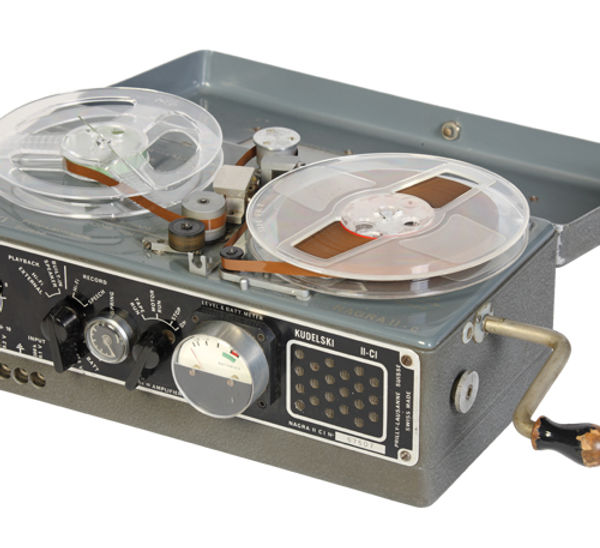
Tape Deck Details
Number of Motors
Full-Track-Mono
Number of Heads
2
Head Configuration
Full-Track-Mono
Wow & Flutter
0.03%
Signal-to-Noise [dB]
50
Dimensions [mm]
280×180×100
Weight [kg]
5.4
Year built
1953 - 1956
Head Composition
Permalloy
Equalization
NAB
Frequency Response
50 Hz to 10 kHz
Speed
7½
Max Reel [inch]
5
Tracks
1/4 Rec/PB
Price
User
Pro
Additional Information
The Nagra II was the first production model of the revolutionary portable tape recorder series, building directly on the prototype Nagra I. Introduced in 1953, it established the Nagra brand as the industry standard for professional location sound for radio and news reporting. The deck was famous for its rugged, almost military-grade construction, capable of working in harsh field environments.
Release Date:1953 (Production Model)
Tape Format: 1/4-inch (6.35 mm) magnetic tape
Track Format: Full-track mono
Tape Speed: Single Speed: 7 1/2 ips (19.05 cm/s)
Motor: TypeClockwork (Spring-wound) motor, providing speed stability without mains power.
Winding Time: One full winding provided approximately 5 minutes of record/playback time.
Electronics: Battery-operated miniature vacuum tubes (valves).
Battery Life: Approximately 30 hours of use.
Weight: Approx. 11.8 lbs (5.4 kg) (considered highly portable for its time).
Frequency Response: 50 Hz to 10 kHz (at 7 1/2 ips)
Signal-to-Noise Ratio: Better than 50 dB:
Wow and Flutter: 0.3% at 7 1/2 ips
Key Improvements and Features over Nagra I
First Production Model: While the Nagra I was a limited prototype, the Nagra II was the first model manufactured in significant numbers, establishing the Kudelski company.
External Modulometer Option: The Nagra II offered the option of an external "Modulometer"—Nagra's proprietary peak-reading VU meter—which provided a more accurate way to set recording levels than the earlier simple indicator.
Enhanced Electronics (Later Versions): Later iterations, such as the Nagra II CI (1955), began incorporating early printed circuit boards (PCBs) to replace complex point-to-point wiring, leading to better reliability and consistency in production.
Built-in Monitor: Included a small internal monitor speaker for playback.
Bias/Erase Circuits: Featured high-frequency stabilized, push-pull bias and erase circuits for professional audio quality.
The Nagra II was crucial for demonstrating that a lightweight, rugged, portable machine could meet the stringent quality requirements of professional broadcast journalism. It was ultimately succeeded by the fully transistorized, servo-controlled Nagra III (1958), which revolutionized filmmaking by introducing the Neopilot sync system.