
Philips N4418
Philips
Netherlands
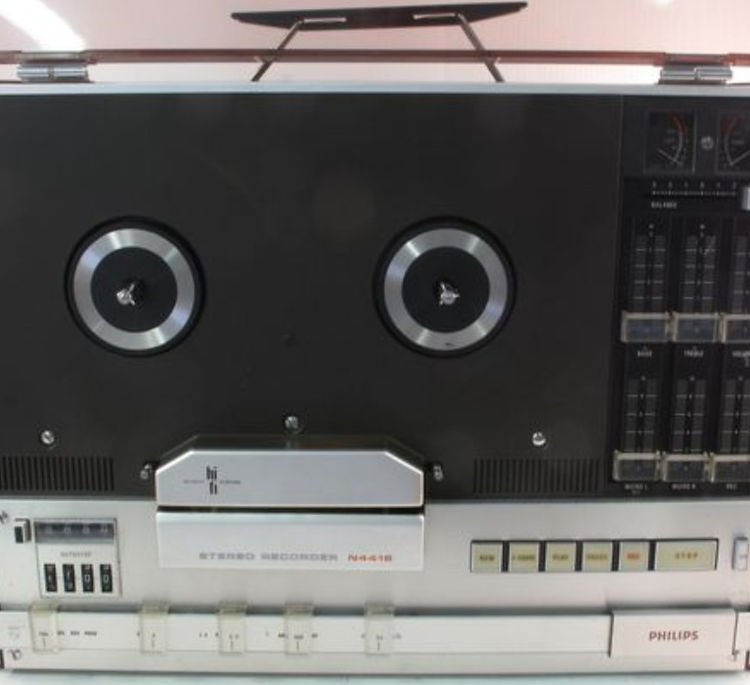
Tape Deck Details
Number of Motors
3
Number of Heads
3
Head Configuration
Stereo
Wow & Flutter
0.15–0.2%
Signal-to-Noise [dB]
45
Dimensions [mm]
535 × 390 × 200
Weight [kg]
13
Year built
1970s
Head Composition
Permalloy
Equalization
Frequency Response
40 Hz – 20,000 Hz
Speed
1⅞, 3¾, 7½
Max Reel [inch]
7
Tracks
1/4 Rec/PB+1/2PB
Price
User
Consumer
Additional Information
The Philips N4418 (including variants like N4418/00 or rebranded as Maestro 4418 in some markets) is a early-to-mid 1970s flagship consumer stereo reel-to-reel tape recorder, produced approximately 1971–1975 (primarily manufactured in Austria by Philips Österreich). It was the top model in Philips' N44xx solid-state hi-fi series, surpassing the N4416 (three motors but mechanical controls) with electronic logic transport controls for smoother, more reliable operation. The N4418 aimed at serious home hi-fi users and amateurs seeking near-professional performance, with full compliance to DIN 45500 hi-fi standards (within tight tolerances using low-noise tape).
This was a 4-track (quarter-track) stereo recorder with true stereo recording and playback in both directions, built-in stereo amplification, dual speakers (often clip-on or integrated), and advanced features like separate tone controls, dual VU meters, and excellent tape handling from its three-motor drive.
Key Technical Specifications
Recording/Playback System — 4-track (quarter-track), 2-channel stereo/mono compatible; records and plays stereo on tracks 1-4 forward and 3-2 reverse; mono compatible; sound-on-sound/multiplay overdub facilities; no auto-reverse.
Tape Speeds — Three speeds:1⅞ ips (4.75 cm/s)
3¾ ips (9.5 cm/s)
7½ ips (19 cm/s)
Reel Size — Up to 7 inches (18 cm) maximum diameter.
Frequency Response (approximate, within DIN tolerances; varies by tape/condition):At 7½ ips: 40 Hz – 20,000 Hz
At 3¾ ips: 40 Hz – 15,000–16,000 Hz (some sources claim 40–18,000 Hz at higher speeds)
At 1⅞ ips: ~60 Hz – 10,000 Hz Hi-fi capable at 7½ ips (exceeding many contemporaries when aligned with quality tape).
Wow & Flutter — Approximately 0.15–0.2% at 7½ ips (excellent thanks to three-motor drive).
Signal-to-Noise Ratio — Better than 45–50 dB (strong transistor performance).
Heads — 3 heads: separate record, playback, and erase (permalloy construction; allows off-tape monitoring).
Drive System — Three motors (1 × capstan + 2 × reel motors); belt/idler drive to capstan; electronic logic controls for transport (smoother than mechanical buttons on N4416); fast wind/rewind; precise braking and tension.
Electronics — Fully transistorized; printed circuit board amplifier.
Amplification & Speakers — Built-in stereo amplifiers; dual internal/clip-on loudspeakers; output power 2 × 10 W (or 10 W total in some descriptions; room-filling for monitoring).
Inputs —Microphone: ≈0.15–0.25 mV (stereo pair).
Line/radio/phono: ≈100 mV.
DIN-style connectors standard.
Outputs —Line out: ≈1 V (or 1000 mV).
Headphones.
External speakers.
DIN-style.
Features —Twin illuminated VU meters (needle type; active for record/playback).
Electronic logic transport controls (push-button with smooth response).
Separate bass/treble tone controls.
Input mixing.
4-digit tape counter.
Off-tape monitoring (straight-through amp).
Pause function.
Stereo indicator lights.
Portable/tabletop design with lid/handle; vertical/horizontal orientation (with hub locks).
Power — AC mains (multi-voltage switchable, e.g., 110–240 V); consumption moderate (higher with built-in amps).
Build & Dimensions — Tabletop case (often wood/teak finish); approx. 515–535 × 380–390 × 200 mm (20.3–21 × 15 × 7.9 inches); weight ≈12–13 kg.
Manufacturing — Primarily Austria (Philips Österreich).
Performance & Legacy Context
The N4418 was Philips' premium consumer open-reel offering in the early 1970s—praised for its three-head design (off-tape monitoring), three-motor stability, electronic logic (reliable soft-touch operation), and hi-fi specs that often exceeded DIN 45500. It delivered excellent stereo imaging, dynamics, and clarity at 7½ ips, making it ideal for serious home recording and playback. The built-in 2 × 10 W stereo amp and speakers allowed direct listening without external gear.
Compared to siblings:
N4416 — Very similar but mechanical push-buttons (no electronic logic).
N4419 — Possible minor refinements or regional variant.
N4408 — Earlier flagship with similar speeds/heads but single-motor drive and mechanical controls.
Common issues today: Belt/idler goo (multiple belts need replacement), dried electrolytic capacitors, transistor aging, dirty heads, worn idler tires/clutches, and occasional logic/flip-flop circuit issues (power supply damage can propagate). Restorations are popular and yield outstanding results—many users report near-pro sound post-service. Service/user manuals widely available (HiFi Engine, Elektrotanya—full schematics, alignment guides, fault trees for logic).