
Sony TC-200
Sony
Japan
Tape Deck Details
Number of Motors
1
Number of Heads
2
Head Configuration
Stereo
Wow & Flutter
0.19% at 7½ ips
Signal-to-Noise [dB]
46
Dimensions [mm]
380 x 227 x 404
Weight [kg]
12
Year built
1963–1968
Head Composition
Permalloy
Equalization
NAB
Frequency Response
50 Hz–14 kHz at 7½ ips
Speed
3¾, 7½
Max Reel [inch]
7
Tracks
1/4 Rec/PB
Price
User
Consumer
Additional Information
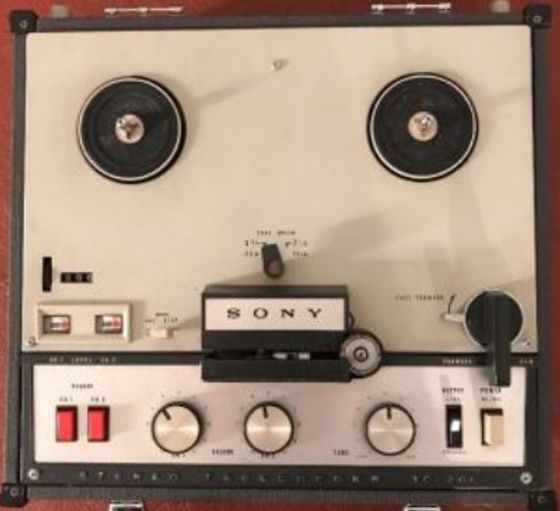
The Sony TC-200 Sterecorder is a classic, mid-1960s (circa 1963–1968) home stereo reel-to-reel deck. It was designed as an all-in-one unit, featuring built-in amplification and speakers, allowing it to function as a complete stereo sound system for both recording and playback.
Technically, the TC-200 is one of Sony's most common and enduring examples of a hybrid reel-to-reel recorder, bridging the gap between the older tube (valve) era and the emerging solid-state (transistor) era.
The Sony TC-200 is a mid‑1960s, quarter‑track stereo reel‑to‑reel recorder with built‑in amplifiers and detachable speakers, aimed at consumer “mid hi‑fi” home use.
Transport and format
Track format: 4‑track, 2‑channel stereo/mono (standard quarter‑track stereo).
Tape speeds: 3¾ ips (9.5 cm/s) and 7½ ips (19 cm/s), selected via a speed control.
Maximum reel size: 7‑inch reels; available recording time up to about 45 minutes per side at 7½ ips and 90 minutes per side at 3¾ ips (stereo), with longer total time in mono.
Heads and drive: 2‑head configuration (erase/record‑playback) with permalloy heads, single‑motor all‑idler mechanism, no auto‑reverse.
Electronics and performance
Electronics: Hybrid design with a solid‑state preamp (silicon transistors and diodes) driving a tube power output stage (valve complement typically 2 x 6267 and 3 x 30A5/30M‑P23).
Output power: Approximately 1.5 W per channel maximum into built‑in or external speakers.
Frequency response: About 50 Hz–14 kHz at 7½ ips (‑3 dB range).
Wow & flutter: ≈0.19% at 7½ ips and ≈0.25% at 3¾ ips.
Signal‑to‑noise ratio: Around 46 dB.
Equalization: NAB standard.
I/O, cabinet and features
Inputs: Two low‑impedance mic inputs (around 600 Ω) and two high‑impedance auxiliary inputs, allowing stereo recording from mics or line‑level sources.
Outputs: Speaker/line outputs switchable via a front‑panel control, plus DIN connection for external hi‑fi amplifiers.
Speakers: Two 16 cm (approx. 6.5") 8‑ohm cone speakers built into the lid halves; the cabinet cover splits so each half can be used as a separate stereo speaker.
Power: AC mains only, around 100–120 V (some markets multi‑voltage), ≈70 W consumption.
Physical: Roughly 380 x 227 x 404 mm (W x H x D) and about 12 kg, with flat‑bed layout, front‑panel VU meters, tone control, tape counter, pause, and temporary stop.
Special functions and use
Sound‑on‑sound / “trick” recording: Can route one channel for playback and the other for recording, enabling overdubs, simple layering, and effects popular with hobbyist recordists of the era.
Role and character: Positioned as a compact all‑in‑one stereo recorder for home hi‑fi and light PA use—though its modest 1.5 W/ch output limits serious public‑address capability, it remains attractive today for its hybrid tube/solid‑state character and detachable‑speaker design.