
Sony TC-540
Sony
Japan
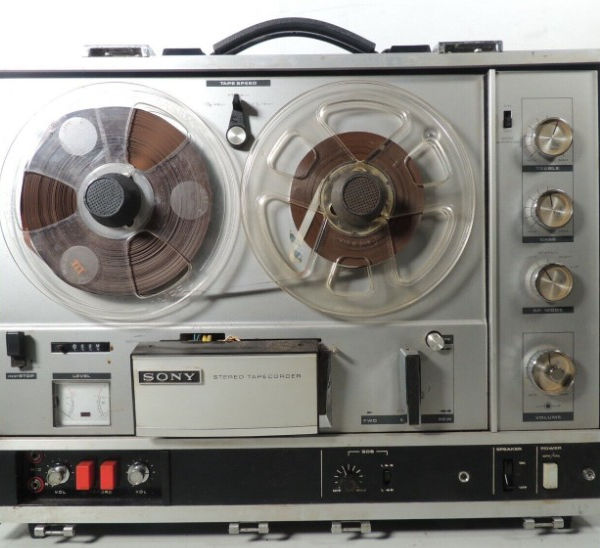
Tape Deck Details
Number of Motors
Number of Heads
2
Head Configuration
Stereo
Wow & Flutter
0.09%
Signal-to-Noise [dB]
50
Dimensions [mm]
502 x 394 x 254
Weight [kg]
19
Year built
1969 - 1972
Head Composition
Permalloy
Equalization
NAB
Frequency Response
30Hz - 20kHz
Speed
1⅞, 3¾, 7½
Max Reel [inch]
7
Tracks
1/4 Rec/PB+1/2PB
Price
User
Consumer
Additional Information
The Sony TC-540, marketed as a "Tapecorder" (Sony's term for an all-in-one tape recorder), is a vintage, solid-state stereo reel-to-reel deck. It was produced in Japan around the late 1960s to early 1970s (approx. 1969–1972), succeeding models like the TC-530. It was designed as a high-quality, fully portable, all-in-one stereo music system.
Key Specifications
Tape speeds: 1 7/8 ips (4.8 cm/s), 3 3/4 ips (9.5 cm/s), 7 1/2 ips (19 cm/s); max 7-inch reels.
Frequency response: 30Hz-20kHz (7 1/2 ips, ±3dB).
Wow and flutter: 0.09% (7 1/2 ips), 0.12% (3 3/4 ips), 0.16% (1 7/8 ips).
S/N ratio: 50dB; THD: 1.2-2%; output power: 20W dynamic (5W RMS/channel).
Dimensions/weight: 502 x 394 x 254 mm; 18.9-19 kg.
Features and Design
Equipped with Sony's XL-4 Quadradial system using four speakers (two 4x8-inch woofers in cabinet, two 4-inch tweeters in detachable lid), sound-on-sound recording, scrape flutter filter, pause, inching, and vertical/horizontal operation. Inputs include mic (0.195mV/600Ω) and line (78mV/100kΩ); outputs feature line (0.775V/100kΩ) and 8Ω speakers/headphones. Rated 5/10 for sound quality and reliability due to single-motor design and age-related issues like belt/pulley wear.
Strengths & For What Use It’s Good
As a self-contained tape system, TC-540 was very convenient — you didn’t need external amplifier or speakers. Good for homes, small spaces, or users wanting an “all-in-one” solution.
With 7½ ips speed and 4-track stereo format, it could deliver decent fidelity for music playback or home recording — reasonable frequency response and acceptable wow/flutter for a consumer deck of its time.
The built-in speaker system (especially with the “Quadradial” speakers) gives surprisingly full sound for a domestic deck — adequate for casual listening.
The “sound-on-sound” and overdubbing capability add flexibility for recording — e.g. home demos, simple multi-layer recordings, voice + music overdubs.
For vintage-audio collectors and enthusiasts, TC-540 is a nice example of late-60s / early-70s “all-in-one” reel-to-reel tapecorder design — combining portability (relatively compact for a reel deck), versatility, and historical value.
Limitations & What to Watch Out For (Especially Today / When Buying Used)
Performance specs are modest by modern standards: SNR ~ 50 dB, THD ~ 2%, and built-in amp power ~ 5 W/channel — so hiss/noise floor, limited dynamic range, and modest loudness — using external speakers/amp will usually sound much better.
As a vintage transistor unit, with many decades behind it — mechanical parts (capstan, belts, pinch-roller, motors) and electronic parts (capacitors, wiring, transistors) may degrade; servicing / re-lubrication / recap likely needed for reliable operation.
Maximum reel size 7″ limits tape runtime compared to larger professional machines.
While the “sound-on-sound” is a nice feature, the fidelity and noise performance of the deck may make the result more “lo-fi vintage” than high-fidelity by modern standards.
For serious archiving, mastering or professional-quality recording: expect limitations — especially with noise floor, frequency response at lower tape speeds, and stereo field — better to consider a higher-end deck if available.
Historical / Contextual Notes
TC-540 was part of a generation of late-1960s/early-1970s Sony tapecorders — aimed at home users who wanted tape playback, recording, amplification and speakers in one box.
The “Quadradial” speaker system reflects a design ambition beyond the simplest “bare deck + external amp” — Sony treated it as a complete domestic audio system.
While by today’s standards the specs are modest, at the time it was a fairly capable and feature-rich recorder for home use; as such, it also represents a slice of audio history and consumer audio culture in the transition from monaural and simple tape recorders to stereo hi-fi gear.