
Sony TC-600
Sony
Japan
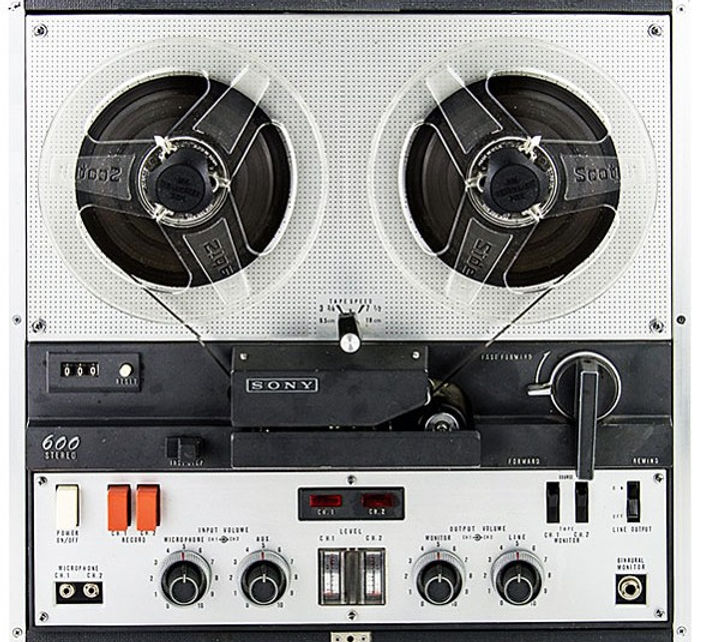
Tape Deck Details
Number of Motors
1
Number of Heads
3
Head Configuration
Stereo
Wow & Flutter
0.15%
Signal-to-Noise [dB]
50
Dimensions [mm]
467 x 425 x 273
Weight [kg]
22
Year built
1964 - 1967
Head Composition
Permalloy
Equalization
NAB
Frequency Response
30Hz - 18kHz
Speed
3¾, 7½
Max Reel [inch]
7
Tracks
$450
1/4 Rec/PB
Price
User
Consumer
Additional Information
The Sony TC-600 is a mid‑1960s hybrid (tube + transistor) stereo reel‑to‑reel recorder, sold as a fairly high‑grade consumer deck with 7‑inch reels, two speeds, and a built‑in stereo amplifier and speakers (on the TC‑600; the TC‑600D is deck‑only).
Basic configuration and transport
Quarter‑track, 2‑channel stereo/monaural format using ¼‑inch tape; designed primarily for home hi‑fi and semi‑serious recording rather than institutional use.
Two speeds: 7 1/2 ips and 3 3/4 ips, giving a frequency response (±3 dB) of about 30 Hz–18 kHz at 7 1/2 ips and 30 Hz–13 kHz at 3 3/4 ips.
Single hysteresis‑synchronous motor driving the transport, with three heads on the TC‑600D (record, playback, erase) and two on the TC‑600 complete recorder; quarter‑track stereo head layout.
Electronics and audio performance
Hybrid electronics: valve complement typically 2 × 6AN8, 4 × 12AT7, 1 × 12BH7A, 1 × 6CA4 plus six 2SD64 transistors, giving tube‑style gain stages with solid‑state support.
NAB equalization, 100 kHz bias, S/N ratio around 50 dB and wow/flutter about 0.15% at 7 1/2 ips (<0.2% at 3 3/4 ips), which was competitive for mid‑1960s consumer machines.
Power output (TC‑600 only) about 3 W per channel into two built‑in 6‑inch speakers, enough for standalone use without an external amp.
Controls, I/O, and ergonomics
Transport controlled by a large rotary selector (play/stop/rewind/fast‑forward) plus interlocked red record buttons, with level indicated by two small edge‑type VU meters.
Inputs: low‑impedance microphone and high‑impedance auxiliary (approx. 80 mV); outputs: line out around 1.5 V and a stereo monitor jack, both high‑impedance, plus 600 Ω line noted in some documentation.
Facilities include basic editing/dubbing, tape index/cutoff, and stereo/mono operation; no auto‑reverse.
Physical characteristics and reliability
Dimensions roughly 467 × 425 × 273 mm; weight about 22 kg (48 lb), making it a substantial tabletop unit rather than a true portable.
Contemporary assessments place sound quality around 6/10 and long‑term reliability around 7/10: heads are soft by modern standards and lubrication and capacitors typically need attention, but a serviced unit can still perform well for music playback and light recording.
Strengths & What the TC‑600 Offers (Especially in Its Time)
For an early 1960s domestic reel recorder, the TC‑600 offered a full 4‑track stereo system — relatively advanced for home use then.
The built‑in amplifier + speakers (in the TC‑600 “sterecorder” version) made it a self‑contained solution: you didn’t need separate hi‑fi equipment to play tapes. Useful in simpler setups or in homes without a full audio chain.
The quarter‑track stereo format combined with selectable tape speeds gave a balance between tape runtime and audio fidelity — users could choose between longer recording time (3¾ ips) or better frequency response (7½ ips).
Its mechanical simplicity (single‑motor, 3‑head design) likely made it more robust and easier to maintain — fewer moving parts vs more complex multi‑motor decks.
As a vintage piece, it represents early‑generation tape‑recorder design and is of interest for audio‑history enthusiasts or collectors.
Limitations & What to Be Mindful of (Especially if Using/Restoring Today)
Audio fidelity is modest by modern standards: 50 dB SNR, limited frequency response especially at lower speed, and significant wow/flutter/noise compared to modern decks or digital playback. Expect hiss/noise floor, limited dynamic range.
As a hybrid tube/transistor design from the 1960s — aging electronic components (tubes, capacitors) are a concern; many units will likely need maintenance, recap, head cleaning / alignment, and possibly repair of the transport.
Only quarter‑track stereo — not high‑fidelity half‑track or professional ½" two‑track — this limits ultimate sound quality.
Limited reel size (7″) and basic transport — not ideal for long recordings or serious archival/mastering work.
If you have the “deck‑only” version (TC‑600D), you’ll need external amplifier + speakers or good headphones — built‑in audio is not available.
Tapes themselves (if old) may have degraded; tape condition will strongly influence playback quality.
Practical Use Cases or Why Someone Might Still Use a TC‑600 Today
The TC‑600 can still make sense today if you:
Have old quarter‑track stereo tapes from the 1960s–70s and want to play or digitize them in a period‑correct machine.
Appreciate vintage audio gear — you enjoy the aesthetic, mechanical design and historical character of early tape recorders.
Are willing to service and maintain the machine (clean/align heads, possibly recap electronics, check/replace belts or rubber).
Use it more for nostalgic or hobby‑level listening / recording, not for modern high-fidelity audio — perhaps for lo‑fi sound, retro vibes or archival retrieval, not audiophile-standard fidelity.