
Sony TC-755
Sony
Japan
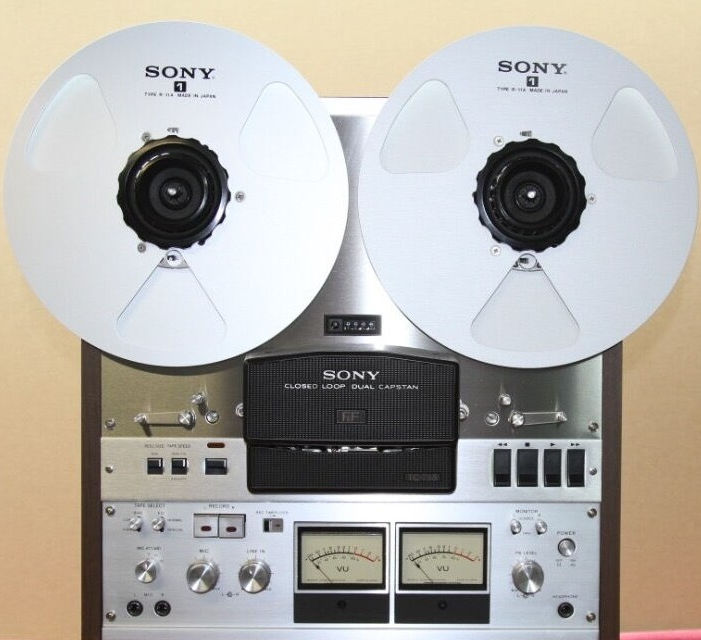
Tape Deck Details
Number of Motors
3
Number of Heads
3
Head Configuration
Stereo
Wow & Flutter
0.05%
Signal-to-Noise [dB]
53
Dimensions [mm]
435 x 451 x 221
Weight [kg]
24
Year built
1973 - 1976
Head Composition
Ferrite
Equalization
NAB
Frequency Response
30Hz - 25kHz at 7½ ips
Speed
3¾, 7½
Max Reel [inch]
10.5
Tracks
$700
1/4 Rec/PB
Price
User
Consumer
Additional Information
The Sony TC-755 is a high-performance stereo reel-to-reel deck from the mid-1970s (circa 1974–1977). It was positioned near the top of Sony's consumer hi-fi lineup, representing a significant technical leap over the earlier single-motor, two-head decks (like the TC-200 series).
The TC-755 is defined by its robust three-motor, three-head architecture, designed for superior audio quality and professional-level tape handling.
General Description & Design Features
The Sony TC-755 is a 4-track, 2-channel (i.e. stereo or mono) reel-to-reel tape recorder/player, intended for consumer or hi-fi use.
It uses a 3-head design: separate heads for erase, record, and playback — a fairly advanced setup compared to simpler 2-head decks.
The tape transport is a dual-capstan, closed-loop drive — this design helps keep tape tension stable and tape-to-head contact consistent, reducing wow & flutter and improving overall fidelity.
Motorization: 3 motors in total — one capstan motor (AC-servo controlled) plus two separate reel motors.
Accepts large reels — up to 10.5 inches (≈ 26–27 cm) in diameter, which means long tapes and longer playing/recording times per reel.
Controls are “logic-controlled” with “feather-touch” buttons (i.e. play, record, stop, rewind/fast-forward, pause, etc.). The controls are designed such that you can press them in any sequence without damaging the tape — a convenience/robustness feature.
The deck supports standard tape equalization (NAB) and has bias/equalization selectors — for better compatibility with different tape types.
Technical Specifications
Track / Channel system: 4-track, 2-channel (stereo / mono)
Tape speeds: 3 ¾ ips (≈ 9.5 cm/s) and 7 ½ ips (≈ 19 cm/s)
Reel size (max): 10.5 inches (≈ 26 cm)
Heads: 1 × erase, 1 × record, 1 × playback (three-head)
Motors: 1 × capstan (AC-servo), 2 × reel motors (independent)
Frequency response: (3¾ ips) ~ 40 Hz – 16 kHz
Signal-to-noise ratio: (S/N)~ 53 dB (normal tape), ~ 56 dB (SLH tape)
Typical distortion / THD: ~ 1.2%
InputsLine: ~ 60 mV (100 kΩ), Mic: ~ 0.2 mV (low-impedance)
OutputLine: ~ 0.43 V; Headphones: 8 Ω
Size / Dimensions: 435 × 451 × 221 mm (≈ 17.2″ × 17.8″ × 8.7″)
Weight: ~ 24 kg (≈ 53 lb)
Strengths & Typical Use Cases
The dual-capstan, servo-driven mechanism gives very stable tape transport — reduced wow & flutter, better consistency, and reliable tape-to-head contact. This makes the TC-755 quite good for high-fidelity playback and decent-quality recording for its time.
The three-head design is a plus: you can monitor playback via separate heads while recording (or use the erase head), which gives flexibility and better quality control.
The ability to use large 10.5″ reels means long play/record durations — practical for archiving, long music sets, rehearsals, or continuous recording.
The sturdy build (“tank-like”) — many owners praise its mechanical simplicity and robustness; with maintenance it can run for decades.
Good for collectors or vintage-audio enthusiasts: the analog “warmth,” the tactile controls, and the vintage aesthetic (wood panels + aluminum faceplate) have appeal beyond pure function.
⚠️ Limitations & What to Watch Out For
Compared to modern gear, signal-to-noise ratio (~56 dB) and distortion (~1.2%) are modest by today’s standards. Noise floor and distortion are acceptable but not “studio-grade.”
The lower speed (3¾ ips) limits high-frequency response (only up to ~16 kHz), so for maximum fidelity you’d generally want to use 7½ ips tape — which consumes tape faster.
As a vintage unit, many surviving examples now require maintenance: lubricants may have dried, belts/pinch rollers aged, transport components may be worn — all typical for ~50-year-old gear. Indeed, in some restored units owners reported needing to replace pinch rollers, belts, brake linings, or re-calibrate the deck for proper alignment.
Because tapes themselves age/deteriorate, playback of old tapes may be problematic (dropouts, “sticky-shed”, poor sound) — common caveat for any vintage reel-to-reel system.
The unit is heavy (~24 kg) and bulky — not ideal for frequent moving or compact setups.
🎯 Typical Uses & Relevance Today
While the TC-755 was never a fully professional mastering deck, it remains a solid choice today if you want to:
Play back legacy tapes (archives, old recordings, mixtapes).
Record or “bounce” analog audio — e.g. rehearse with a band, capture live sessions, or experiment with tape saturation/analog warmth.
Use as a vintage piece in a Hi-Fi system or for hobbyist analog audio projects.
Collect or restore vintage audio gear — many TC-755 units are now “serviced,” refurbished, or sold as parts/restoration projects.