
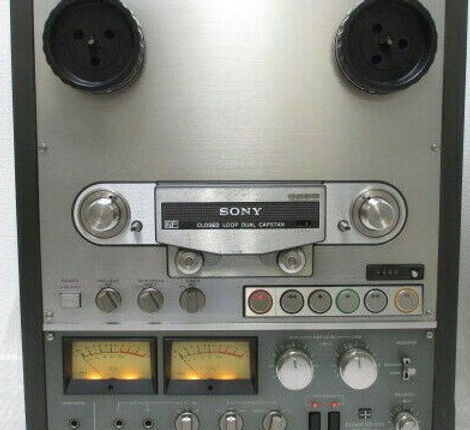
Sony TC-R7-2
Sony
Japan
Tape Deck Details
Number of Motors
3
Number of Heads
4
Head Configuration
Stacked/Inline
Wow & Flutter
0.018% at 15 ips
Signal-to-Noise [dB]
65
Dimensions [mm]
521 x 445 x 235
Weight [kg]
26.6
Year built
1977 - 1982
Head Composition
Ferrite
Equalization
NAB
Frequency Response
30Hz – 22kHz at 15 ips
Speed
7½, 15
Max Reel [inch]
10.5
Tracks
1/2 Rec/Play+1/4PB
Price
User
Semi-Pro
Additional Information
Sony’s TC-R7-2 is a late-1970s Japanese-market high-end open-reel tape deck (equivalent to the international TC-766-2), featuring a 3-motor belt-driven transport, 4-head configuration with ferrite heads, and dual-speed operation at 19 cm/s (7½ ips) and 38 cm/s (15 ips) for ¼-inch tape on up to 10.5-inch reels. It supports half-track stereo recording/playback plus quarter-track stereo playback compatibility, targeting audiophiles and semi-pro users with its closed-loop dual-capstan-like stability and low wow/flutter of 0.018% WRMS at 15 ips.
Track and Head System
Employs four heads: erase, record (half-track), half-track playback, and quarter-track playback for versatile stereo operation and legacy tape compatibility.
Ferrite construction ensures durability and high-frequency response, with frequency response of 30 Hz–22 kHz (±3 dB) at 15 ips.
Transport and Performance
The 3-motor system (capstan plus reel motors) delivers precise tape handling, 65 dB S/N ratio, 0.5% harmonic distortion, and speed tolerance of 0.5% at 15 ips, making it one of Sony's top consumer/prosumer decks before open-reel's decline. Dimensions are 521 x 445 x 235 mm at 26.6 kg, with NAB/Other equalization, RCA I/O, and Japan 100V power.
In addition, the TC‑R7‑2 includes features more common in professional/semi‑pro decks:
Closed‑loop dual‑capstan drive for stable tape motion and precise speed regulation.
“Feather‑touch” logic‑controlled transport — you can change modes (rewind → play, stop, record) without mechanical shock, improving tape & head longevity.
Independent record / playback monitoring, mixable line + mic inputs, optional remote control (with external remote unit), and a reel‑size selection switch.
Overall — the TC‑R7‑2 was one of the best‑built consumer/semi‑pro reel decks Sony made (on par with its worldwide twin TC‑766‑2).
Strengths — Where TC‑R7‑2 Shines (Even Today)
Very stable and precise tape transport — the dual‑capstan servo system yields extremely low wow/flutter (0.018 % at 38 cm/s). This makes the deck ideal for critical playback or recordings that need stable speed/pitch.
Good fidelity potential for its class — frequency response and SNR (with good tape) are strong, making it suitable for serious stereo music playback, archival work, or home‑studio recordings.
Great flexibility with tape formats — half‑track stereo recording + quarter‑track playback head gives you the ability to use both stereo recordings and already existing 4‑track tapes.
Large reel capacity (10.5") — useful for long recordings (concerts, sessions) or long playback sessions without frequent reel changes.
Professional‑style features — mixing inputs, logical transport controls, monitoring, remote‑control support make it versatile for studio‑like work or more advanced home use.
In short: for a non‑studio budget, TC‑R7‑2 approaches “near‑professional” performance for tape playback/recording.
⚠️ Limitations & What to Watch Out For (Especially on Vintage / Used Units)
Even though specs are good, noise floor and dynamic range are still limited compared to modern digital — expect noise/hiss especially on quieter material or older tapes.
As a quarter‑inch half‑track / quarter‑track deck, it's still less capable than half‑inch or multitrack studio decks — headroom, stereo separation and dynamic range remain constrained by format.
Tape‑path and maintenance sensitivity — because of precision mechanics (capstans, pinch rollers, servo motor), wear on pinch rollers or capstan belts, dirt/dust on heads or tape‑path can degrade performance more severely than simpler decks. Regular maintenance, head cleaning/demagnetizing, and careful alignment are important.
Original voltage / region limitation — many TC‑R7‑2 units were made for the Japanese market (100 V mains), so running in countries with different voltage may require transformer or voltage conversion.
Parts / tape‑type dependency — for best performance, “Duad / high‑bias / FeCr” tape is recommended. Using low‑grade tape reduces fidelity, increases noise, and stresses heads over time.
Who the TC‑R7‑2 Makes Sense For Today — Use Cases & Recommendations
The Sony TC‑R7‑2 remains a solid choice for vintage‑audio enthusiasts, home‑studio owners, or anyone wanting good-quality open‑reel playback/recording — especially if you:
Want a stable, high‑fidelity stereo reel deck without venturing into bulky half‑inch studio machines.
Have good-quality tape (high‑bias / FeCr / Duad) and want to maximize fidelity with proper bias/EQ and maintenance.
Are interested in archiving tapes, digitizing analog material, or recording in analog — TC‑R7‑2 offers the transport stability and flexibility for such tasks.
Appreciate vintage gear build quality and repairability — the deck’s robust mechanics and logic controls give a good platform for restoration, maintenance, and long-term use.
Seek a “sweet‑spot” between budget and quality — higher than basic home tapecorders, but much more manageable than large pro decks in size, complexity, and cost.