
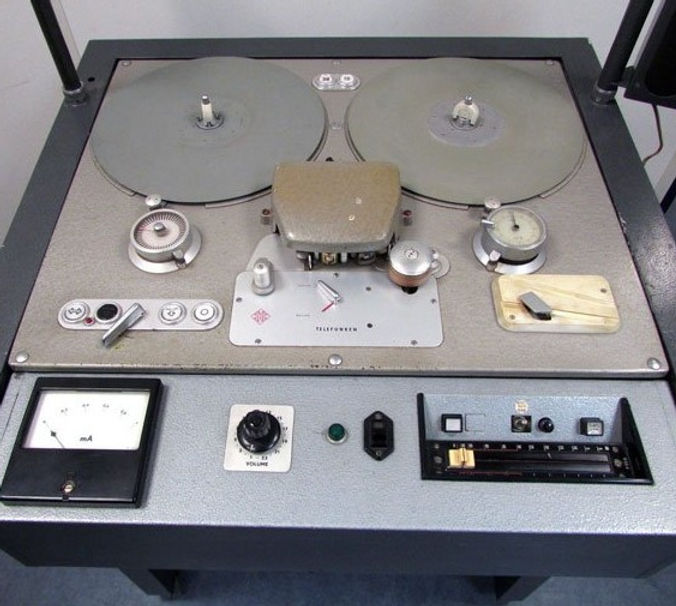
AEG/Telefunken Magnetophon M10
AEG/Telefunken
Germany
Tape Deck Details
Number of Motors
3
Number of Heads
3
Head Configuration
Stacked/Inline
Wow & Flutter
0.15%
Signal-to-Noise [dB]
58
Dimensions [mm]
645 x 525 x 308
Weight [kg]
63
Year built
1957–1973
Head Composition
Alfenol
Equalization
NAB
Frequency Response
31.5 Hz–18 kHz
Speed
7½, 15, 30
Max Reel [inch]
10.5
Tracks
1/2 Rec/PB
Price
User
Pro
Additional Information
The AEG Telefunken Magnetophon M10 is a professional studio-grade open-reel tape recorder from 1957–1973, produced by Telefunken under AEG's Magnetophon division in Germany. Designed for broadcast and recording studios, it featured advanced mechanical engineering with double capstan drive and solid-state electronics in later variants, earning 9/10 sound quality ratings for exceptional frequency response and low distortion.
Key Technical Specifications
Track System: 1/2 track mono recording/playback (2-track stereo capability in M10A/B variants)
Tape Speeds: 7½ ips (19 cm/s), 15 ips (38 cm/s), 30 ips (76 cm/s)
Maximum Reel Size: 10.5 inches (26.7 cm) NAB hubs
Heads: 3 heads (erase, record, playback) — Alfenol composition (guaranteed 10,000 hours); stacked/inline configuration
Motors: 3 motors — dual hysteresis synchronous capstans (pre- and post-headblock) plus reel motor for precise tension/speed stability
Frequency Response: 31.5 Hz–18 kHz (±0.5 dB) at 15 ips; even flatter at 30 ips
Wow and Flutter: <0.15% at 15 ips (reaches spec in 1 second from start)
Signal-to-Noise Ratio: 58 dB at 15 ips; 54 dB at 7½ ips
Total Harmonic Distortion: <0.2% across recording levels (exceptionally low)
Electronics: Solid-state (later models); modular printed circuit boards for record/replay amps with independent EQ/bias per speed
Inputs/Outputs: Balanced XLR (mono/stereo), DIN sockets; symmetrical circuitry (5 kΩ in, 40 Ω out)
Equalization: IEC/NAB with speed-specific calibration
Features:
Dual tape tension settings (small/large reels)
Variable rewind speed, stroboscopic speed indicator
Front-accessible trimpots (except 80 kHz bias traps)
6-second fast-forward/reverse transition without stretchPower Requirements: 220–240 V AC, 55 W
Dimensions: 645 x 525 x 308 mm (25.4" x 20.7" x 12.1")
Weight: 63 kg (138.7 lbs)
Build: Heavy-duty studio rackmount with wooden transport surround; amps mounted below deck
Variants and Context
M10: Base professional model (1957–1961)
M10A: Updated with stereo amp rack (V396/V397); 19/38 cm/s speeds common
M10B: Later solid-state evolution
Rare 19/38 cm/s configuration (vs. common 38/76 cm/s); original 220V/50Hz versions
Priced as broadcast-grade equipment, the M10 excelled in mechanical precision (double capstan eliminated wow), distortion-free recording, and flat response that rivaled contemporary Studer machines. Reviews praised its test-tape accuracy and rapid speed stabilization. Modern ownership requires specialist restoration (head alignment, motor bearings). A benchmark of German engineering bridging tube and transistor eras, collectible today for studio heritage and reference playback potential.