
AEG/Telefunken Magnetophon M20
AEG/Telefunken
Germany
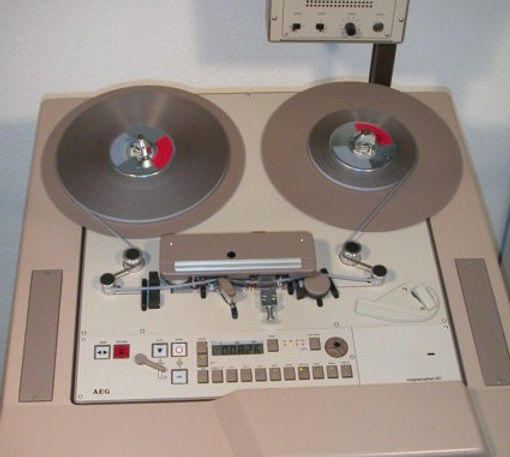
Tape Deck Details
Number of Motors
3
Number of Heads
3
Head Configuration
Wow & Flutter
0.04%
Signal-to-Noise [dB]
79
Dimensions [mm]
Weight [kg]
45
Year built
1980–1989
Head Composition
Vitrovac
Equalization
NAB
Frequency Response
20 Hz – 20 kHz
Speed
7½, 15, 30
Max Reel [inch]
12.5
Tracks
1/2 Rec/PB
Price
User
Pro
Additional Information
The AEG-Telefunken Magnetophon M20 (also known as Magnetophon M20 or M 20) is a professional studio/mastering reel-to-reel tape recorder, produced approximately 1980–1989 (manufactured in Germany by AEG-Telefunken). It was the flagship model in the final generation of analog open-reel machines from AEG-Telefunken, succeeding the well-known M15a series. The M20 was a high-end professional deck designed for broadcast, mastering, and studio applications, featuring advanced computer control, electronic tape tension, and high-speed capability. It was sold in limited numbers (around 240 units total for the M20 series), making surviving examples rare and highly sought-after by collectors and pro-audio enthusiasts. The M21 (reduced-capability variant) was its sibling, with the M20 often considered the pinnacle of AEG-Telefunken's analog tape technology before the division was sold to Studer in 1989.
This was a ½-inch (12.5 mm) wide tape machine, typically 2-track (half-track stereo) or configurable for mono/full-track, optimized for professional mastering with wide dynamic range and low noise.
Key Technical Specifications
Recording/Playback System — 2-track (half-track) stereo (standard professional configuration); mono/full-track variants possible; high-headroom mastering/broadcast focus; full-servo edit capability.
Tape Speeds — 4 selectable speeds:9.5 cm/s (3.75 ips)
19 cm/s (7.5 ips)
38 cm/s (15 ips)
76 cm/s (30 ips) (Programmable; high speeds for maximum fidelity in mastering).
Reel Size — Up to 12.5 inches (32 cm) NAB hubs or pancakes; minimum core diameter 1¾ inches.
Frequency Response (approximate, typical for pro mastering):At 76 cm/s (30 ips): 20 Hz – 20 kHz ±1 dB (flat, excellent low-frequency response via asymmetrical head poles).
At 38 cm/s (15 ips): 20 Hz – 20 kHz ±1–2 dB. Broadcast/mastering-grade with low phase distortion.
Wow & Flutter — Extremely low: ~0.04% or better at 76 cm/s (quartz-locked servo and electronic tension ensure stability).
Signal-to-Noise Ratio — High: ~70–79 dB (depending on speed and tape; pro-grade with low-noise tape).
Heads — 3 heads: separate record, playback, and erase (high-quality Vitrovac or similar butterfly heads in some units; 0.75 mm track separation possible).
Drive System — Three motors (direct-drive capstan + two reel motors); electronic tape tension servo (no belts for capstan in some configs); computer-controlled (8085 processor) with programmable bias/EQ/level for 3 tape types; autolocator (4 positions); variable winding speed; full-servo edit; scissor arrangement for head block.
Electronics — Fully transistorized/digital hybrid; programmable parameters (bias, EQ, level stored digitally); separate symmetric power supplies for spooling and capstan.
Inputs/Outputs — Balanced professional line-level (XLR or similar); monitor/headphone out; broadcast-standard connectors.
Features —Electronic tension control.
Programmable tape type memory (3 types).
Autolocator with 4 positions.
Variospeed.
Variable winding speed.
Full-servo edit.
Rack-mountable (19" format; compact for studios).
Power — AC mains (multi-voltage); high consumption (professional power supply).
Build & Dimensions — Massive die-cast aluminum chassis; rack-mountable; weight ~45 kg (deck) + ~32 kg (rack); very heavy and robust for studio use.
Manufacturing — Germany (AEG-Telefunken); limited production (low volumes due to high cost and professional focus).
Performance & Legacy Context
The Magnetophon M20 was a professional mastering/broadcast workhorse—built for precision, with ultra-low wow/flutter, wide bandwidth (flat ±1 dB from 20 Hz–20 kHz at 30 ips), and electronic tension ensuring gentle tape handling and consistent performance at high speeds. It delivered clean, professional sound with excellent dynamics and low noise—comparable to the best analog mastering decks of the 1980s (e.g., Studer A80, Ampex ATR-100). The computer control (8085 processor) and programmable parameters made it highly versatile for studios.
Surviving examples are extremely rare (mostly collector/studio pieces; often needing restoration). They are prized for historical importance as one of the last great analog pro recorders from AEG-Telefunken before the Studer sale. Restorations are complex due to electronic tension, processor, and head quality—service manuals exist (German originals; some shared online via collector sites, e.g., Dropbox links from forums).
Common issues today: Dried electrolytic capacitors, transistor/processor aging, electronic tension faults, dirty heads (alignment critical), worn idler tires/clutches, and mechanical wear on heavy transport. Service info scarce (mostly German; some Dropbox/shared PDFs from collectors).
Compared to siblings:
Magnetophon M21 — Reduced-capability variant (M20 as flagship).
M15/M15a — Earlier pro models (M20/M21 as successors).
M20 — Pro studio/mastering deck with computer control and high-speed capability.