
AEG/Telefunken Magnetophon M28
AEG/Telefunken
Germany
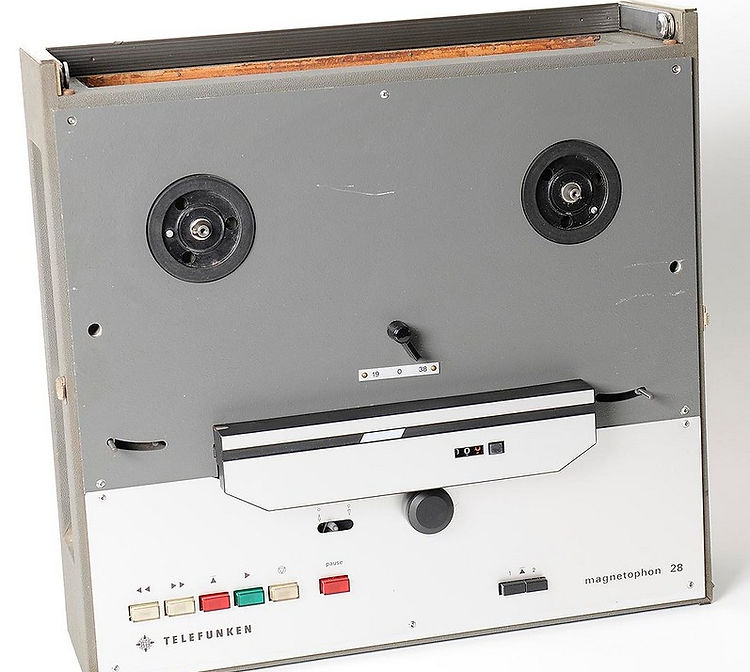
Tape Deck Details
Number of Motors
3
Number of Heads
3
Head Configuration
Stereo
Wow & Flutter
0.12%
Signal-to-Noise [dB]
60
Dimensions [mm]
483 x 160 x 409
Weight [kg]
40
Year built
1967–1972
Head Composition
Permalloy
Equalization
NAB
Frequency Response
30 Hz–20 kHz
Speed
7½, 15, 30
Max Reel [inch]
10.5
Tracks
1/2 Rec/PB
Price
User
Pro
Additional Information
The AEG Telefunken Magnetophon M28 is a professional studio-grade open-reel tape recorder from 1967–1972, produced by Telefunken under AEG's Magnetophon division in Germany. Known as the "workhorse" of German broadcast and recording studios, it featured robust construction, solid-state electronics, and exceptional mechanical reliability that earned it a legendary reputation among engineers.
Key Technical Specifications
Track System: 2-track stereo / half-track mono (¼-inch tape)
Tape Speeds: 7½ ips (19 cm/s), 15 ips (38 cm/s), 30 ips (76 cm/s)
Maximum Reel Size: 10.5 inches (26.7 cm) NAB hubs
Heads: 3-head configuration (erase, record, playback) with permalloy laminations
Motors: 3-motor transport — dual capstan system (hysteresis synchronous capstans + reel motors)
Frequency Response: 30 Hz–20 kHz (±2 dB) at 15 ips; extended range at 30 ips
Wow and Flutter: <0.12% at 15 ips (broadcast standard)
Signal-to-Noise Ratio: >60 dB (CCIR weighted)
Total Harmonic Distortion: <1% at 0 VU levels
Electronics: Solid-state modular amplification with professional-grade preamps
Inputs/Outputs: Balanced XLR connectors, DIN sockets for German broadcast compatibility
Equalization: NAB/IEC switchable with tape-type calibration
Features:
Electronic tension control for consistent tape path
Remote control capability
Front-panel bias/EQ calibration
Variable speed operation (±10%)Power Requirements: 220–240 V AC, 50/60 Hz
Dimensions: 483 x 160 x 409 mm (19" rackmount standard)
Weight: ~35–40 kg (77–88 lbs)
Design and Build Context
The M28 was engineered for continuous professional duty in radio stations, TV post-production, and record plants. Its dual-capstan transport maintained constant tape tension across the entire reel, eliminating the speed variations common in single-capstan consumer decks. The solid-state electronics provided clean amplification with low noise floor, while the mechanical design prioritized longevity over convenience.
Variants:
M28A/B/C: Progressive updates with refined electronics
Rackmount versions for studio integration
Often paired with external Telefunken mixers and monitor amps
Priced as broadcast equipment (~DM 6,000+ new), the M28 competed with Studer A80 and Ampex models but distinguished itself through German precision engineering. Contemporary reviews praised its "hard as a rock" reliability and transparent sound.
Modern Status
Rare collectibles today; restoration focuses on recap of solid-state boards, pinch roller replacement, and head alignment. Among Telefunken's most sought-after professional decks, sitting between the earlier M10/M15 and later M20 computational models in the evolutionary chain.