
The Linn LP12, A Living Restoration

What Stays Original and What Gets Updated
A Guide to the Machine That Never Stopped Evolving
Analog Soundware Restoration Lab for audiophiles , collectors, audio designers and restorers

There is a thought experiment I find myself returning to whenever a Linn LP12 arrives in my listening room for assessment. It goes something like this: if you replace the sub-chassis, then the bearing, then the motor, then the armboard, and finally the plinth itself. Of course each time with a newer Linn-approved component, at what point, precisely, did the original turntable cease to exist? This is not a rhetorical trick designed to embarrass anyone. It is a genuinely useful question, and the LP12 is almost uniquely positioned to raise it. Unlike virtually any other turntable produced in the last fifty years, it has never actually gone out of production. Linn has continued to develop, revise, and issue new components for it since 1972. The machine has been in continuous conversation with itself.
That continuity is part of what makes the LP12 so compelling, and also what makes restoring one or deciding how to restore one an exercise that rewards careful thought rather than automatic assumptions.
_______________________________________________________________________________________
The Specification Problem
When you restore a Thorens TD-124 or a Garrard 301, the target is broadly understood. You are trying to return the machine to a high standard of its original self, perhaps with sympathetic upgrades where the original engineering was genuinely compromised, but the philosophical direction is clear. The machine existed in a specific era, with specific design intentions, and your role is largely archaeological.
The LP12 refuses this framing. Walk into a specialist dealer today and you can purchase a brand-new LP12, the Klimax specification. That is for the kind of money that would have seemed fantastical when the turntable was conceived in Ivor Tiefenbrun's Glasgow workshops. The Klimax LP12 as currently configured includes the Keel sub-chassis, the Radikal DC motor and power supply, the Karousel bearing, and optionally the Ekstatik cartridge on an Ekos SE arm. This is not what was produced in 1972. It is not even close to what was produced in 1995. And yet it is, according to Linn, an LP12.
This creates a specific challenge for the person who has acquired a mid-period LP12 . Say, a late-1980s or early-1990s example with an original steel sub-chassis, a Valhalla power supply board, and the older thrust bearing, and who wants to do it right. The honest answer is that "doing it right" depends enormously on what you want the machine to be, and that clarifying that question before spending money is the most valuable thing you can do.

Sub-Chassis: Steel, Cirkus, and Keel
The original steel sub-chassis is the foundation on which the LP12's reputation was built. It is not a crude component. Properly set up, and from my own experience, the LP12 is notoriously sensitive to setup, a fact worth keeping front of mind throughout any restoration discussion. The original steel sub-chassis produces a musical coherence that has satisfied serious listeners for decades. I have heard original-spec LP12s, correctly dressed and adjusted, that embarrass much newer and more expensive alternatives. The steel sub-chassis is not something to be automatically discarded.
The Cirkus upgrade, introduced in 1993, revised the inner platter and bearing housing in ways that tightened the bass and improved channel separation. It was a meaningful change, and a good second-hand example of the Cirkus bearing assembly, properly installed, represents genuinely good value in a restoration context. Most LP12s of a certain age encountered outside specialist collections will already have the Cirkus upgrade fitted, simply because it was so widely adopted.
The Keel, introduced in 2007 and machined from a single billet of aerospace-grade aluminium, is a different proposition entirely. It is demonstrably superior to both its predecessors in terms of resonance control and the rigidity of the arm-to-bearing relationship, and the improvement it makes to the LP12's soundstage and low-level resolution is not subtle. But the Keel costs serious money. Current pricing puts it well above £3,000. Fitting it to a modest LP12 raises the question of proportionality. Dropping a Keel into a turntable that still has a worn bearing and an elderly Valhalla board is a bit like fitting Brembo carbon-ceramic brakes to a car with perished tyre sidewalls. You have addressed one variable while leaving others that will limit the overall result.
There is also the question of what you are restoring to. A steel sub-chassis LP12, thoughtfully reconditioned and properly set up, is a historically coherent machine. A Keel-equipped LP12 with the rest of the ancillaries left in their original state is something less than coherent. If the Keel is your destination, it should probably be part of a broader plan rather than an isolated intervention.

The Bearing: The Overlooked Priority
If I had to identify the single most underestimated restoration priority on an ageing LP12, it would be the main bearing. Not the most glamorous component, I grant you. The bearing does not have the totemic status of a Garrard 301's platter or the visual drama of an EMT 927's motor assembly. But on the LP12, where the bearing is integral to the suspended sub-chassis design and directly influences how cleanly rotational energy is managed, it matters enormously.
The original thrust pad, which is a nylon component bearing directly against the hardened steel ball at the base of the spindle wears in ways that are not always obvious. A worn thrust pad introduces very subtle but audible noise into the bearing well, and that noise, even at levels below conscious perception, tends to manifest as a kind of hardening of the upper midrange and a slight compression of dynamic contrasts. I have heard listeners attribute these symptoms to arm or cartridge issues, sometimes spending considerable amounts chasing a solution that was sitting, quite literally, at the base of the platter.
The Karousel bearing, introduced by Linn in 2021, replaces the traditional thrust-pad arrangement with a redesigned housing that uses a ceramic ball bearing against a PEEK polymer seat. The improvement in low-noise performance is measurable and audible. Crucially, the Karousel is also backwards-compatible across a very wide range of LP12 vintages, making it one of the more cost-effective ways to genuinely improve an older machine rather than simply return it to its original (and potentially already compromised) specification.
If budget is limited and only one upgrade is possible, the Karousel is the one I would recommend above all others. It addresses a real mechanical limitation rather than an aspirational one.
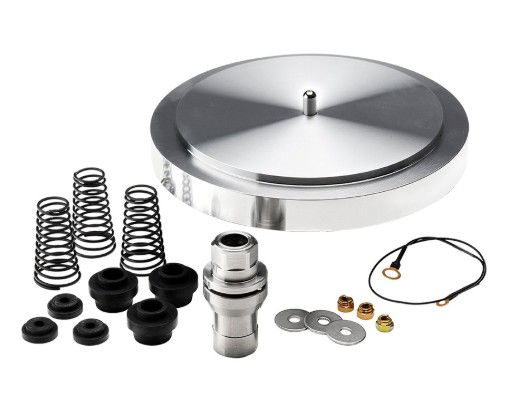
Motor and Power Supply: Valhalla, Lingo, Radikal
The motor drive and power supply progression is where the LP12's evolution becomes most philosophically loaded, and where the cost curves become steepest.
The Valhalla, the AC synchronous motor's original electronic controller introduced in 1982 to replace the earlier Papst motor setup, was a significant step forward at the time. A properly functioning Valhalla board, and many are no longer properly functioning, having spent forty years accumulating capacitor drift and component ageing produces a stable 50Hz supply that keeps the AC motor rotating at a consistent speed. An original Valhalla in good electronic health is a perfectly honest component, and having it recapped by a competent technician is sensible maintenance rather than compromise.
The Lingo, first appearing in 1990 and subsequently revised through several generations (the current Lingo 4 is a substantially different device from the original), introduced a more sophisticated approach to motor control, with lower residual noise and better speed stability. The improvement over a healthy Valhalla is real but not transformative. Over a degraded Valhalla, it is more significant, which partly explains why so many LP12s acquired in the 1990s and 2000s received Lingo upgrades. The comparison was often not Lingo versus healthy Valhalla, but Lingo versus something that had been quietly deteriorating for years.
The Radikal is in a different category. Introduced in 2009 and revised since, it drives the LP12's DC motor. This is in itself a departure from the original AC motor architecture. The Radikal has a degree of precision that has no practical precedent in this design's history. The Radikal produces genuinely measurable improvements in speed stability and a corresponding reduction in what engineers call wow and flutter, but which listeners experience as improved pitch stability and a more relaxed presentation of sustained notes. A piano chord, on a Radikal-equipped LP12, decays in a way that simply sounds more like a piano decaying in a room.
The Radikal also costs, at current pricing, over £4,000. Whether that expenditure is appropriate depends on what the rest of the system is capable of resolving. And again on what you are trying to achieve philosophically. A Radikal-equipped LP12 is not a restored machine in any conventional sense. It is a current-generation machine wearing an older plinth.

When Does a Restoration Become Something Else?
This is where I find the conversation most interesting, and where I think the audiophile community could benefit from a little more honest self-examination. There is a tendency, which I understand, given how the upgrade path is structured and marketed to treat each LP12 upgrade as cumulative progress toward some ideal state. And in purely sonic terms, the upgrades do generally represent improvements, at least in controlled comparisons. But the question of what you are actually left with deserves attention.
Consider a comparison with another long-lived high-end platform: the Wilson Audio WATT/Puppy loudspeaker system. The WATT/Puppy evolved through eight iterations over roughly twenty-five years, each version substantially different from the last. A WATT/Puppy 8 is not a restored WATT/Puppy 1, even if the design lineage is continuous. No one would seriously describe it as such. The LP12 presents the same situation in a slightly more granular and user-accessible form, because the upgrades are sold as retrofit components rather than as whole new products.
There is nothing wrong with building the best-sounding LP12 you can assemble from current-generation components. The result can be genuinely outstanding, and I have heard Klimax specification LP12s that stand comfortably in the company of competing turntables from SME, Brinkmann, and TechDAS, which are some of the finest tables being produced anywhere in the world today. But I think it is worth being honest with yourself about what that machine represents. It is a contemporary high-performance turntable with a continuous design heritage and an idiosyncratic suspended-chassis architecture. It is not a restored vintage machine. The plinth may be forty years old, but the engineering inside it is current.
Conversely, there is real value, sonic and otherwise, in a thoughtfully reconditioned LP12 that respects its original specification. A late-1980s LP12 with a recapped Valhalla, a new Karousel bearing, a careful setup, and a well-chosen arm and cartridge combination is a coherent, musically satisfying machine. It has a character shaped by its era, which is itself a form of integrity.

A Framework, Not a Formula for Linn LP12 restoration
What I would encourage anyone approaching an Linn LP12 restoration to do is decide, before spending anything, which of two broad aims they are pursuing. Are they trying to return a specific machine to honest working order, with perhaps one or two targeted improvements addressing genuine mechanical limitations? Or are they using an existing LP12 as a platform for building the best-performing turntable the LP12 architecture currently permits?
Both are legitimate. Both produce excellent results in the right hands. But conflating them and upgrading opportunistically without a clear destination tends to produce machines that are neither fully restored nor fully optimised, and accounts. I suspect, for many of the LP12s one encounters that sound slightly unresolved despite having had considerable money spent on them.
The LP12 is a remarkable machine precisely because this question remains genuinely open after more than fifty years. That it continues to prompt careful thought is, perhaps, the most Linn-like thing about it.
_______________________________________________________________________________________
The author writes on analogue audio, music, and the economics of physical media. The author has no commercial relationship with Linn Products or any of its distributors. The author has no commercial relationships with any company mentioned in this article. Views expressed are the author's own. Correspondence and disagreement are equally welcome.


Comments