
Who Buys a £20,000 Turntable (or a £15,000 Tape Deck)?

A Serious Look at the High-End Analog Consumer
Analog Soundware Business Lab for audiophiles, collectors, audio designers and restorers

Ask this question in the wrong room and the answer arrives before you have finished asking. Somebody will say dentists. Somebody else will say rich men in Singapore. A third person, usually the one who has never actually been to a show, will say nobody at all, that machines like these exist to be photographed for magazine covers and are not really bought by anyone.
I understand the reaction because the prices call for it. But none of it is true. I have spent enough time at shows, in dealer back rooms, and in the corners of forums where these machines are genuinely discussed rather than merely admired, to know that the real answer is stranger and rather more interesting than the cliché. It is also two answers rather than one, because the person who buys a £20,000 turntable and the person who buys a £15,000 tape deck are not the same person, even in those cases where they happen to be the same person.
A note on method before I go any further, because I would rather be truthful than merely sounding authoritative. Nobody at this end of the market publishes unit sales. Manufacturers will not tell you, and the ones who would tell you are generally the ones whose numbers would not be worth very much anyway. Dealers know, but they know their own patch rather than the market. So, what follows is not data, and I will not pretend otherwise. It is a picture assembled from what I have watched happen at shows, from what gets asked and argued about in the places these buyers congregate, and from a fair number of conversations with people who were either about to spend the money or had just finished doing so. Treat it as a well-informed sketch rather than a census. If it does not match your own experience, I would genuinely like to hear about it. More on that at the end.
_______________________________________________________________________________________
The turntable buyer, in four rough shapes
The returner. This is the single largest group I encounter, and it is considerably less glamorous than the stereotype. Typically a man, and it is overwhelmingly men, somewhere between his mid-fifties and his early seventies. He had a decent system in his twenties, sold it or shelved it when the mortgage and the children arrived, spent two decades not thinking about it at all, and then found himself with a spare room, a settled income, and the sudden realisation that he has perhaps twenty-five good listening years left. The £20,000 turntable is not the natural next step from his old Linn. It is a deliberate jump over about four steps, made by a man who has done the arithmetic on how many upgrade cycles he has time for and has decided to skip to the end.
The collector-first buyer. Here the hardware sits downstream of the software (vinyl). This person owns four or five thousand records, sometimes a great many more, often accumulated over forty years with real discrimination. He can tell you which pressing plant stamped his copy of a given record and why he replaced it twice. At some point the imbalance becomes intolerable to him, an extraordinary collection playing through a merely good deck, and the turntable purchase becomes a kind of respect to be paid to the records.
These are frequently the best listeners in the room and the least interested in specifications. Ask them about bearing tolerances and they will change the subject to a mono Blue Note.
The mechanism person. Engineers, surgeons, machinists, people who work with rotating masses or tight tolerances for a living, and people who simply find the physics engaging. They are the buyers who read the white papers, who want to understand why an air bearing behaves the way it does, and who will happily spend an hour on the trade-offs between belt, rim and direct drive without mentioning music once. This buyer gravitates toward the brands that put their engineering in the foreground, TechDAS, Kuzma, Döhmann, Acoustic Signature, Bergmann, and he is the one most likely to end up owning three tonearms.
He is also, in my experience, the buyer most likely to remain genuinely delighted by his purchase for the longest time, because what he has bought is an object he can keep thinking about.
The design buyer. Smaller in number, but real, and increasingly well served. This person is buying an object as much as an instrument. The turntable will sit somewhere visible in a carefully considered room, often matching the furniture, and sometimes with an interior designer or a custom-install firm in the loop rather than a traditional hi-fi dealer. Purists tend to sniff at this. I do not. A beautifully made machine deserves to be looked at, and this buyer is at least paying for craft openly rather than pretending not to notice it.
Geographically the pattern I observe is straightforward enough. There is strong representation across Western Europe and North America, and a distinctly serious high-end culture in Japan, South Korea, Hong Kong, Taiwan and Singapore, where the top of the market has been taken seriously for far longer than the current vinyl revival, and where the buyer profile skews toward a longer and more continuous relationship with the format. Walk the Tokyo show and then walk a US show. The difference in how people stand in front of a turntable tells you a good deal.

What they actually listen to
This is the part that most surprises people who have not spent time around audio shows.
The music is not exotic. At the very top of the market you hear, over and over, jazz from roughly 1955 to 1965, classical that is mostly orchestral and chamber and mostly on well-regarded reissue labels, and the rock and singer-songwriter standard of the late sixties through the seventies. Some blues. And some vocal jazz that everybody privately admits is there mainly for demonstration purposes.
There is a reason for this, and it is not a failure of imagination. These buyers are largely listening to music recorded during the analog era, on equipment optimised for analog-era recordings, chosen partly because they were young when that music was current. It is nostalgic in the technical sense rather than the pejorative one, and I think the distinction matters.
What is rarer than you would expect is contemporary music. Not absent altogether, and I have heard genuinely current records sound extraordinary on six-figure systems. But the buyer who is using a £20,000 turntable to explore new releases is the exception, and he tends to know it.
__________________________________________________________________________________________________
The tape deck buyer is a different animal
Here is where the two categories separate, and they are completely separate.
The turntable buyer has an enormous, functioning, globally distributed vinyl ecosystem waiting for him. He can buy records in every city on earth. His decision is essentially a hardware decision, and once it is made, he is done.
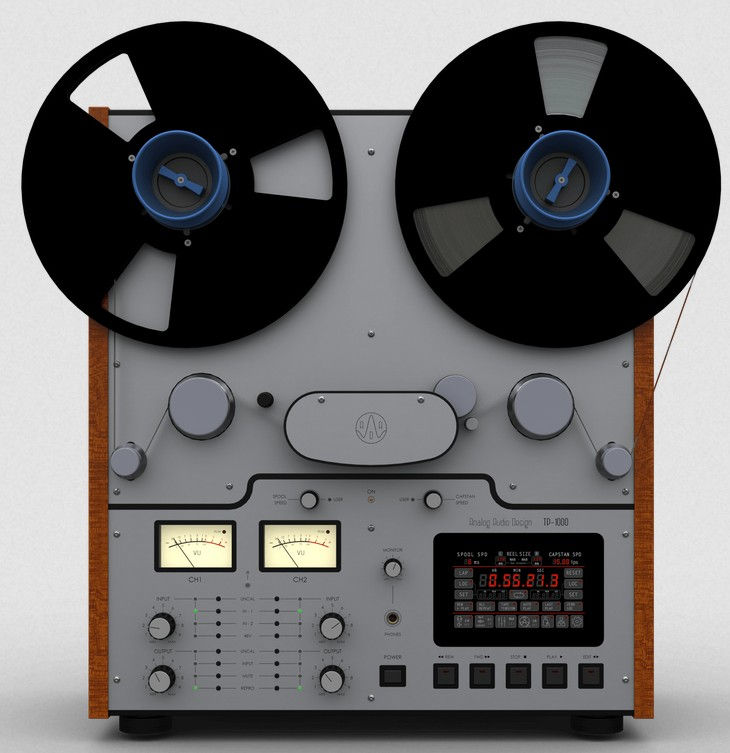
The tape buyer faces the inverse problem. The hardware is comparatively easy, because there is a small and well-known set of options, whether that means a new-build machine from Ballfinger, Metaxas & Sins, Analog Audio Design or United Home Audio, or a properly restored Studer, ReVox or Technics from one of a handful of specialists. It is the software (tapes) that is hard. Commercially available pre-recorded tape comes from a short list of labels and specialists such as The Tape Project, Chasing the Dragon, Yarlung, Horch House, STS Digital, Opus 3 and a scattering of others. Titles are limited, expensive per unit, and frequently sold in small runs.
So, the tape buyer's journey runs in the opposite direction to the turntable buyer's. He does not buy the machine and then wonder what to play on it. He works out what he can actually obtain first, decides whether that modest, curated and costly library is worth building a system around, and only then commits to the deck.
This selects for a very particular person. In my experience he is:
Older, on average, than the turntable buyer, and considerably more likely to have a professional or semi-professional background in audio, perhaps a studio, a broadcast facility or a live recording habit. He has threaded a machine before. He is not romanticising tape, because he remembers it as a working format, with all of the aggravation that implies.
Technically self-sufficient or well connected to somebody who is. Turntables ask very little of their owners. Tape machines ask for alignment, calibration, head wear monitoring, capstan and pinch roller attention, and an ongoing relationship with a technician who may be seventy years old and no longer accepting new clients. Every serious tape owner I know either does this work himself or has a name in his phone that he guards jealously. This is not a hobby you can buy your way into as cleanly as vinyl.
Motivated by something closer to authenticity than to convenience. The pitch for tape, at its best, is that a well-made two-track copy running at 15ips sits closer to the master than anything else you can put in a domestic room. That is the claim. Whether it justifies the cost and the inconvenience is a matter for the individual, but the buyer is chasing proximity to the source rather than a better version of a familiar experience.
There is overlap, of course. Plenty of tape owners also own serious turntables, and the tape machine is very rarely somebody's only analog source. But it arrives later, and it arrives after a different set of decisions.
The things nobody says on the forums
A few observations that I believe to be true and that are almost never stated plainly.
Most of these purchases are made with money that is genuinely spare. Not always, and I have met people who stretched, including a couple who probably should not have. But the dominant case is a buyer at a life stage where the mortgage is gone, the children are launched, and a five-figure purchase represents a discretionary sum rather than a sacrifice. This is unglamorous, and it is the single biggest factor in the demographic skew.
Resale is thought about far more than it is discussed. The used market at this level is thin, slow and unforgiving, and buyers know it perfectly well. When somebody tells you he will never sell it, that is sometimes conviction and sometimes a way of not confronting the depreciation.
Mortality is in the room. The endgame language that dominates high-end discussion is, if you look at it directly, people talking about running out of time. I do not think that is morbid. I think it is the most honest thing in the hobby. At a certain age you stop optimising the path and simply buy the destination.
And there is almost always a domestic negotiation to be conducted. Nobody writes about it. Everybody has had it.
__________________________________________________________________________________________________
Who is not buying, and why that matters
Younger buyers are present at the top end, but they are not the story that anyone hopes they are. The ones I meet are typically people who have made money quickly, often in technology or finance, and who have arrived at high-end audio sideways rather than through a lifetime of upgrading. They tend to buy faster, to research online rather than through dealers, and to care rather less about brand heritage. Whether that is a healthy sign for the industry depends entirely on whether they stay.
The larger question, and the one the industry does not much like asking, is what happens when the returner group ages out. The vinyl revival has produced an enormous number of new record buyers. It has not obviously produced a pipeline of people who will spend £20,000 on a plinth in twenty years' time. Those are different behaviours, and assuming that the first leads naturally to the second is exactly the kind of comfortable reasoning that gets businesses into trouble.
Now, are you one of them, and did I get you wrong?
I have described four or five types of people here, and I am well aware that real buyers are more complicated than categories. So, I would like to hand this over.
If you have bought at this level, whether a turntable, a tape deck or both, I would like to know what actually tipped you over. Was it a demonstration, a specific record, a birthday, an inheritance, or a slow accumulation of dissatisfaction? Did you audition properly, or did you buy on faith and reputation? How long passed between first considering it and actually paying? And the question I am most curious about, has it done what you wanted it to do?
Tape owners in particular, I would like to hear how you solved the tape problem, and whether you would do it again knowing what it costs to keep a machine right.
Tell me where I have got it wrong. I would rather be corrected than flattered.
_____________________________________________________________________________________
The author has no commercial relationships with any manufacturer mentioned in this article. Views expressed are the author's own. Correspondence and disagreement are equally welcome.


Comments