
Chasing the Horizon: What Would the Most Ambitious, Achievable Turntable Specification Look Like?

Analog Soundware Design Lab for audiophiles , collectors, audio designers and restorers
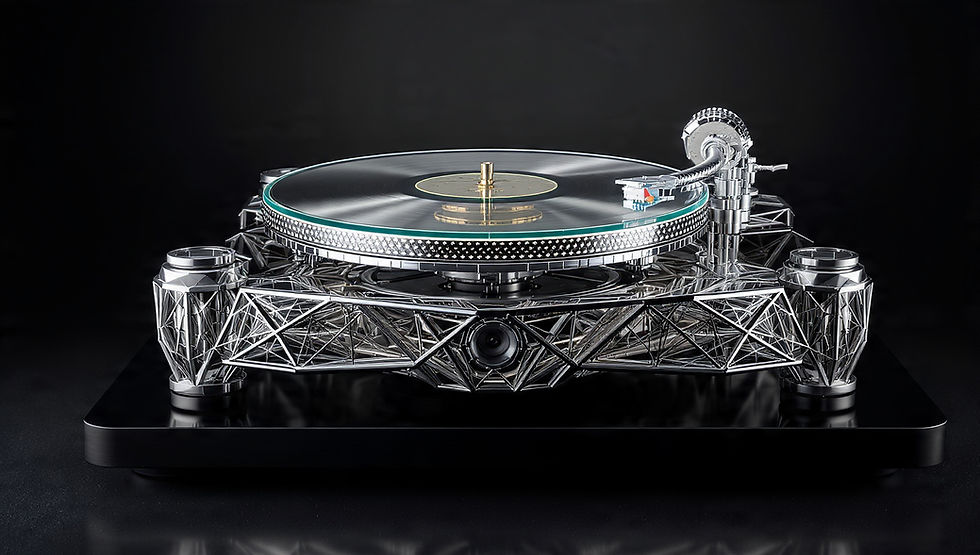
There is a particular kind of conversation that surfaces reliably at audio shows, in the listening rooms of serious dealers, and in the pages of magazines like this one. It usually begins with the question: has anyone actually built the best possible turntable? Not the most expensive. Not the most beautiful, or the most talked-about. The best — meaning the one that extracts the most complete, most accurate, least corrupted signal from a vinyl groove that physics will permit.
The honest answer, when you strip away the marketing language and the reverent photography, is no. And the reasons why that answer remains stubbornly negative tell us something genuinely interesting about where analogue design currently stands, what the real engineering constraints are, and — perhaps most usefully — what an ambitious but achievable specification might actually look like if the right team, the right budget, and the right manufacturing philosophy were brought to bear simultaneously.
_______________________________________________________________________________________
The Market Reality
The current high-end turntable market is, by any measure, extraordinarily healthy. Prices for serious reference-class instruments have climbed steeply over the past fifteen years. The Clearaudio Statement, the TechDAS Air Force Zero, the Kronos Pro, Simon Yorke Designs' Series 10, the Grand Prix Audio Monaco, the Thorens Reference — these are machines sold for sums that would, in an earlier era, have purchased a modest family home in many parts of Europe. Yet none of them — not one — can claim to have achieved a definitive specification in every critical parameter simultaneously.
This is not a failure of ambition. It is a reflection of a market structured around differentiation rather than convergence. Each manufacturer has staked out a philosophical position: belt drive versus direct drive, air bearing versus conventional bearing, suspended sub-chassis versus rigid plinth, vacuum platter versus clamp, and so on. These are genuine engineering choices, each with legitimate rationale. But they are also commercial positions, and a commercial position is by definition not a neutral one.
The consequence is that a buyer at the very top of the market is, in effect, being asked to choose a set of trade-offs rather than to purchase a solution. That is a rather different proposition, and the distinction matters when we try to define what an ideal specification might look like.

Defining the Parameters
Before asking whether belt or direct drive is superior — a debate that has generated more heat than light over five decades — it is worth establishing what we are actually trying to optimise. A turntable's mechanical task can be reduced to three fundamental requirements:
First, the platter must rotate at a precise and stable velocity, free from speed variation at any time-scale, from long-term drift down to the sub-millisecond flutter that the ear interprets as a kind of smeared unease in sustained tones and massed strings.
Second, the tonearm and cartridge must be isolated from all external mechanical vibration — from the floor, from airborne acoustic energy re-entering the structure, from the motor itself — while simultaneously providing a rigid, resonance-free platform for stylus-to-groove contact.
Third, the platter, bearing, and plinth must not themselves generate or amplify resonances that contaminate the signal. In this sense a turntable is as much a passive vibration-management device as it is a motor-driven instrument.
These three requirements are, in practice, frequently in tension with one another. A bearing stiff enough to resist external vibration may conduct motor noise more efficiently. A plinth massive enough to resist airborne energy may itself store and release energy in coloured, audible ways. The art of turntable design is largely the art of managing these trade-offs with enough intelligence and care that the residual compromises fall below the threshold of audibility.
The question then becomes: how low is that threshold? And how close have any current designs come to it?
_______________________________________________________________________________________
The Case for Belt Drive — and Its Ceiling
The belt drive topology has dominated serious high-end design for good reasons. A compliant belt — whether rubber, silk thread, or the textile loops used by Linn, Michell, and Basis Audio — provides a mechanical low-pass filter between the motor and the platter. Motor-generated cogging, vibration, and electrical noise are substantially attenuated before they can reach the stylus. At its best, as in the Basis Inspiration or the Simon Yorke Series 10, this results in a sonic cleanliness in the mid and upper frequencies that direct drive designs have historically struggled to match.
But the belt introduces its own set of limitations. Belts stretch, age, and change compliance with temperature. More fundamentally, a compliant coupling between motor and platter means that speed correction — in response to stylus drag as the groove modulation changes — is inherently slow. The platter, however massive, is momentarily on its own. The motor is, in effect, disconnected from the load in the very moment when the load changes.
Manufacturers have responded to this in various ways. A very high rotational mass platter — such as the 30-kilogram bronze platter used in the TechDAS Air Force One — acts as a flywheel, resisting speed perturbation by sheer inertia. This is effective at frequencies below a few hertz but becomes progressively less so as modulation frequency rises. An alternative approach, used by Kronos Audio in its remarkable Pro and Sparta models, involves a counter-rotating sub-platter to cancel the gyroscopic effects that a single heavy platter introduces. This is elegant engineering and it measurably improves bearing stability, but it does not address the fundamental issue of speed correction latency.
A belt drive turntable operating at the absolute ceiling of the topology requires a motor with exceptional speed stability in its own right — the DC motors used by several high-end manufacturers, or the hysteresis synchronous motors used by Nottingham Analogue and others — combined with a platter of sufficient inertia to bridge the gap between motor corrections. The best current designs approach this ceiling creditably. They do not fully reach it.

The Case for Direct Drive — and Its Renaissance
Direct drive was, for most of the audiophile world, tainted by association with the mid-price Japanese market of the 1970s and 1980s — the Technics SL-1200 series, ubiquitous and competent, but hardly a reference. The prejudice that formed around those associations was arguably never entirely fair, and it has now been decisively challenged.
The Technics SP-10R, reintroduced in 2018 at a price point that would have seemed implausible a decade earlier, demonstrated convincingly that direct drive — when executed with modern motor design, sophisticated servo control algorithms, and a genuinely serious plinth — could deliver speed stability that belt drive designs struggle to approach in measured terms. The motor in the SP-10R is a coreless direct drive with a cogging torque specification so low as to be essentially unmeasurable in practice, and the servo system operates with a response time fast enough to correct for stylus drag in real time.
The result, in practice, is a precision that reveals itself most clearly in the reproduction of complex polyphonic material: large orchestral climaxes, dense jazz ensemble passages, where the cumulative drag of multiple simultaneous groove modulations would, in a less controlled design, produce a barely perceptible but real reduction in dynamic authority. This is not hypothetical. It is audible under careful comparison, and it matters.
The Continuum Caliburn, an Australian design of ferocious engineering ambition that has been in production in small numbers for nearly two decades, takes a different approach: a direct drive motor of considerable originality, combined with one of the most sophisticated plinth resonance management systems in production. At prices exceeding $100,000 USD for the full system, it represents perhaps the closest that any single commercial design has come to addressing all three fundamental requirements simultaneously.
But even the Caliburn represents a series of choices, not a universal solution.

The Plinth Problem and Manufacturing Economics
Here the discussion becomes genuinely complex, because the plinth — the structure that supports bearing, motor, and tonearm — is arguably the least understood and most poorly specified component in turntable design. There is no agreed measurement protocol for plinth resonance behaviour analogous to the THD or signal-to-noise measurements we apply to electronics. Manufacturers speak of materials in terms that are often more poetic than technical: "constrained-layer damping," "polymer-granite composite," "aircraft-grade billet aluminium." Some of these descriptions correspond to genuine engineering choices; others are closer to vocabulary.
The material science is real and interesting. Finite Element Analysis, now widely available even to small manufacturers, allows plinth resonance modes to be predicted and managed before a single component is machined. But FEA is only as useful as the accuracy of the material models fed into it, and the damping behaviour of composite structures under acoustic excitation is notoriously difficult to model with confidence.
This is where manufacturing economics become decisive. A company like TechDAS, Continuum, or Grand Prix Audio can afford to iterate — to build prototypes, listen carefully, measure rigorously, and refine. A company producing fifty units a year cannot absorb the cost of ten prototype cycles in the way that, say, a Swiss watch manufacturer can amortise tooling costs over long production runs. The result is that even genuinely serious designs are often optimised on the basis of incomplete information, with final voicing done by ear in a listening room rather than on an engineering workbench.
This is not necessarily wrong. The ear remains, in several important respects, a more sensitive instrument than any measurement system currently available at realistic cost. But it introduces a subjectivity into the process that makes it very difficult to know, with confidence, whether the ceiling has been reached.
_______________________________________________________________________________________
What Would the Most Ambitious Turntable Specification Actually Look Like?
Synthesising these considerations, a genuinely ambitious but achievable specification for a reference turntable might look something like this:
A direct drive motor of the coreless or hysteresis type, with cogging torque below 0.1 mNm and a servo system capable of correcting speed error within 5 milliseconds — fast enough to respond to stylus drag in real time without overshooting. Speed accuracy, measured at the platter rim, of better than ±0.01% over any 10-second window.
A main bearing using an air-lubricated or magnetically levitated spindle, eliminating metallic contact and the micro-friction variations that accompany it. Vertical and lateral runout below 1 micron. The TechDAS Air Force series already approaches this with its air bearing designs; the engineering is known and manufacturable.
A platter of moderate to high rotational inertia — perhaps 8–12 kilograms — in a material with a high internal damping coefficient. Aluminium is easy to machine but acoustically lively; constrained-layer designs using a damped core between outer skins offer better energy absorption. A vacuum hold-down system, as used in the Basis Inspiration and the Goldmund Reference, eliminates record warps and ensures complete coupling between disc and platter surface.
A plinth designed using FEA to place all primary resonance modes above 200 Hz and below 20 Hz — outside the most sensitive region of the audioband — and constructed in a constrained-layer composite with independently confirmed damping performance. Footers using pneumatic or active magnetic isolation to provide greater than 30 dB of attenuation above 3 Hz.
A tonearm mount that is mechanically independent of the motor assembly, connected to the main structure only through a defined, high-impedance joint that prevents motor-borne vibration from reaching the arm.
The cost of such an instrument, built in meaningful but small quantities — perhaps twenty to fifty units per year — would be substantial. Based on current pricing for comparable engineering complexity in other precision industries, a realistic retail price of $80,000–$150,000 USD seems plausible rather than fanciful. That is within the current market for serious reference designs, and it would buy genuine engineering rather than jewellery.
_______________________________________________________________________________________
Why the Holy Grail Remains Out of Reach
And yet — and this is the important caveat — even a turntable built to this specification would not be the final answer, for a reason that has nothing to do with engineering.
The playback system is a chain, and the turntable is one link in it. A cartridge that cannot resolve the information the platter is recovering with new precision, a tonearm that introduces its own resonance behaviour into the signal, a phono stage with a noise floor above the turntable's capability — any of these renders the additional investment in the source itself effectively inaudible. The ultimate turntable, if it were built, would demand an equivalently ambitious supporting system, and the combined cost of such a system would place it beyond the reach of most of the serious listeners who would most benefit from it.
There is also the question of the software — the records themselves. Vinyl pressed at modern quality levels, from well-preserved lacquers, on quiet-pressing PVC, represents genuine excellence. But it is not consistent, and no turntable, however well specified, can recover information that was not cut into the groove in the first place.
Perhaps the honest conclusion is that the ideal turntable is not a destination but a direction. The engineering discipline of asking "what would the specification actually require?" — rather than "what is our chosen topology good at?" — is itself valuable, regardless of whether the resulting instrument is ever built. It forces clarity about trade-offs, honesty about limitations, and respect for the genuine complexity of the problem.
That seems like a worthwhile conversation to be having, at whatever price point one happens to inhabit.
_______________________________________________________________________________________
The author would like to acknowledge the published engineering documentation from TechDAS, Continuum Audio Laboratories, Basis Audio, Kronos Audio, and Technics, which informed sections of this article.


Comments