
Forgotten Names in Turntable Manufacturing — Part VI The Empire of Garrard


In most contemporary audio conversations, the “golden age” of the turntable is reduced to a handful of tidy binaries: belt drive versus direct drive, Swiss finesse versus Japanese industrial might, low-mass minimalism versus broadcast‑heritage muscle. Those narratives are not wrong—but they are incomplete. Beneath them lies a deeper history built by firms whose names are now far less visible than their influence.
This sixth part of Analog Soundware’s series on forgotten turntable makers turns to one of Britain’s most important, and strangely under‑celebrated, players: Garrard Engineering and Manufacturing Company.
_______________________________________________________________________________________
From Crown Jewels to Transcription Motors
Garrard & Co., established in 1735 in London, and later with precision engineering for the Royal Navy. In 1915, Garrard Engineering and Manufacturing was founded in Swindon to supply finely made mechanical parts during the First World War; by 1919, the firm had pivoted from munitions to high‑quality spring‑wound gramophone motors for Columbia, Decca, and other record companies.

Through the 1930s Garrard developed complete gramophones, early record changers, and high‑grade electric motors, many of which quickly found favour with broadcasters and serious music lovers. By the early 1950s, the company had become a genuine turntable powerhouse, exploiting die‑cast aluminium and heavy‑duty motor technology to create record players that were unapologetically over‑engineered. In an era before the word “audiophile” was common currency, Garrard was already building to that standard.
That trajectory—from jewellery to naval mechanisms to gramophones—left Garrard with a particular mindset: treat a turntable as a precision machine tool, not a piece of furniture.
During the 1950s through the early 1970s Garrard was anything but niche. It was, arguably, the most influential turntable manufacturer in the world. Garrard mechanisms powered:
broadcast studio installations
domestic radiograms and consoles in North America
European separates systems
educational and institutional record players
Brands like Thorens, Dual and EMT are rightly revered, but it was Garrard that most effectively industrialised the turntable as a repeatable, reliable mechanical platform.
_______________________________________________________________________________________
The Idler‑Drive Years: Torque as a Design Philosophy
Contemporary orthodoxy often treats idler‑drive decks as colourful outliers—full of “drive” and “slam,” but supposedly compromised by noise. In Garrard’s heyday, idler drive was not a charming eccentricity; it was the professional state of the art.
The Garrard 301, launched in 1953 with sales beginning in 1954, was a purpose‑built transcription motor unit designed for studios and demanding enthusiasts. Its big shaded‑pole induction motor ran at roughly 1,740 rpm, driving a rubber idler wheel that in turn coupled to the inside rim of a heavy 12‑inch die‑cast aluminium platter. An eddy‑current braking system allowed fine speed trimming at 33⅓, 45 and 78 rpm, with wow, flutter and rumble figures that were exceptional for the time.
The design priorities were clear:
rapid start‑up to full speed in fractions of a second
high torque to maintain speed under varying stylus drag
continuous‑duty reliability for broadcast environments
straightforward mechanical serviceability
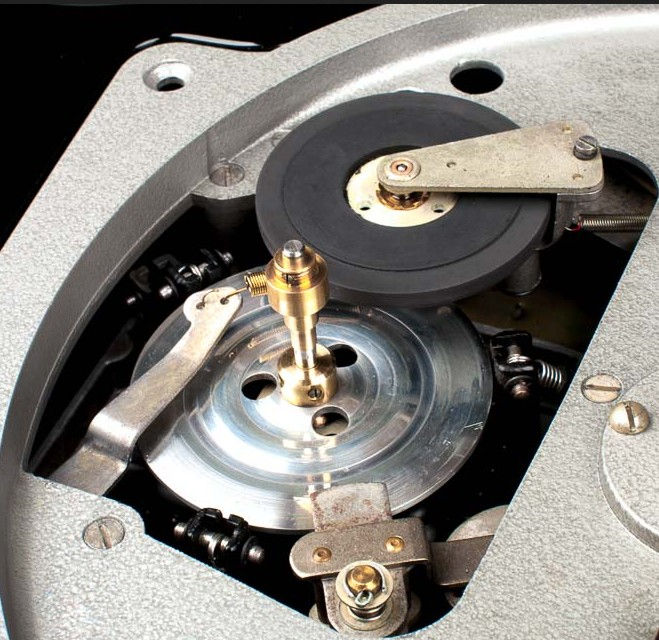
Where modern high‑mass belt‑drive designs tend to seek speed stability via platter inertia and decoupled motors, Garrard sought it via torque and mechanical authority.
The 401, introduced in 1965, refined the concept rather than replacing it. Mechanically it remained similar to the 301 but added a redesigned exterior, a more powerful motor in a heavy cast‑iron housing for better vibration control and magnetic screening, and a revised thrust bearing and speed control arrangement. To this day, enthusiasts debate which model is “better,” but both share the same underlying philosophy: speed stability first, everything else follows.
To sit in front of a properly restored 301 or 401 is to be reminded that progress in turntable design has not been a straight line. We have certainly simplified and cost‑optimised; we have not necessarily improved on Garrard’s core virtues.
_______________________________________________________________________________________
Modular Engineering Before It Was Fashionable
Another aspect of Garrard’s contribution is easier to overlook precisely because it is so widely imitated today: the motor‑unit concept.
The 301 and 401 were not sold as complete, arm‑equipped decks. They were sold as motor units—robust mechanical platforms intended to be dropped into custom plinths and paired with the user’s choice of tonearm. That architecture:
encouraged experimentation with plinth materials and construction
allowed customers and studios to fit different arms for different cartridges or applications
simplified servicing, as the mechanism lifted out as a single module
reduced acoustic feedback when mounted into heavy, well‑damped bases
This separation of subsystems—drive, plinth, arm—has become a cornerstone of the modern high‑end turntable ecosystem. It is visible in everything from bespoke 301/401 rebuilds to SME’s contemporary motor units and Linn’s modular Sondek LP12 upgrade path. Garrard did not merely build idler‑drive decks; it helped define the idea that a high‑performance turntable is a system of mechanically distinct, optimisable parts.

How the Empire Unravelled
By the late 1960s the landscape had started to move under Garrard’s feet. Japanese makers such as Technics and Pioneer were bringing quartz‑locked direct‑drive motors, low rumble figures and aggressive pricing to market. At the same time, European designers were championing minimalist belt‑drive decks that prioritised motor isolation and low moving mass—philosophies that would ultimately culminate in designs like the Linn Sondek LP12.
Garrard itself had already been acquired by Plessey in 1960, and corporate priorities shifted steadily toward high‑volume automatic changers and lower‑cost consumer models. The very traits that once defined the brand—large induction motors, intricate mechanics, heavy castings—suddenly looked expensive, old‑fashioned and out of step with a market fascinated by sleek, quiet, low‑profile decks.
By the late 1970s production of the classic transcription turntables had ceased, and Garrard’s presence at the enthusiast end of the market had faded dramatically. The name lingered on cheaper units and, eventually, under foreign ownership; the sound and engineering philosophy that made the Swindon machines special nearly disappeared from view.
_______________________________________________________________________________________
The Long Shadow of Swindon
The story might have ended there, had the analog revival not reached back into this particular past. Over the last few decades, restorers and listeners have rediscovered how effectively Garrard’s basic recipe still works when given a sympathetic context.
Boutique firms and individual builders now take vintage 301 and 401 motor units and house them in massive multi‑layer hardwood, slate, or constrained‑layer plinths, often fitted with modern tonearms and cartridges. SME’s acquisition of the Garrard brand and long‑time service specialist Loricraft in 2018 formalised that revival, bringing OEM‑level support and new‑build interpretations to market.
What once read as “broadcast” qualities—immediate start‑up, unwavering pitch, an almost propulsive sense of timing—are now prized as musical virtues:
rhythmic authority and a strong sense of drive
dynamic expression that makes transients feel life‑sized
a solidity of pitch that anchors complex acoustic music
In the right system, a rebuilt 301 or 401 does not sound like a charming relic; it sounds like a very direct, very confident way of turning mechanical groove modulation into musical energy.
Beyond the Badge: Garrard’s Ongoing Influence
Even where the name Garrard is absent, elements of its thinking live on. Modern idler‑drive revivals, high‑mass belt‑drive decks that chase torque via other means, and modular motor‑unit designs all trace conceptual lines back to Swindon.
Garrard’s enduring contributions include:
the standardisation of the transcription‑grade, multi‑speed turntable for professional use
the motor‑unit paradigm that makes plinth and arm choices part of the tuning palette
a clear demonstration that speed stability, mechanical grounding and energy management are inseparable from perceived musicality
For those of us who care about analog replay, this is an invitation rather than a closed chapter. You do not have to own a 301 or 401 to engage with what Garrard achieved; you only need to recognise that many of our current debates—mass versus suspension, torque versus isolation, modularity versus integration—were being explored with real rigour more than half a century ago.
Remembering Garrard is not an exercise in nostalgia. It is a reminder that innovation in turntable design has always been plural rather than linear, and that some of the most compelling ideas for the future of vinyl may lie in the engineering imagination of its past.


Comments