
The Business of the Resurrected Heritage Brand

Buying a Ghost
Analog Soundware Business Lab for audiophiles , collectors, audio designers and restorers
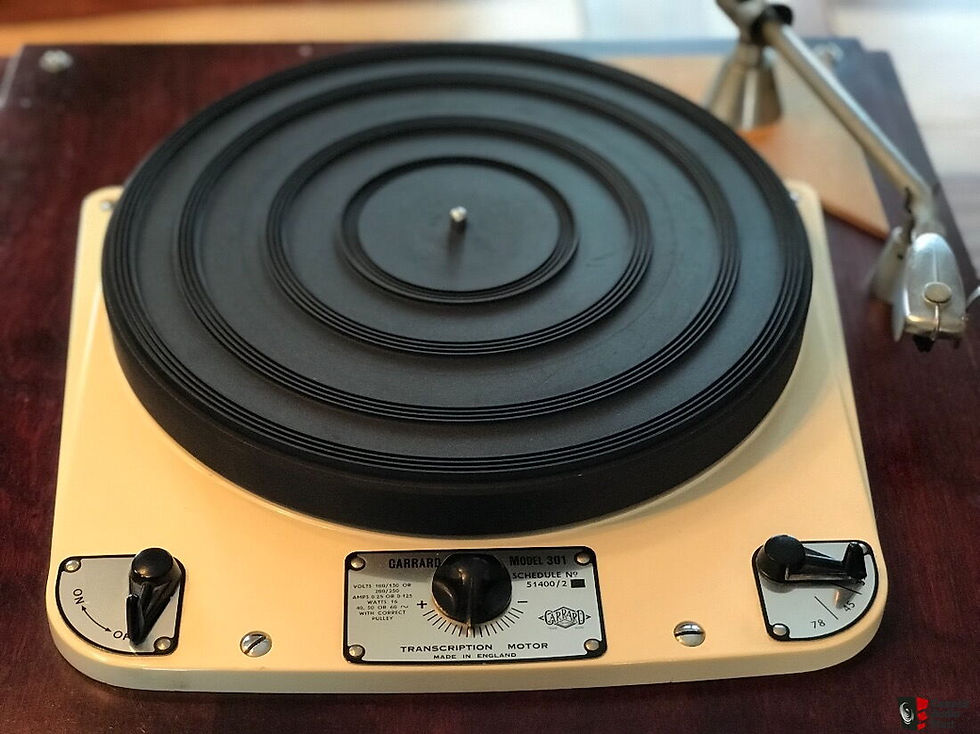
A few years ago, at the Munich High End show, I stood in front of a Garrard 301 that had, by any reasonable accounting, been out of production for more than half a century. It was gleaming, ivory-enamelled, and unmistakably Garrard. The gentleman beside me, a collector of some importance, leaned over and asked the only question that mattered: "Is it real?"
I've been chewing on that question ever since, because the honest answer is that depends on what you mean by real. And I've come to believe that how we answer it says a great deal about what we actually value in this hobby.
__________________________________________________________________________________________________
The trade in names
Let's begin with the unromantic part, because it's the part the brochures never mention. A dormant hi-fi brand is, legally speaking, a bundle of trademarks. When a company like Garrard collapses (and Garrard's decline through the Plessey years into eventual dormancy under Brazil's Gradiente is well-documented), what survives is rarely the factory, the tooling, or the workforce. What survives is the name, sitting in an intellectual-property portfolio, sometimes on another continent, waiting for someone to decide if it is worth something.
And it usually is worth something. The name arrives pre-loaded with fifty years of goodwill that no startup could buy at any price. A new turntable company must spend a decade earning the benefit of the doubt. A resurrected one inherits it on day one. That asymmetry is precisely why these acquisitions happen, and it is why the valuation of a dormant marque has almost nothing to do with engineering and almost everything to do with the narrative. The reviews, the broadcast heritage, the memory of a father's hi-fi in the front room.
None of this is sinister. It is simply commerce. But it means the burden of proof sits differently than it does with a continuously operating firm. When Linn sells you an LP12, you are buying from an unbroken chain of institutional knowledge stretching back to 1973. When you buy a revived marque, the chain was cut, and someone has spliced it. The question worth asking without cynicism is, how carefully the splice was made.
__________________________________________________________________________________________________
What actually transfers, and what doesn't
Here is what a trademark purchase does not automatically include: engineering drawings, production tooling, supplier relationships, test procedures. And, in my opinion most importantly, the people who knew why every decision was made the way it was.
Sometimes the new owner goes to extraordinary lengths to recover these things. SME's 2018 acquisition of the Garrard name is, to my mind, the most instructive example we have. SME didn't just buy the trademark from Gradiente; it also acquired Loricraft Audio, which had been the authorised Garrard service agent since the late 1990s and had spent two decades accumulating exactly that sort of tacit knowledge. The feel of a correctly set idler, the behaviour of those motor springs that no drawing captures. The first new-era 301s were built around meticulously refurbished original motor units, with SME tooling up to manufacture new parts to the original method. Platters cast and then machine-finished, as Garrard did it, rather than machined from billet as the aftermarket prefers. The stated philosophy was telling, Build it as it was built, and resist the urge to "improve" it.
Whether one finds a five-figure idler-drive turntable sensible is a totally separate conversation. But as an act of resurrection, it is about as rigorous as the genre gets. A precision-engineering firm with a genuine historical relationship to the product (SME made parts and arms that partnered 301s in period), buying not just the badge but the surviving expertise, and committing to remanufacture rather than reinterpretation.
Now hold that against the other end of the spectrum. Lenco is the example most readers will know. The company exists today primarily as badges on inexpensive, contract-manufactured consumer electronics that share nothing with the Swiss idler decks that made the name matter. The trademark holder is entirely within their rights. But the object on the shelf has no engineering relationship whatsoever to the object in our collective memory. Meanwhile, the actual engineering legacy of those Swiss decks lives on in the restoration community and in boutique rebuilders who take vintage motor units and re-house them to a standard the original factory never attempted. Heritage without the badge, which is the mirror image of a badge without the heritage.

The honest middle ground
Most revivals live between these poles.
Thorens is the case of the resurrected heritage brand I find most interesting. (I recently published a review of the Thorens TD 404 DD turntable). The brand, one of the oldest names in recorded sound, with roots in Sainte-Croix going back to the nineteenth century, passed through multiple owners and some genuinely forgettable product before its 2018 relaunch as a German operation under experienced industry leadership. What emerged included a new TD 124, and here is the fascinating detail. It is not an idler-drive machine. The TD 124 DD is a direct-drive turntable wearing the visual language of the 1957 original.
Is that a betrayal? I'm not sure it is. The new team never claimed to be remanufacturing the old deck. They built a modern machine, engineered from scratch, that pays open homage to a classic design. One can reasonably argue that this is more honest than a nominal continuation would have been. New engineering presented in period dress. One can equally argue that the visual quotation is doing commercial work the internals haven't earned. What I'd note is that the same revived catalogue also contains models whose manufacturing origins are more conventional and more shared with the wider industry.
The clean counterexample to all of this is Technics. When the SL-1000R appeared, it was greeted as a "return," but strictly speaking Technics was never a ghost. The brand rested inside Panasonic, and when the corporation chose to revive the range, it could summon its own motor engineers, its own coreless direct-drive research, its own institutional memory. That is the difference between a brand that slept and a brand that died. The SL-1000R is a continuation. A revived Garrard, however scrupulous, is a resurrection. The distinction isn't pedantry; it tells you where the engineering came from.

What the missing engineers cost and what they don't
There is a romantic view that says a product without its original team is necessarily hollow, and I want to push back on it gently, because I don't think it survives contact with the facts.
Consider what modern practice can do that the originals could not. SME's remanufactured Garrard platters are reportedly finished to tolerances the Swindon factory never held. The strobe markings on a new 301 sit steadier than on most survivors, because mid-century production variation is no longer part of the recipe. Metrology, materials science, and CNC machining mean that a serious modern operation can often exceed the original build quality, provided it understands what it is measuring and why.
And that is where the real cost of the missing engineers lives. Drawings record decisions, they don't record reasons. Why that rubber compound for the idler tyre? Why that spring rate, that paint formulation, that bearing clearance? Some of those choices were the fruit of years of iteration; others were accidents of supplier availability that happened to sound good. Without the people, a reviver can't always tell which is which and the ones who succeed tend to be those who found a substitute for the missing team. The value in Loricraft lay in accumulated service experience. The ghost in the machine, it turns out, can sometimes be re-hired.
What cannot be bought back is the culture that produced the original. The broadcast contracts that demanded instant start-up, the price pressures, the specific problems of 1954. A revival is always a translation, and translations reveal the translator.
__________________________________________________________________________________________________
A short catechism for the prospective owner
So, when the next resurrected name crosses your dealer's threshold, and it will (the vinyl revival has made ghost-hunting a growth industry), I would suggest a few quiet questions before the story sweeps you along.
Who owns the name now, and what did they buy besides the trademark? Where was this product engineered, by whom, and is the company forthcoming about it? Does anything, parts, tooling, people, service records actually connect this object to the one in the photographs? Is it presented as a continuation, a remanufacture, or a reinterpretation, and does the marketing match the reality? And finally. If this identical product wore an unfamiliar badge, would it justify its price?
That last question is the uncomfortable one, and it cuts both ways. If the answer is yes, then the heritage is a bonus, and you may buy with a clear conscience. If the answer is no, then you should at least know that what you're paying for is the story. It is a legitimate thing to buy, incidentally, as long as you're the one who decided to buy it.
I own vintage kit whose value is inseparable from its history, so I am in no position to sneer at sentiment. Nostalgia is not the enemy here; unexamined nostalgia is. The resurrected brand asks us to feel first and verify second. The best of them, and there are genuinely superb machines among them, will happily survive the verification. The rest are counting on us not to try.
The ghost is real, in other words, whenever someone did the work of raising it properly. Our job, as ever, is simply to check for a pulse.
__________________________________________________________________________________________________
The author has no commercial relationships with any manufacturer mentioned in this article. Views expressed are the author's own. Correspondence and disagreement are equally welcome.


Comments