
The Instagram Turntable and the YouTube Tape Deck

How Social Media Changed What Gets Built and What Gets Bought
Analog Soundware Restoration Lab for audiophiles , collectors, audio designers and restorers

I have been involved in audio equipment for long enough to remember when the most influential marketing a manufacturer could hope for was a coveted Recommended Component listing in a print magazine, or a quiet word from a knowledgeable dealer. A good write-up in Hi-Fi News or Stereophile could move stock. A bad one could quietly kill a product. The ecosystem was small, slow, and whatever its limitations, largely tethered to the act of listening.
That world has not disappeared, but it has been joined by something quite different. Over the past decade, two parallel social platforms, Instagram and Youtube, have reshaped which products get attention, which get built, and more subtly, which get bought. The effect on the turntable market and the reel-to-reel market are each fascinating, but they are fascinating in almost opposite ways. One is predominantly about image. The other is predominantly about sound. Unpicking that distinction is worth a discussion.
_______________________________________________________________________________________
The Turntable as Object
Let me start with something I noticed on a dealer's floor in Munich about for years ago, watching customers interact with products during a trade weekend. A couple, probably in their early thirties, had their phones out before they had their ears on. They photographed the Pro-Ject X8 Evolution. They focused on its layered chassis and the clean geometry of the tonearm counterweight. This before they asked a single question about how it sounded. They were not being shallow. They were doing what people do now, they were what I would describe as composing.
Instagram and its algorithmic cousins reward photographs of objects that have graphic clarity. A turntable, almost uniquely among audio components, photographs extraordinarily well. A spinning record, a tonearm poised in the groove, a lit display behind it, these make inherently strong images. The Rega Planar 6 in its matte white finish, or a Pro-Ject Debut Carbon EVO in its limited-edition colours, look as though they were designed partly with a grid of nine squares in mind. In the case of some products, I suspect they were.
This is not automatically a criticism. Good industrial design and good sonic performance are not mutually exclusive, and there is no shame in acknowledging that an object people will live with for twenty years should be pleasing to look at. The Linn LP12 is still with us after more than fifty years and still the subject of fierce loyalty among its owners. And let’s face it, it is not an unattractive machine. The SME Model 15A, with its precision-machined plinth and arm, has a quiet authority that rewards close attention. These are beautiful objects that also happen to be seriously capable reproducers of recorded music. Nobody is accusing them of Instagram cynicism.
But the Pro-Ject and Rega divide, which I find myself returning to repeatedly in conversation with dealers and readers alike, maps quite neatly onto something real about social audiences, and it is worth being honest about what that something is. Rega's design philosophy is still, fundamentally, functional. The Planar 3 looks the way it does because Gordon Savage and Roy Gandy decided decades ago that mass, rigidity, and minimalism were the engineering priorities. The aesthetic arrived as a consequence of the engineering, not the other way around. Pro-Ject's approach is more eclectic: the Perspex SX is a visual statement as much as an acoustic one, and the range of finishes available across their lineup suggests a company paying close attention to the decorative function of audio equipment in a domestic setting. Neither approach is wrong. But they are appealing to subtly different people, and increasingly those people encounter products via different channels.
The question I keep returning to, and the one I find myself asking dealers across Austria, the Netherlands, and the UK, is whether social media visibility translates to actual sales at the higher end, or whether it primarily generates what I would call aspirational reach, i.e. people who follow, save, share, and never buy. The honest answer, based on those conversations, appears to be some of both. The proportion shifts considerably with price point. A £500 turntable in a fashionable finish does move partly because of its social visibility. A £3,500 Rega P10 or a Vertere SG-1 moves because someone spent serious time reading, listening, and consulting. The Instagram effect has a ceiling, and that ceiling is lower than some manufacturers might hope.
What concerns me more is the subtler distortion: the possibility that design resources are being directed, consciously or otherwise, toward visual differentiation at the expense of acoustic development. I have no hard evidence for this, and I want to be careful not to overstate it. But when I see a manufacturer launching a product whose distinguishing feature is a new finish before the engineering beneath has been substantially revised. Then I wonder who they are building it for, and whether that person is primarily a listener.

The Tape Deck as Revelation
The reel-to-reel story is different in almost every respect, and more interesting for it.
No sane marketing director would have predicted, in 2010, that vintage open-reel tape machines would become objects of widespread fascination. The format was commercially dead. New software support was negligible. Pre-recorded tapes in the 15 ips, 1/4-track studio format favoured by serious enthusiasts cost upwards of £300 apiece, that is when you could find them. The machines themselves, often thirty or forty years old, required expert service before they were safe to run. The barrier to entry was not merely financial; it was technical and logistical.
And then YouTube happened.
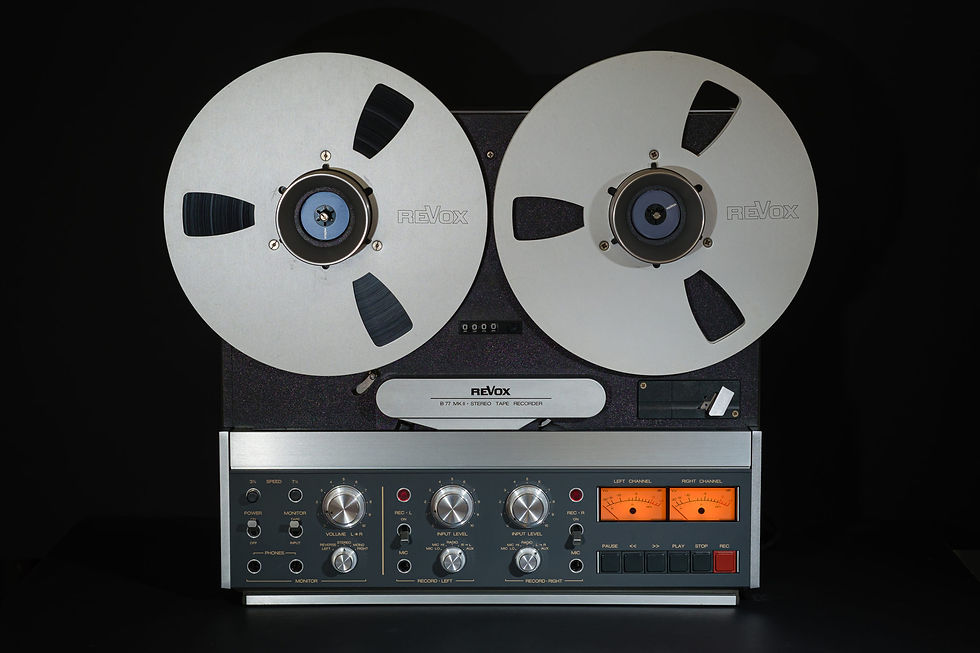
I mean this with genuine precision. The restoration and demonstration videos that began accumulating on the platform, many by individuals with no commercial interest in the machines they were servicing, operating out of workshops and spare rooms. They collectively generated an audience that no manufacturer's promotional budget could have assembled. Channels devoted to the revival of vintage Revox machines, the recapping and alignment of the Studer A810, the mechanical overhaul of the Teac X-1000R and the various Akai GX-series decks, drew audiences not of thousands but of hundreds of thousands, for individual videos that ran to an hour or more. The combined view counts across the genre run into the tens of millions.
What strikes me about this, as someone who has observed it from the inside of the industry, is that these videos are not primarily aesthetic. They are primarily educational and procedural. A camera held over a circuit board while someone explains the function of the bias oscillator is not Instagram content. It is something closer to an apprenticeship, conducted at scale, across borders, in a format that the traditional trade press never managed to produce. The people who found their way to a Revox B77 or a Studer A807 via YouTube were, by and large, arriving with a serious understanding of what they were acquiring. They were not composing photographs. They were listening.
The downstream effect on the market has been real and measurable. Prices for well-serviced examples of the canonical machines such as the Revox PR99, the Studer A810, the Teac X-2000R, and similar, have risen significantly in the past eight years. A technician-serviced Revox B77 in reliable order commands a price today that would have seemed extraordinary a decade ago. That price is being driven partly by genuinely increased demand, and that demand was seeded substantially by video content. Meanwhile, small manufacturers working in the new tape space such as Germany's Ballfinger, with their exquisitely built M 063 H, and the quiet work being done around tape formulation at companies like RMGI have found an audience that simply did not exist before the YouTube restoration community helped create it.
The opportunity here is genuine and largely positive. A format with real sonic virtues highlighting the warmth, the headroom, the physical immediacy of analogue tape at 15 ips found a new generation of serious advocates through a medium that rewarded depth and patience as much as novelty. That is a good outcome, and it is worth acknowledging without embarrassment.
But there are distortions on this side of the ledger too. The rise in prices for vintage machines has made access harder for exactly the audience that YouTube created: enthusiastic, technically curious, but not necessarily wealthy. A young engineer who spent forty hours watching restoration videos and genuinely fell in love with the format may find that the machines have become unaffordable precisely because so many others followed the same path before him. And the secondhand market, flooded with machines that have been 'serviced' to varying standards by a new generation of self-taught technicians, and I admit, some of them very good, some of them not, has become harder to navigate reliably without specialist guidance.
What We Should Be Watching, Instagram or Youtube
I want to be clear about where I stand on all of this, because it is easy to slip into either uncritical enthusiasm or reflexive scepticism, and neither is especially useful.
Social media has, on balance, grown both these markets. It has introduced people to formats and experiences they would not have encountered otherwise, and some of those people have become serious, engaged, long-term participants in a hobby that desperately needs new blood. The YouTube restoration community, in particular, has done something that feels genuinely valuable. It has preserved a body of technical knowledge that might otherwise have been lost, and it has transmitted that knowledge to people who care about it.
But markets shaped by image or even by the particular kind of depth that video rewards are not identical to markets shaped by listening. The question of whether a product deserves attention because of how it photographs, or how well it performs under a sustained, critical, sighted evaluation, remains the question that this industry exists to answer. I have spent enough time in listening rooms to know that those two answers do not always coincide.
The sensible response is not to ignore what social platforms have done, or to pretend the industry can return to a world organised entirely around print and dealer recommendation. That world has gone. But it is worth maintaining clarity about what it is we are actually doing here: we are trying to get closer to the music. The platforms that help people do that, whatever form they take, are worth welcoming. The ones that redirect attention toward the ritual and the object at the expense of the experience are worth watching, carefully, and with a little honest scepticism.
The turntable should be a means to an end. So should the photograph of it.
__________________________________________________________________________________________________
The author has no commercial relationships with any manufacturer mentioned in this article. Views expressed are the author's own. Correspondence and disagreement are equally welcome.


Comments