
How to Read an Advert for Used Analog Equipment

A used deck comes with a history you cannot see. The advert is the only part of that history you get to read before you pay, and it often tells you more than the seller intended.
Analog Soundware Restoration Lab for audiophiles, collectors, audio designers and restorers

Over the years I have bought a great number of machines second-hand. Some were for restoration, some for parts, some for study, and a few simply because I could not bear to leave them where they were. Some arrived in better condition than described. Others arrived as a box of problems with a working machine's description attached. What I have learned, slowly and sometimes expensively, is that the detail was usually there in the advert long before the machine arrived. I just had not learned to read it yet.
This is not a guide to spotting crooks. Most people selling a turntable or a tape deck are honest, and many of them know less about the machine than the person buying it. That is the real difficulty. An advert is a document written by someone describing a complicated electromechanical object, often from memory, often in a hurry, and quite naturally hoping to sell it. Reading it well means paying attention to what is there, what is missing, and what the seller may not realise they are telling you.
What follows is how I go about it. It is not a checklist to apply mechanically, and you may disagree with parts of it. If you do, I would genuinely like to hear from you.
__________________________________________________________________________________________________
What the photographs tell me
I look at the photos of used analog equipment before I read a word of the description. Words are chosen; photographs are chosen too, but the background, the lighting and the angles that were left out tend to be far less edited.
The first thing I notice is coverage. A single front-on shot of a deck under a table lamp tells me almost nothing. What I hope to see is the top, the front, the rear panel and the serial plate, the underside of a turntable plinth, and on a tape deck, the head block, ideally with the cover off. When every photo carefully avoids one side of the machine, I ask myself why. Usually the reason is innocent, because the seller simply did not think of it. Even so, that side becomes the subject of the first question I ask.
Next, I check whether it is switched on. Lit meters, a turning platter or reels caught mid-wind tell me the machine powers up, and that is all they tell me. They say nothing about how it plays. Still, a deck that never appears powered in any photo, in an advert that describes it as working, leaves a gap I want filled.
I also check that the pictures show this particular machine. Brochure images, or photos that look suspiciously like ones I have seen on another listing, tell me nothing about the unit for sale. I want to see its own scuffs and its own dust.
Then I zoom in. On a tape deck, I look at the head faces for a flat, bright wear patch or a visible groove, and at the guides and heads for brown oxide build-up, which shows how the machine was used and how often it was cleaned. The pinch roller is worth a long look. A glossy surface, fine cracks or a ridge where the tape has run all suggest rubber that has hardened. I also look at screw heads. Burred or mismatched screws tell me somebody has been inside. That isn't necessarily bad, but I will want to know who it was and what they did.
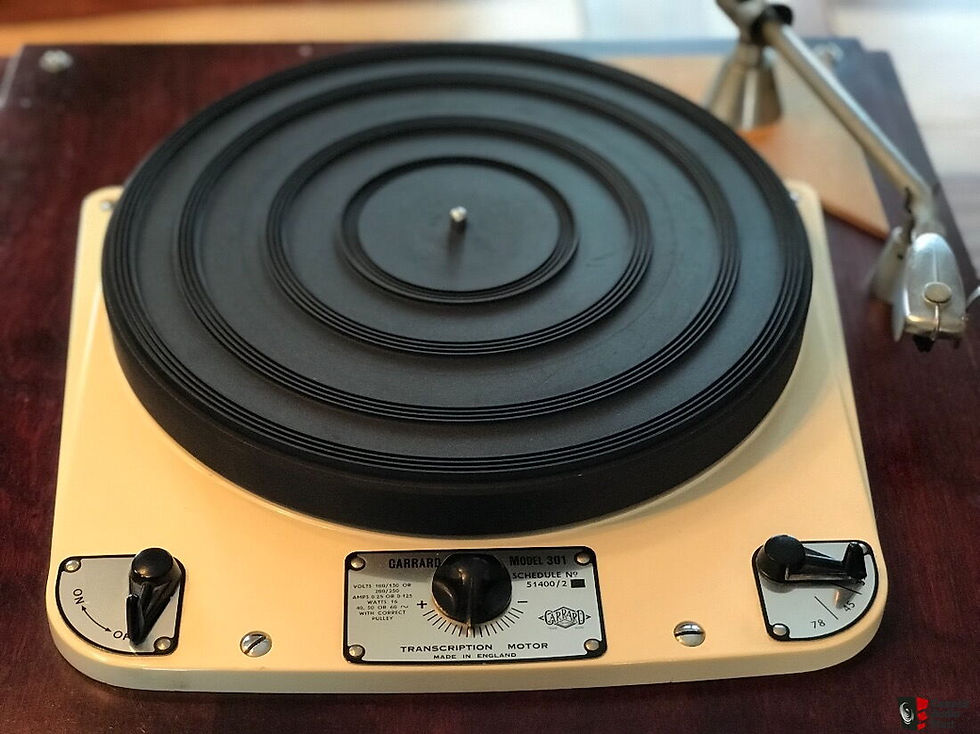
On a turntable, I look at the stylus and cantilever, since a bent cantilever is often visible in a decent close-up. I check whether the tonearm sits level and is secured on its rest, and whether a suspended deck's platter sits evenly or leans to one side. Plinth corners, dust-cover hinges and the cueing lever all get a glance.
Finally, I look past the machine. The background tells me where it has lived. A loft, garage or shed suggests temperature swings and damp, which are hard on rubber, lubricants and contacts. A tidy workbench with test equipment in view says something different, but is not necessarily reassuring. It may mean the deck has been worked on, and I will want to know by whom. An original box in the corner of the frame is good news, because it usually means safer shipping.

The phrases that make me nervous
None of these phrases condemns a machine on its own. What they do is tell me is where the seller's knowledge, or their testing, came to an end.
"Powers on." This tells me the transformer and the lamps work. It says nothing about the motors, the transport or the audio path. Often the seller writes it because that is genuinely as far as they could test, and I respect the honesty. I just price the machine accordingly.
"Untested" or "sold as seen." Frequently this is the most truthful line in the whole advert. It makes me nervous only when it sits beside a working-machine price, or beside a confident account of how well the deck performed. Those things cannot all be true at once.
"Worked when it went into storage." The gap between that moment and today might be a year or a few decades. Rubber, belts and grease age whether the machine is used or not. A deck that worked perfectly before it went into a cupboard may not be the same deck when it comes out.
"Just needs a belt." This is perhaps the most hopeful phrase in the second-hand trade. Sometimes it is true. But a belt is the first thing anyone suspects, and it is cheap. If the fix really were that simple, I wonder why the seller did not make it and ask a higher price.
"Recently serviced." Without knowing who did the work, what they did and when, this means very little. A service can be anything from a wipe-down to a full mechanical and electronic rebuild. It can also mean somebody with a screwdriver had a go. I will ask for details and any paperwork.
"Mint" and "immaculate." These words almost always describe the outside. The condition of a deck that matters most to me is inside, where photos cannot reach. I have also learned to be curious about a cosmetically perfect example of a machine that is usually worn, because it can mean careful ownership or it can mean replaced panels.
"Rare." Rarity and value are not the same thing, and for a restorer rarity can be a disadvantage. The rarer the machine, the harder it may be to find parts when something fails.
"Upgraded" or "modified." Neither is a bad sign in itself. Some modifications are thoughtful improvements. Others are irreversible and undo exactly what made the machine worth owning. I need specifics before I can judge.
"No timewasters, no returns." I understand the frustration behind this, since sellers deal with a lot of noise. But it tells me something about how any problem after the sale is likely to be handled.
As telling as any phrase is, so is what is not mentioned. An advert for a three-speed turntable that never mentions speeds, or a tape deck described in detail apart from its heads and playback, has a hole in exactly the place I care about most.
__________________________________________________________________________________________________
The questions I always ask
My questions do two jobs. They get me information, and they show me how the seller responds. A clear, specific answer, even one that admits a fault, reassures me far more than a quick "all fine, mate."
Could you send a few more photos? I name the exact areas I want to see: the head block, the pinch roller, the stylus, the underside, the rear panel. A seller who sends them promptly usually has nothing to hide.
How long have you owned it, and where has it been kept? Ownership history and storage conditions tell me more about the rubber and lubricants than any description can.
When did you last use it, and how did it sound? For a turntable, I ask whether both channels worked, whether every speed was correct and steady, and whether there was any rumble or hum. For a tape deck, I ask whether it played, recorded, fast-wound, rewound and stopped cleanly, and whether there was any squeal, hesitation or slow start.
Has it ever been worked on? If so, by whom, what was done, and is there any paperwork?
Are there any modifications or non-original parts? That includes the cartridge, headshell, belts, rollers and anything inside.
What comes with it? The manual, counterweight, headshell, dust cover, reels, hub adaptors and head-block cover all matter, and some are surprisingly hard to replace.
How will it be packed, or can I collect? In my experience, poor packing has damaged more good machines than dishonest sellers ever did. I want to know that transport screws will be fitted, the tonearm and platter secured or removed, and reels taken off a tape deck before it travels.
Would you mind sending a short video? A minute of a tape transport moving through its functions, or a platter running under a strobe, tells me more than a dozen still photos.
Could I see and hear it in person? This is not always possible, but when it is, nothing replaces it.
I do not expect a casual seller to answer everything. What I am listening for is willingness. Someone who says "I don't know, but I'll check" is usually someone I am happy to buy from.

Reading the seller fairly, and reading myself
It would be easy to come away from all this treating every advert as a puzzle with a trap hidden in it. That is not how I see it, and it is not fair to the people selling.
A great many of the machines I have been offered came from someone who did not own them in any meaningful sense. They were selling a parent's system, clearing a house, or passing on something that had sat unused for years. For those sellers, "untested" is the only honest word available, and penalising that honesty would be perverse. The right response is to price the uncertainty, not to resent it. An advert that openly lists faults (a dead channel, a sticky counter, a missing lid) is often the one I trust most, because it shows the seller has looked and is telling me what they found.
The harder part, I have found, is reading myself. The adverts that have cost me most were rarely the misleading ones. They were the ones for a machine I had wanted for a long time, where my own enthusiasm filled in everything the photos left out. A good story about where a deck came from can quietly override a poor photograph of its heads.
So, the habit I rely on now is simple. Before I make contact, I decide what I would pay for the machine assuming it does not work, and I hold to that number. Anything that turns out to work is a bonus rather than an expectation. It does not make me immune to temptation, but it gives me something firm to come back to when I notice I am talking myself into a purchase.
I would also suggest one more thing. No single phrase, photo or answer should decide the matter. What I am looking for is a pattern. A vague description, thin photos and evasive replies together tell a story. Any one of them alone usually does not.
__________________________________________________________________________________________________
Your turn
Everything above comes from one person's bench and one person's mistakes. Yours will be different, and I suspect many of you have learned things the hard way that I have not yet.
So, I would like to open this up. In the comments below, tell us who you are as a buyer or seller, first-time buyer, long-time collector, restorer, or someone who has mostly been on the selling side. Then share a story. It might be the phrase in an advert that saved you, or the one that caught you out. It might be the question you now never forget to ask, or a time a seller surprised you by being more honest than you expected.
If you sell machines, I would especially like to hear from you. Which buyer questions help, and which ones feel unreasonable? A good advert is a conversation between two people, and we have only heard from one side here.
One request. Please do not name individual sellers or link to live listings. The point is to learn from each other's experience, not to put anyone on trial.
I will be reading, and I will reply where I can.
_______________________________________________________________________________________
The author has no commercial relationships with any audio manufacturing or retail company . Views expressed are the author's own. Correspondence and disagreement are equally welcome.


Comments