
Matter Over Myth: Do Exotic Materials Make a Better Turntable, or Just a More Expensive One?

Analog Soundware Design Lab for audiophiles , collectors, audio designers and restorers

The Market We Live In
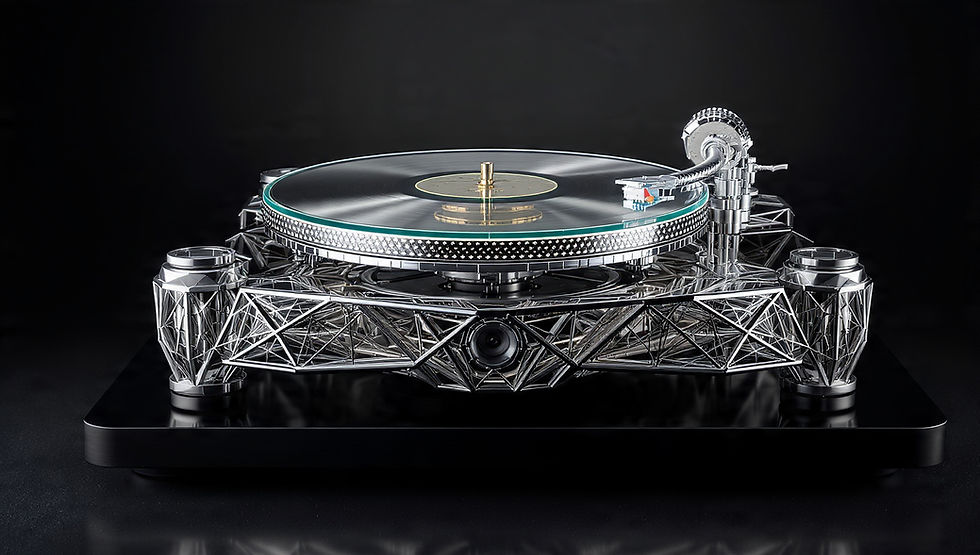
Walk the floors of any serious high-end audio show — Munich's High End, Tokyo's Inter BEE, or the quieter, more intimate rooms of the Rocky Mountain Audio Fest — and you will encounter turntables made from materials that would not look out of place in a materials science laboratory or an aerospace procurement catalogue. Plinths machined from aircraft-grade aluminium billet. Platters turned from acrylic, Delrin, or carbon fibre composite. Spindle bearings running in ceramic or synthetic ruby. Tonearm tubes fashioned from titanium, boron, or magnesium. Sub-chassis suspended on air bladders. Feet carved from polyoxymethylene or even granite. And prices — frequently north of ten, twenty, sometimes a hundred thousand pounds, euros or dollars — that demand a certain level of justification.
I have been writing about and listening to analogue equipment for the better part of three decades. I have had the privilege of spending extended time with some of the finest turntables ever made, and the humbling experience of being wrong about a few of them. What I want to explore here is not whether exotic materials are good or bad — that framing is too blunt — but whether the engineering rationale behind them is as rigorous as the marketing copy implies, and, crucially, whether equivalent or near-equivalent performance might be achievable through more traditional means. These are not rhetorical questions. They deserve careful thought.
_______________________________________________________________________________________
What Does "Ultimate Specification" Actually Mean?
Before we can ask whether any material helps or hinders the goal, we need to be honest about what that goal is — and about how elusive it remains.
The ideal turntable is, in essence, a precision device whose sole purpose is to rotate a disc at an absolutely constant speed, while holding the playback stylus in a geometrically perfect, mechanically isolated environment, free from any vibration not encoded in the groove itself. Every engineering decision — materials included — should serve those two objectives: rotational stability and isolation from contamination (mechanical noise, resonance, electromagnetic interference).
The honest answer, which most manufacturers know but few state plainly, is that the absolute ideal is unachievable. Speed constancy is never perfect. A bearing, however precisely engineered, has tolerance. A motor, however refined, has cogging torque, electrical noise, or both. A platter, however massive, has resonant modes. The groove itself is not geometrically perfect. The stylus tip is not a geometric point. We are always managing a hierarchy of compromises. The question then becomes: where does material choice sit in that hierarchy, and how much does it actually move the needle?
_______________________________________________________________________________________
The Traditional Foundation: What Classic Designs Proved
It is worth pausing to acknowledge what was achieved with thoroughly conventional materials before we reach for the periodic table.
The EMT 930, a broadcast-specification direct-drive turntable introduced in 1960 and used extensively in European radio stations for decades, was built from steel, aluminium, and cast iron. Its platter was heavy, its motor a hysteresis-synchronous type, its tonearm a relatively conventional pivoted design. Its speed stability and low-noise floor were extraordinary by any era's standard, and many professional and audiophile users today still prefer its measured and audible performance to machines costing ten times as much. Similarly, the Technics SP-10 Mk II and Mk III — direct-drive machines machined primarily from aluminium and equipped with quartz-locked motors — set speed accuracy benchmarks in the late 1970s and early 1980s that remain genuinely difficult to surpass.
On the belt-drive side, the Linn LP12 — in continuous production since 1972 and constructed around a pressed-steel subchassis, an MDF plinth, and an AC synchronous motor — has been the reference point for a generation of listeners. Its virtues are real and audible. Its materials are, by modern exotic standards, almost laughably prosaic. Linn has, over the decades, updated it with improved bearings, motor controllers, and subchassis geometry, but the core principle and materials palette have remained largely conservative.
What these machines demonstrate is that the physics of the problem can be addressed, to a very high level, with traditional materials applied with exceptional precision and care. The limiting factors were never really the periodic table. They were machining tolerances, bearing geometry, motor control electronics, and — most critically — the quality of engineering thinking applied to the problem.
_______________________________________________________________________________________

Do Exotic Materials Make a Better Turntable - Where Exotic Materials Enter, and Why
So why, then, the turn toward exotic materials in the past thirty years? The answer is partly genuine engineering ambition and partly a market dynamic that rewards the perceptible and the tangible over the merely measurable.
Let me take each material class in turn, and try to be as fair as possible to the engineering case for each.
Ceramic and Silicon Carbide Bearings. The theoretical case is real. Ceramic balls in a spindle bearing offer lower friction coefficients than steel under many conditions, greater hardness (meaning less microscopic deformation under load), and — because ceramics are non-conductive — the elimination of eddy current effects. The Clearaudio Statement and the AMG Viella both use refined bearing systems with these properties in mind. But the manufacturing tolerances required to realise these benefits are extreme. A ceramic bearing running in a poorly matched housing may perform worse than a precision-lapped steel bearing in a well-dimensioned one. The material is not sufficient; the system matters.
Carbon Fibre Tonearm Tubes. The argument here rests on stiffness-to-mass ratio and internal damping characteristics. A carbon fibre tube can be both lighter and stiffer than an aluminium one of equivalent geometry, which in principle allows a lower effective mass while maintaining rigidity — desirable for compatibility with a wide range of cartridges. The SME Series V's armtube, the Clearaudio Simplicity, and the Graham Phantom all use carbon fibre variants to exploit this. The limitation is subtler: the damping properties of carbon fibre are highly directional and frequency-dependent, and a poorly designed laminate can introduce resonant signatures of its own — different from, but not necessarily more benign than, those of a well-damped aluminium tube. Again, the material creates possibility; only the engineering converts that into performance.
Acrylic and Delrin Platters. These materials were first seriously promoted by manufacturers such as Clearaudio and VPI on the basis that their acoustic impedance is closer to that of vinyl than metal, potentially reducing the reflected energy at the platter-disc interface. This is a plausible mechanical argument. The practical evidence is more mixed. A great many listeners and reviewers have found differences between acrylic and metal platters to be system- and cartridge-dependent, and not always in the direction theory predicts. Acrylic also has resonant characteristics of its own. The Basis Debut Vacuum, which uses acrylic extensively, is a fine machine — but its excellence derives from the totality of its engineering, not from any single material choice.
Magnetic and Air Bearing Systems. Here we encounter perhaps the most genuinely exotic engineering in contemporary turntable design. Air-bearing platters — as used in the Rockport Sirius III and the Continuum Caliburn — replace the conventional spindle bearing with a pressurised air film, theoretically eliminating metal-to-metal contact and its associated noise floor. The engineering case is strong, the results measurable, and the best implementations are genuinely revelatory. The limitations are also real: these systems require a continuous air supply (a compressor, with its own vibration and noise management requirements), are sensitive to dust and particulate contamination, and impose significant maintenance demands. Their cost is enormous, and that cost is not purely marketing: the machining tolerances required to make air bearings work are among the most demanding in consumer product manufacturing.

The Manufacturing Economics
This brings me to a dimension of the conversation that audiophile writing often skirts: the economics of production.
Do exotic materials make a better turntable? Exotic materials are, in many cases, genuinely more expensive to source and more difficult to machine. Silicon carbide is hard — which is part of its value — and that hardness makes it demanding and slow to work with precision. Carbon fibre layup is a labour-intensive process requiring skilled hands and controlled environments. Tight-tolerance aluminium billet work on five-axis CNC machinery is expensive. These cost realities are not invented.
But manufacturing economics also work in a less flattering direction. In a market where unit volumes are tiny — a boutique turntable manufacturer may produce dozens of units per year, not thousands — the cost of any component is dominated by setup, tooling, and labour rather than materials. The marginal cost of upgrading from standard stainless steel to a silicon carbide bearing may, in this context, be relatively modest. Yet its marketing value — its story value — is significant. Exotic materials photograph beautifully, communicate precision, and justify price points in a market where the buyer has no independent means of verifying the engineering rationale.
I do not raise this cynically. I raise it because it is a structural feature of the market that both manufacturers and buyers should acknowledge honestly. The best manufacturers — SME, Brinkmann, TechDAS — use exotic materials where they can make a clear engineering case, and conventional ones where they cannot. The pricing of their machines reflects manufacturing reality and genuine R&D investment. Others are less disciplined.

Could the Highest Specification Be Achieved Without Exotica?
My honest answer is: largely, yes — with caveats.
The Technics SL-1000R, reintroduced in 2018 as the flagship of Technics' professional direct-drive line, is constructed predominantly from aluminium, with a coreless direct-drive motor and a precision-lapped spindle bearing. Its speed accuracy measurements are exceptional by any standard — sub-0.001% wow and flutter in independent testing. Its materials are sophisticated, but not exotic in the sense of rare or esoteric. Its performance is the product of engineering rigour, motor control algorithm sophistication, and manufacturing precision.
Similarly, the Simon Yorke Designs S7 and S10 — machined with extraordinary care from conventional metals — demonstrate that a single-minded engineering focus, applied to traditional materials, can produce a turntable whose performance competes with machines using more theatrical material choices.
What traditional materials cannot easily deliver is the ultimate in bearing noise floor — the sub-threshold rumble of a perfectly implemented air bearing — or, perhaps, the lowest achievable effective mass in a tonearm without some resort to carbon or boron fibre construction. These are real, if incremental, advantages.

A Final Thought
The question I find most useful to ask when evaluating any exotic material claim is not "is this material better?" but "does this design extract the theoretical benefit of this material, and is that benefit audible and significant in this system?" Those are harder questions than reading a specification sheet, but they are the right ones.
The great turntables of the past — the EMT 930, the Garrard 301, the early Linn, the SP-10 — were great not because of their materials but because the people who designed them thought with extraordinary clarity about what a turntable is actually supposed to do. That clarity of thought is still the rarest and most valuable material in this industry, and no amount of carbon fibre or ceramic quite substitutes for it.
Exotic materials, used with engineering discipline and intellectual honesty, can push performance into genuinely new territory. Used as decoration, or as a substitute for clear thinking, they are expensive wallpaper. Learning to tell the difference is, I would argue, one of the more rewarding exercises available to the serious listener.
_______________________________________________________________________________________
The author has no commercial relationships with any manufacturer mentioned in this article.


Comments