
The Imperfect Ascent: Moving Beyond the Entry-Level Turntable

The path from a first deck to a serious analogue system is paved with good intentions, compromised decisions, and the occasional transcendent moment. That's rather the point.
Analog Soundware Business Lab for audiophiles , collectors, audio designers and restorers
The Market Reality Nobody Quite Admits
The entry-level turntable market has never been healthier — which is, depending on your perspective, either an encouraging sign of vinyl's resilience or a slightly troubling indicator of how many people have been quietly convinced that a £300 belt-drive deck, a manufacturer-supplied cartridge of uncertain provenance, and a built-in phono stage represent a genuine encounter with high-fidelity audio.
They don't, of course. But that isn't quite the point. Those decks — your Rega Planars, your Pro-Ject Debut Carbons, your Audio-Technica LP120s — have done something genuinely useful: they have kept the mechanical ritual of playing records alive, introduced a generation to the idea that format matters, and, eventually, made a proportion of their owners curious enough to ask a harder question. What, exactly, am I missing?
This article is addressed to that person. Not the vinyl fundamentalist who already owns a Garrard 301 and bridles at the suggestion that digital has merit, and not the casual listener perfectly satisfied with their Bluetooth turntable. This is for the person who has lived with their entry-level deck for a year or three, who has started to notice — subtly, then less subtly — that something in the upper registers sounds a little threadbare, that the soundstage collapses on complex orchestral passages, that the bass, while present, lacks the kind of authority that makes you feel a double bass in the room rather than merely hear it reproduced. That person is standing at a genuinely interesting threshold, and the choices ahead of them are neither obvious nor cheap.
_______________________________________________________________________________________
The Holy Grail Problem
Before considering any specific upgrade path beyond the entry-level turntable, it is worth confronting an uncomfortable truth that the high-end audio industry has a commercial incentive to obscure: the perfect turntable — the one that extracts every last particle of information from the groove without adding or subtracting anything — does not exist, and likely cannot.
The physics of analogue playback are, at root, adversarial. A cantilever-mounted stylus is being dragged through a modulated groove at a contact pressure measured in tonnes per square centimetre, generating a signal in the microvolt range, while the whole assembly sits on a spinning platter subject to minute variations in speed, vibration from the environment, acoustic feedback from the loudspeakers, and the thermal and mechanical properties of the vinyl itself. Every design decision — the mass of the platter, the bearing tolerance, the arm geometry, the cartridge compliance — involves a trade-off. Reduce one distortion mechanism and you often amplify another.
This is not counsel for despair. It is, rather, an argument for intellectual honesty when evaluating the marketing language that surrounds serious analogue equipment. "Vanishingly low wow and flutter" means something, but it does not mean none. "Neutral tonearm" is a category error — all tonearms have a mechanical signature. The audiophile who understands this is better placed to make rational purchasing decisions than one chasing a specification that the laws of physics won't permit.
What you are actually doing, at every price point above the entry level, is exchanging one set of compromises for a different — ideally more benign — set of compromises. That reframing changes the conversation considerably.
_______________________________________________________________________________________
Total Replacement Versus Incremental Upgrade Beyond the Entry-Level Turntable
The first fork in the road is philosophical. Do you improve what you have, or do you replace it entirely?
For decks at the very bottom of the market, the answer is usually replacement. A turntable in the £200–£350 bracket typically has a bearing, platter, and motor that are already performing near the ceiling of their capability. Spending £200 on a superior cartridge — a Nagaoka MP-200, say, or an Ortofon 2M Blue — will yield real improvements in resolution and tracking, but you will also be revealing the limitations of the arm and the plinth more acutely. There is a well-worn audiophile joke about polishing an increasingly shiny stone: the metaphor is apt.
The calculus changes meaningfully, however, if your entry-level deck happens to be a Rega Planar 1 or 2. Rega's engineering philosophy, applied consistently across their range, means that the upgrade path within their own ecosystem is genuinely coherent. The RB110 arm on a Planar 1 shares design DNA with the RB330 and RB880 found on far more expensive decks; the platter and bearing can be meaningfully improved with Rega's own upgrade kits. This is not marketing fiction — it reflects a real commitment to modularity that most manufacturers at this price do not share.
By contrast, the Technics SL-1200 series — the MK2 in its original form, and the more recent SL-1200GR and G — represents a different kind of upgrade logic. The direct-drive mechanism is effectively mature, and the arm, while competent, is a known quantity. The serious SL-1200 devotee typically replaces the arm entirely — a KAB-modded example, or a full third-party fit of something like a Jelco (now sadly discontinued, though used examples remain findable), an SME Series IV, or an Ortofon RS-309D — and treats the chassis and motor assembly as a stable foundation for experimentation. This is entirely reasonable, and reflects the fact that the 1200's plinth and motor are genuinely excellent things that do not need to be discarded.

The Middle Kingdom: £800 to £3,000
Assuming you decide the time has come for a new deck rather than piecemeal improvement, the range between roughly £800 and £3,000 is where the market becomes genuinely interesting — and where manufacturing economics begin to tell a story worth understanding.
At this level you encounter decks such as the Michell Gyrodec, the Nottingham Analogue Interspace, the Clearaudio Concept, and (in the upper reaches) the Linn LP12 in its more accessible configurations. Each of these represents a distinct engineering philosophy.
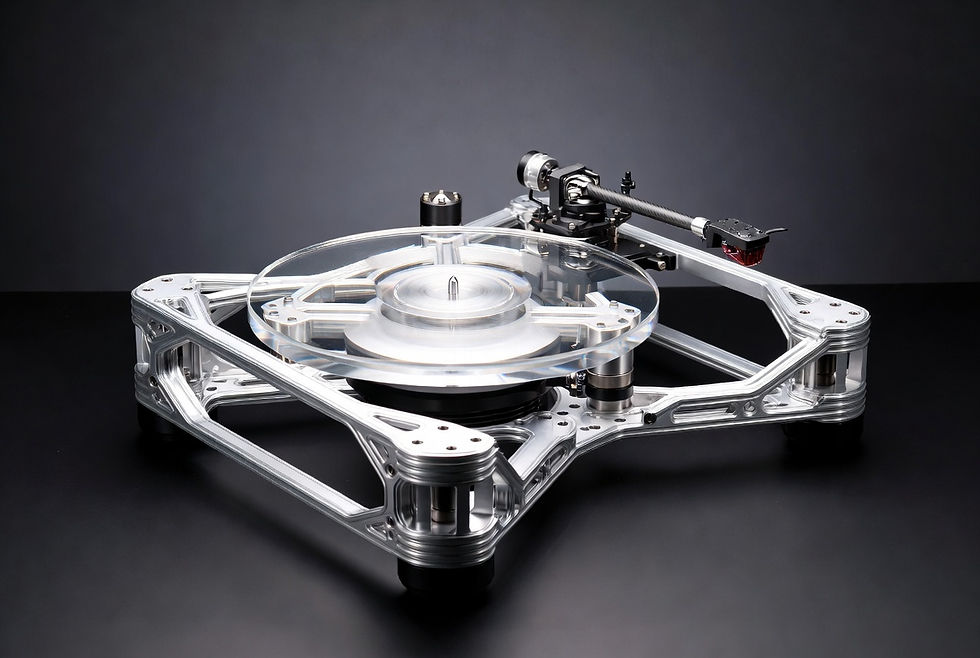
The Gyrodec — designed by John Michell in the 1970s and still manufactured by the company in Willesden, north London — is a subchassis deck with an inverted bearing and a skeletal acrylic plinth whose open construction is intended to avoid resonance accumulation rather than damp it. It is also, unambiguously, a beautiful object. Michell still manufactures the Gyrodec by hand in relatively small numbers, which explains why its price has moved considerably over the decades but also why it retains genuine residual value. When a manufacturer produces perhaps a few hundred units annually, the economics of scale do not apply; what you are paying for is genuine craft, carefully sourced components, and an engineering lineage that has been iteratively refined rather than redesigned by committee.
The Linn LP12 is an even more instructive case. Introduced in 1972 and never discontinued, the LP12 is perhaps the most famous argument for the "source first" philosophy — the belief that the turntable is the most critical component in the analogue chain and should receive the largest share of budget. Linn have never been shy about making that case, and they have been willing to sell upgrades — the Cirkus bearing, the Radikal motor controller, the Ekos tonearm, the Klimax subchassis — at prices that provoke both admiration and incredulity. The result is a turntable that can be purchased for around £2,000 in basic form and developed, over years, into a machine costing £20,000 or more. Whether that trajectory represents the most rational use of an audio budget is legitimately debatable. What is not debatable is that the engineering at the top of the LP12 range is genuinely excellent, and that the upgrade path is among the most clearly defined in the analogue world.
Nottingham Analogue, smaller and less celebrated internationally, is worth particular mention for those who value quietness of presentation. The company's decks — heavy, non-suspended, built around an outboard motor and a proprietary arm — have a distinctive sonic character: unhurried, with a particularly low noise floor. They are not widely stocked, which makes auditioning difficult, but for listeners who have found that more animated-sounding decks fatigue them over long sessions, an Interspace or a Space Deck is worth seeking out.

The Complete System: Where Turntable Decisions Ripple Outward
A critical error that even experienced enthusiasts make is evaluating a turntable in isolation from the system it will inhabit. The phono stage, preamplifier, amplifier, and loudspeakers are not passive recipients of whatever the turntable delivers; they are active participants in the character of the sound, and a mismatch at any point in the chain can neutralise — or, equally, amplify — the qualities you are seeking.
Consider the cartridge-to-phono-stage relationship. A moving-coil cartridge — a Shelter 501 III, a Benz Micro Wood SL, a Koetsu Black, or the extraordinary and more affordable Hana SL — requires a phono stage with sufficient gain (typically 60–70dB) and an appropriate input impedance, usually between 100 and 500 ohms depending on the specific cartridge. Pairing a low-output MC cartridge with a phono stage designed primarily for moving-magnet operation is not catastrophic, but it is suboptimal, and no amount of spending elsewhere in the chain will fully recover the ground lost at that first stage of amplification.
The amplifier matters too, though perhaps not in the ways most often discussed. A valve preamplifier — a Line Magnetic, a Shindo, an Audio Note — will present a different interface with loudspeakers than a solid-state design, and the question of whether its particular character complements or conflicts with your analogue front end is something that only listening can resolve. Systems built around Shindo components and vintage horn loudspeakers, for instance, have a consistency of character — a kind of organic warmth and immediacy — that is not easily achieved by assembling components from different design philosophies and hoping they add up.
For a practical illustration: a listener upgrading from a Rega Planar 2 to a Michell Gyrodec with an Ortofon Cadenza Bronze cartridge, feeding a Leema Pulse III phono stage and a PrimaLuna EVO 100 integrated amplifier, driving Harbeth P3ESR loudspeakers, has assembled a system with genuine internal coherence. The total investment might approach £8,000 to £10,000 including cables — a number that deserves to be stated clearly rather than buried. That is real money, and the expectation of commensurate improvement over a £400 system is reasonable but should not be held without humility.
_______________________________________________________________________________________
Manufacturing Economics and the Question of Value
The high-end audio industry is small, which creates economic pressures that are not always legible to consumers. A company producing 500 tonearms annually cannot achieve the manufacturing efficiencies that a mass-market electronics firm takes for granted. The SME Model 309 arm — made in Steyning, West Sussex, from billet aluminium on CNC machinery, assembled by hand — costs what it costs partly because of the materials and engineering, and partly because 500 units must each absorb a proportional share of factory overheads, engineering salaries, and the time cost of doing things carefully. This is not an excuse for unreasonable pricing; it is an explanation for why a product that might look simple is not.
The obverse of this is that some premium pricing in audio is indeed unreasonable — the product of brand mythology, boutique marketing, and the peculiar willingness of affluent enthusiasts to equate price with quality without sufficient critical interrogation. The Rega RP6 and the Clearaudio Concept perform remarkably similarly at their respective price points; which you prefer is a question of character and compatibility, not a question of one being obviously better than the other. Learning to ask "better at what, and better by how much?" is among the most useful intellectual habits an audio enthusiast can develop.
_______________________________________________________________________________________
The Approach Worth Considering
None of this points to a single correct upgrade path, because none exists. What it points toward is a methodology: listen before you buy, preferably in your own system; consider the chain as a whole rather than any single component; understand what you are actually dissatisfied with in your current setup before spending money to change it; and resist the seduction of the specification sheet when your ears are trying to tell you something more useful.
The holy grail of the perfect turntable remains permanently out of reach. But the journey toward it — undertaken thoughtfully, without excessive haste, and with genuine curiosity about what each iteration of the system reveals — is, for those susceptible to this particular form of obsession, one of the more rewarding things a person can do with an afternoon and a record they know well.
The groove does not lie. It only asks that you give it a fair hearing.
_______________________________________________________________________________________
The author has no commercial relationship with any manufacturer mentioned in this article.


Comments